.jpg)
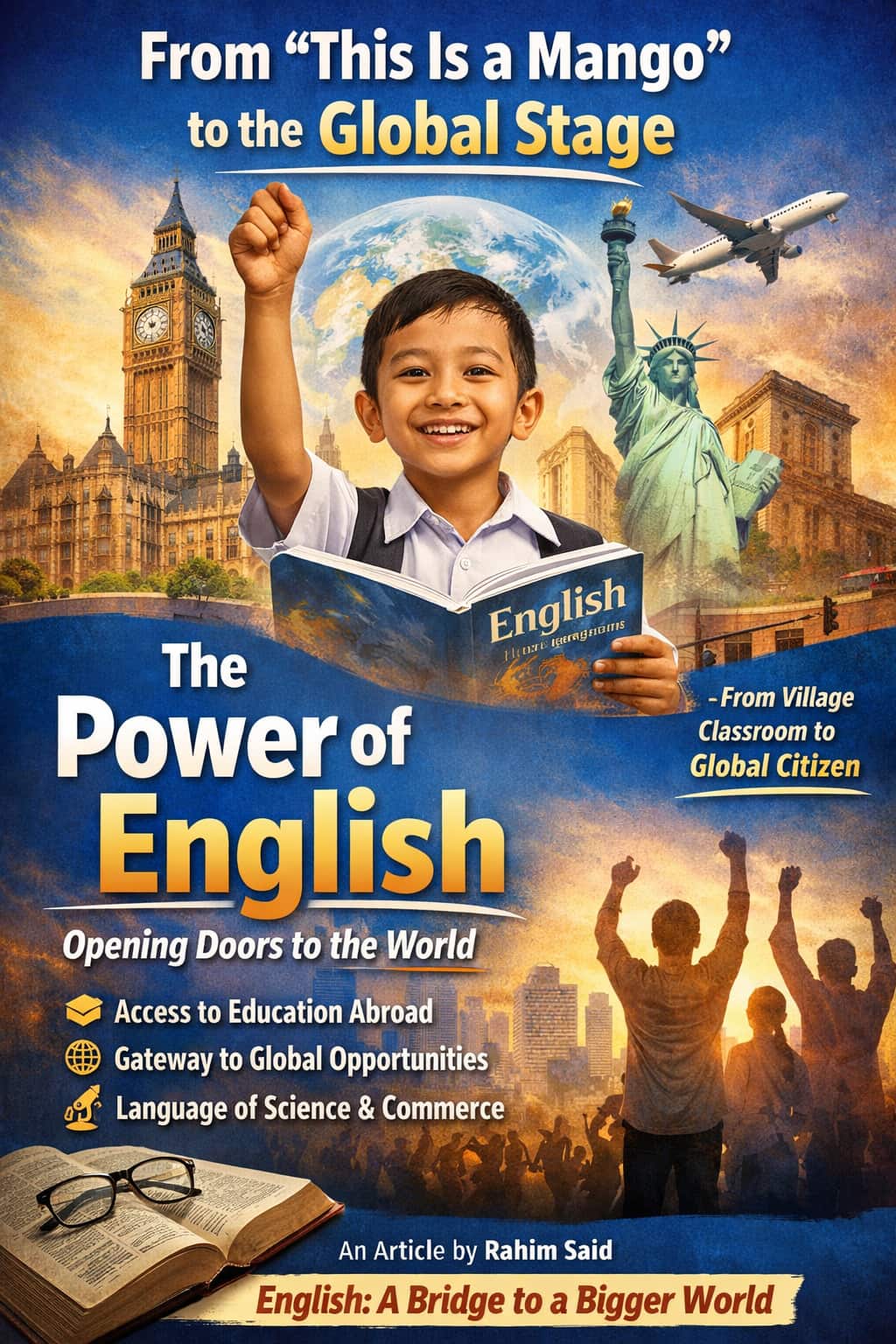
From “This Is a Mango” to the Global Stage
By Mihar Dias May 2026
There was a time in Malaysian classrooms when English arrived not with fanfare, but with quiet practicality. In my own case, it came in the form of a “Special Malay Class” in Standard Four — a curious little educational bridge where Malay-medium students were suddenly nudged, sometimes shoved, into the world of English in preparation for secondary school and eventually university.
We stumbled through “This is a book,” “That is a mango,” and the eternal mystery of why “knife” begins with a silent “k.” Yet somewhere between chalk dust, dog-eared dictionaries and terrified oral exams, a generation of Malaysians accidentally acquired something invaluable: access.
Access to universities abroad. Access to science journals. Access to commerce. Access to the wider world beyond our villages, estates, kampungs and new villages.
So when Indonesia announces that English will become compulsory from Primary Three beginning 2027, one cannot help but smile knowingly. https://jakartaglobe.id/news/indonesia-to-make-english-mandatory-from-third-grade-starting-in-2027
This is not cultural surrender. It is strategic realism.
And frankly, it is refreshing.
For decades, parts of Southeast Asia have treated English like a suspicious foreign relative — useful when applying for jobs but dangerous if allowed to stay overnight. Politicians often behave as though children learning English will immediately abandon nasi goreng, forget their mother tongue and start demanding fish and chips for breakfast.
Reality, of course, says otherwise.
The Dutch speak excellent English and remain unmistakably Dutch. Singaporeans speak English while arguing passionately over the correct laksa. Indians move fluidly between multiple languages without collapsing into existential confusion. Malaysians themselves are living proof that multilingualism does not erase identity — it enriches it.
If anything, Malaysia’s own history demonstrates that English proficiency helped build a more connected society. Our classrooms once mixed children from different ethnic and social backgrounds through a shared linguistic platform. English became less a colonial relic and more a practical operating system for a diverse nation.
The irony today is that many parents who loudly denounce English-medium education privately spend fortunes on tuition centres, imported phonics programmes and YouTube channels featuring animated British rabbits teaching grammar.
The market already decided long ago.
Indonesia’s move simply acknowledges what modern economics has been whispering for years and what artificial intelligence is now shouting through a megaphone: English remains the world’s transactional language. Technology manuals, coding communities, academic research, aviation, diplomacy, medicine, global finance and even online freelancing continue to operate heavily in English.
A child in Lombok who masters English may someday build software for a company in Berlin without leaving home. A student in Makassar could publish research read in Toronto. An entrepreneur in Surabaya may negotiate directly with partners in Dubai. https://jakartaglobe.id/news/indonesia-to-make-english-mandatory-from-third-grade-starting-in-2027
That possibility matters.
More importantly, Indonesia appears to understand something crucial: timing. Waiting until secondary school to introduce English is like teaching someone swimming after throwing them into the ocean. Younger children absorb languages with astonishing ease. By adolescence, embarrassment arrives, confidence disappears and classrooms become graveyards of broken pronunciation.
One remembers entire Malaysian generations traumatised by the word “vegetable.”
Of course, implementation will be everything. Declaring policies is easy; training competent teachers across an archipelago of more than 17,000 islands is another matter entirely. But at least Jakarta seems willing to confront the challenge instead of drowning itself in ideological theatrics.
And perhaps there is another lesson here for the region.
Language should never be treated as a zero-sum political weapon. A child learning English is not betraying Bahasa Indonesia, Bahasa Melayu, Javanese, Tamil, Mandarin or any other mother tongue. Human beings are perfectly capable of carrying multiple linguistic identities simultaneously. In Southeast Asia, we practically specialise in it.
My old Special Malay Class did not make us less Malaysian. If anything, it prepared many ordinary boys and girls from modest backgrounds to participate in a much larger world while remaining deeply rooted at home.
Sometimes nation-building begins not with grand speeches or expensive slogans, but with a nervous ten-year-old trying to pronounce “thought,” “through,” and “though” without collapsing into despair.
Indonesia may be about to discover that too.
Mihar Dias (mihardias@gmail.com) is a content creator under the Newswav Creator programme, where you get to express yourself, be a citizen journalist, and at the same time monetize your content & reach millions of users on Newswav. Log in to creator.newswav.com and become a Newswav Creator now!
The User Content (as defined on Newswav Terms of Use) above including the views expressed and media (pictures, videos, citations etc) were submitted & posted by the author. Newswav is solely an aggregation platform that hosts the User Content. If you have any questions about the content, copyright or other issues of the work, please contact creator@newswav.com.