
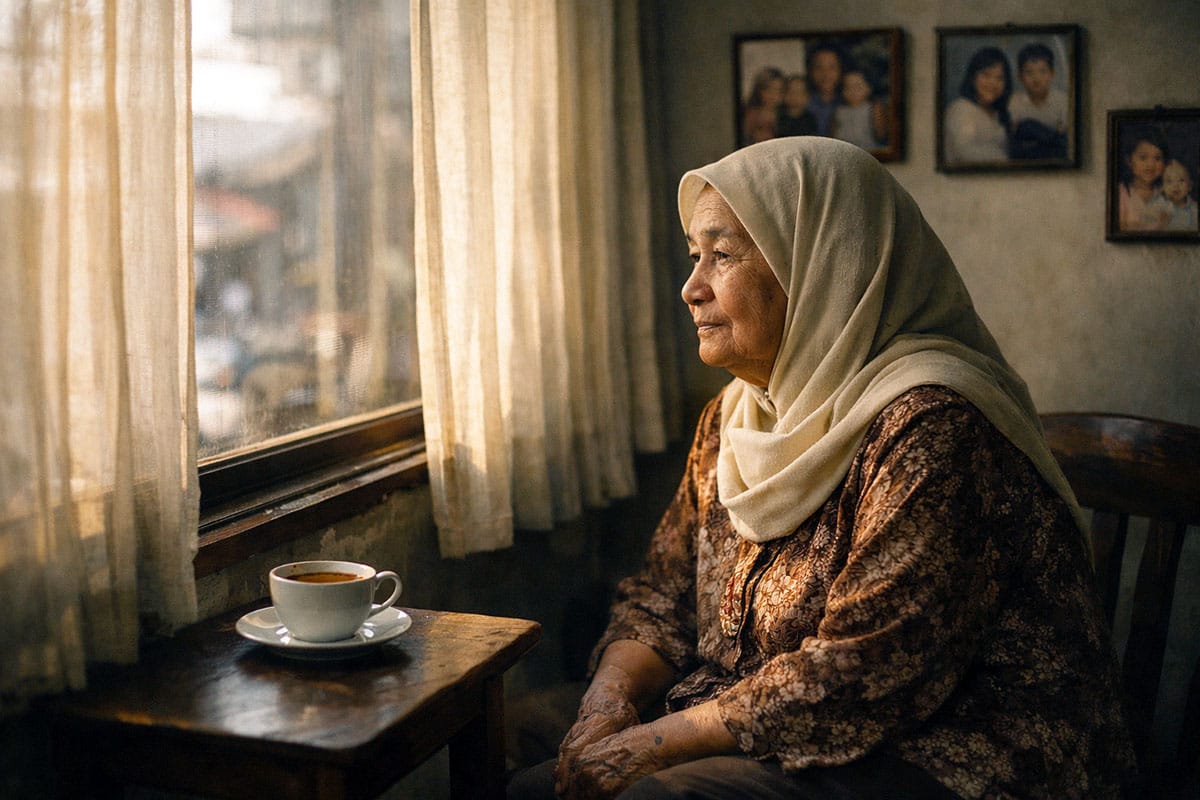
Nearly half of Malaysia's elderly are at risk of social isolation. And most families don't know yet.
My mother lives with me.
That sentence feels ordinary when I say it. Normal, even. She is here, in the same home, part of the daily rhythm of our household. She has breakfast with us. She hears my boys argue about whose turn it is on the Nintendo Switch. She is present for the small, unremarkable moments that make up a life.
But the more I read about what is happening to elderly Malaysians who are not so fortunate, the more I realise that what I consider ordinary is becoming increasingly rare. And the consequences of that shift are more serious than most of us are prepared to acknowledge.
Malaysia is ageing. Fast. Faster than most people realise. And the social infrastructure that should be catching our elderly as they age is quietly failing to keep up.
How Fast Are We Actually Ageing?
Malaysia officially became an ageing society in 2021, when 7% of the population was aged 65 and above, crossing the United Nations' first threshold for an ageing nation. By 2030, nearly 15% of Malaysians will be aged 60 and above, according to the Department of Statistics Malaysia. That is one in six Malaysians. Among ASEAN nations, Malaysia already has the fourth highest percentage of people aged 65 and above at 7.74%, behind Thailand, Singapore and Vietnam.
But the raw demographic numbers are not the most alarming part of this story. What keeps researchers and policymakers up at night is the speed of the change and what is happening socially alongside it.
Malaysia is ageing approximately 1.5 times faster than Japan, a country that has been grappling with its own elderly loneliness crisis for decades. Japan has the infrastructure, the policy frameworks, the cultural memory of dealing with an ageing population. We are arriving at a similar place far more rapidly, with far less preparation.
The Numbers Behind the Quiet Crisis
Here is the data that should be making national headlines but has somehow remained largely a background story.
Poor social support among older Malaysians increased from 30.8% in 2018 to 33.1% in 2025, according to the National Health and Morbidity Survey 2025. That is not a small statistical fluctuation. That is a consistent, worsening trend measured across seven years, showing that a growing proportion of our elderly are increasingly unsupported.
Research published in the Makara Journal of Health Research found that among a sample of older Malaysians, 32.6% experienced social loneliness, 39.9% experienced emotional loneliness, and 9.2% experienced family loneliness. A separate study found that nearly 50% of older Malaysians are at risk of social isolation.
And then there are the cases that rarely make the news but happen with disturbing regularity. The Vibes reported in April 2026 on a pattern that social workers and community volunteers know all too well: elderly Malaysians found deceased in their homes, discovered only days or weeks after death, sometimes only when neighbours detected an unusual smell. Not rare isolated incidents. A pattern.
These are people who lived and died alone, in a country where family is supposed to be everything.
Why Is This Happening?
The answer is not simple and it is not comfortable for any of us.
Malaysia's traditional family structure assumed that elderly parents would be cared for within the household by adult children. That assumption held reasonably well for generations. It is under enormous strain now.
Urbanisation has moved young working adults away from their hometowns. A family that once lived within walking distance of grandparents now lives a two-hour drive away, or in a different state entirely. The cost of living in urban centres makes large multi-generational households logistically and financially challenging. Both parents in a household often need to work full time. Space is limited. Time is limited.
The Women, Family and Community Development Ministry acknowledged the gap directly: "Without stronger social infrastructure, we risk a 'loneliness epidemic' that could strain families, hospitals and the economy." There are currently only 465 registered care centres nationwide, 376 privately managed and the rest by NGOs, for a rapidly growing elderly population. The Senior Citizens Activity Centres, known as PAWEs, number just 217 nationwide as of December 2025.
The maths does not work. The infrastructure is not there. And the cultural expectation that families will simply absorb the care burden, without support, without resources, without policy backing, is increasingly unrealistic.
What Loneliness Does to the Body
This is not just an emotional or social issue. It is a public health crisis.
Research consistently shows that chronic loneliness is associated with higher rates of depression, cognitive decline, cardiovascular disease, and premature death. The health risk of prolonged social isolation is comparable to smoking 15 cigarettes a day, according to international studies. An elderly person who has no regular social contact, who does not speak to another human being for days at a time, is not just lonely. They are at measurably higher risk of serious illness and early death.
When these elderly individuals deteriorate in isolation and eventually require emergency medical intervention, the cost falls on an already overburdened public healthcare system. The loneliness epidemic is not just a social problem. It is a fiscal one.
What Can Actually Be Done
The government has a role to play here, and it is not playing it adequately yet. More PAWEs, better funding for community care programmes, tax incentives for families who care for elderly relatives at home, and stronger regulation and subsidisation of care centres are all overdue policy conversations.
But waiting for the government is a strategy that will leave a lot of elderly Malaysians waiting a very long time.
At the community level, the simplest interventions are also among the most effective. Knowing your elderly neighbours. Checking in on them. Noticing when you have not seen them for a few days. These are not complicated or expensive. They are the kind of neighbourliness that previous generations of Malaysians practised instinctively and that modern urban life has quietly eroded.
For families, the conversation about ageing parents needs to happen earlier and more honestly than most Malaysian families currently manage. Not when a parent has already fallen ill, not when a crisis forces the issue, but now, while there is still time to plan, to make decisions, and to make arrangements that actually serve everyone's dignity and wellbeing.
My Honest Take
My mother lives with me. She is not alone. She is not isolated. She is part of our daily life and our boys are growing up with a grandmother present in the house, which I think is a gift to all of them in ways that will only become fully apparent over time.
I made that choice deliberately, not because I had no other options, but because I believe it is the right thing to do. She cared for me. Now I care for her. That is how it should work.
But I am also aware that not every family has the space, the capacity, or the circumstances to make that same choice. I do not judge those who cannot. What I do believe is that we need to stop treating elderly care as a purely private family matter and start treating it as the societal responsibility it actually is.
Malaysia is ageing. The loneliness is already here. The epidemic the ministry warned about is not a future possibility. For hundreds of thousands of elderly Malaysians living alone right now, it is already the present reality.
The question is whether we will act before the crisis becomes too large to manage, or whether we will wait until the scale of it forces our hand.
Call your parents. Visit your grandparents. Check on the elderly neighbour you have not seen in a while.
It costs nothing. And to the person on the receiving end, it means everything.
Kamarul Azwan (k.azwan@gmail.com) is a content creator under the Newswav Creator programme, where you get to express yourself, be a citizen journalist, and at the same time monetize your content & reach millions of users on Newswav. Log in to creator.newswav.com and become a Newswav Creator now!
The User Content (as defined on Newswav Terms of Use) above including the views expressed and media (pictures, videos, citations etc) were submitted & posted by the author. Newswav is solely an aggregation platform that hosts the User Content. If you have any questions about the content, copyright or other issues of the work, please contact creator@newswav.com.