NASA’s experimental X-59 aircraft is approaching one of the most significant moments of its development as it prepares for its first flights above the speed of sound. According to NASA, the quiet supersonic research jet is entering a new phase of testing that will push it beyond previous limits and move it closer to demonstrating a future where commercial aircraft can travel faster than sound without producing the disruptive sonic booms that have restricted supersonic operations over land for decades.
A Critical Step Toward Quiet Supersonic Travel
The upcoming test campaign represents far more than a simple speed milestone. The X-59 was specifically designed under NASA’s Quesst Mission to address one of aviation’s longest-standing challenges: reducing the impact of sonic booms. For decades, the thunderous shockwaves generated by supersonic aircraft have prevented routine overland supersonic travel in many regions. NASA hopes the X-59 can help change that reality.
The aircraft is expected to exceed 630 mph during upcoming flights at approximately 43,000 feet, officially entering the supersonic regime for the first time. Shortly afterward, the jet will attempt a mission-conditions flight at Mach 1.4, roughly 925 mph, at an altitude of around 55,000 feet. These operating conditions are not arbitrary targets. They represent the exact flight environment NASA ultimately intends to use when flying over U.S. communities to gather public feedback on the aircraft’s unique low-boom acoustic signature.
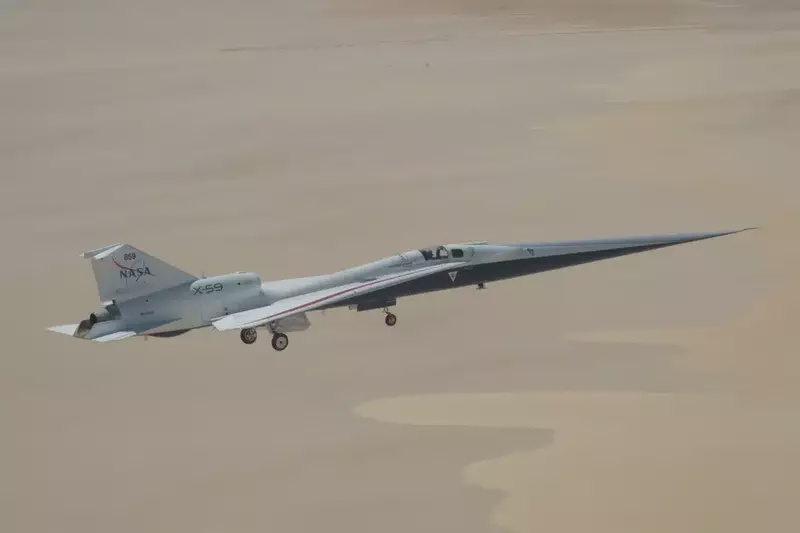
“What comes next is the first time this one-of-a-kind aircraft will fly supersonic,” said Cathy Bahm, project manager for NASA’s Low Boom Flight Demonstrator. “We are starting toward the mission conditions test point that X-59 was designed for.”
Unlike traditional supersonic aircraft, the X-59 features a highly elongated nose and carefully engineered airframe intended to reshape shock waves before they reach the ground. Rather than producing a loud boom, NASA expects the aircraft to generate a much softer sonic “thump,” potentially opening the door for future commercial aircraft capable of crossing continents significantly faster than today’s airliners.
How Fifteen Flights Built Confidence In The Aircraft
Before reaching this point, the X-59 team completed an extensive series of developmental flights that steadily expanded the aircraft’s operational envelope. Following its maiden flight in October 2025 and a scheduled maintenance period, the aircraft returned to flight operations in March 2026 and has since accumulated fifteen flights that have progressively tested its systems and performance.
Among the most notable achievements was the aircraft’s first landing gear retraction, allowing engineers to evaluate the jet’s aerodynamic configuration in flight. The aircraft also climbed to 43,000 feet and approached supersonic speeds at Mach 0.95, roughly 627 mph, stopping just short of breaking the sound barrier. Engineers further increased operational tempo by conducting dual-flight days and gathering performance data under a broad range of flight conditions, including both higher-speed and lower-speed profiles.
Throughout these tests, teams carefully monitored key onboard systems including fuel management, hydraulic controls, environmental systems, and the aircraft’s innovative eXternal Vision System. Since the X-59 lacks a traditional forward windshield, pilots rely on a sophisticated camera network feeding high-resolution displays inside the cockpit. Structural strain gauges distributed across the airframe have also delivered valuable information about aerodynamic loads and how the aircraft responds to stress during flight.
“Flying at supersonic speeds is a major milestone for the X-59 team,” Bahm said. “Every step of envelope expansion brings us closer to demonstrating the quiet supersonic capability that is at the heart of the Quesst mission. Completing the first mission-conditions flight is especially meaningful – it’s the moment where we begin validating the aircraft in the environment it was designed for.”
NASA’s Next Challenge: Measuring The Aircraft’s Unique Shock Waves
While the upcoming flights will mark the aircraft’s first supersonic operations, they are not yet intended to prove the effectiveness of its quiet-boom design. During these tests, the X-59 will fly alongside a conventional supersonic chase aircraft whose own sonic boom would mask any acoustic signature generated by the experimental jet.
Instead, the focus will be on collecting technical data. One of NASA’s F-15 research aircraft will carry specialized instrumentation designed to measure the X-59’s shock-wave characteristics. These early measurements will provide engineers with the information needed to prepare for a much more demanding phase of testing later this year.
According to NASA, these probing flights are a key bridge between validating basic aircraft performance and evaluating whether the aircraft truly achieves its low-boom objectives. Engineers will analyze how shock waves propagate through the atmosphere, compare real-world results with computer predictions, and refine models that will guide future operational demonstrations.
“These flights not only deepen our confidence in the X-59’s performance – they mark our progression toward the future phases of the mission that will ultimately help shape the future of supersonic travel,” Bahm said.
Pushing Toward Mach 1.6 And The Future Of Commercial Aviation
The current phase of testing still has several major objectives ahead. Beyond the mission-conditions flight at Mach 1.4, the X-59 is expected to reach its maximum design speed of Mach 1.6, equivalent to approximately 1,218 mph, and climb to an altitude of 60,000 feet. Achieving these performance goals will provide engineers with a comprehensive understanding of how the aircraft behaves across its full operating range.
The work is part of Phase 1 of the broader Quesst mission, which focuses on proving the aircraft’s safety, performance, and airworthiness. Once these goals are achieved, NASA plans to move into Phase 2, where the emphasis shifts from aircraft validation to acoustic validation. During that stage, teams will directly measure the X-59’s sound signature and verify whether it produces the quiet sonic thump predicted by years of research and simulation.
“Aviation pioneer Otto Lilienthal said, ‘To design a flying machine is nothing. To build one is something. But to fly is everything.’ The 15 X-59 flights we’ve accomplished since March have been everything to this team and the mission,” Bahm said. “Every flight has pushed the boundaries of what’s possible, steadily expanding the envelope and strengthening our confidence in the aircraft.”
The Mission That Could Change High-Speed Flight Forever
The significance of the X-59 extends well beyond NASA’s test program. If the aircraft successfully demonstrates quiet supersonic flight, regulators could eventually gain the data needed to reconsider longstanding restrictions on overland supersonic operations. Such a shift would have profound implications for the future of commercial aviation, potentially enabling passenger aircraft to dramatically reduce travel times without creating widespread noise disturbances for communities below.
For NASA and its partners, the coming weeks represent a pivotal moment in a project that has taken years of engineering innovation, testing, and perseverance to reach this stage. Every successful flight brings the aircraft closer to proving that faster-than-sound travel and community acceptance can coexist.
“As we look ahead to the upcoming flights, we’re poised to open the envelope even further – moving boldly toward the mission test point this aircraft was built to achieve,” Bahm said. “Flying supersonic and reaching these milestones isn’t just progress; it’s the realization of years of perseverance, innovation, and teamwork. Each step brings us closer to Phase 2, and to the future of commercial supersonic flight.”