
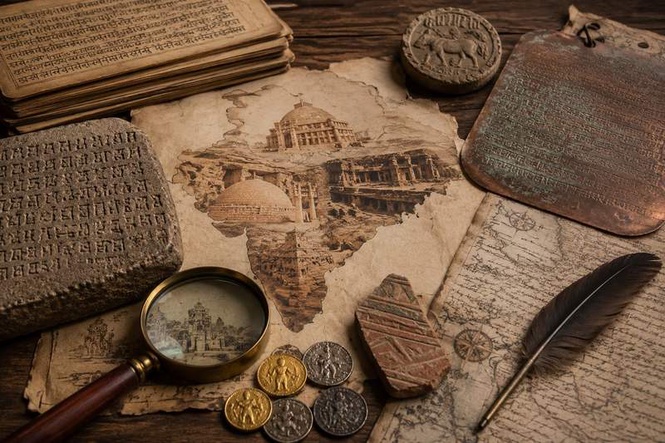
History is not merely a narration of past events. It is a disciplined reconstruction of human experience based on evidence. The historian does not witness the past directly. Instead, the past is understood through traces left behind by earlier societies. These traces are called sources of history. They provide the raw material from which historians interpret political developments, economic systems, social structures, religious beliefs and cultural transformations.
The reliability, authenticity and interpretation of sources determine the quality of historical writing. In ancient and medieval India, where continuous chronological records are limited, historians rely heavily on literary texts, inscriptions, coins, foreign accounts, archaeological remains and oral traditions. Each source has its own strengths and limitations. Therefore, historical methodology requires corroboration among multiple categories of evidence.
Literary sources
Literary sources are written records that provide direct or indirect information about the past. They are broadly divided into religious (non-secular) and secular literature.
A. Religious or non-secular literary sources
These texts were primarily composed for religious, philosophical or ethical purposes, yet they contain invaluable historical information.
- Vedic literature
The Rigveda, Samaveda, Yajurveda and Atharvaveda provide insights into early Aryan society, political institutions, economy and religious practices.
- The Rigveda mentions tribal assemblies such as Sabha and Samiti.
- It sheds light on pastoral economy and clan-based society.
The Brahmanas, Aranyakas and Upanishads reflect the transition from ritualism to philosophical speculation.
- Epics
The Ramayana and Mahabharata are not purely historical texts, but they contain references to political institutions, kinship structures, warfare and social norms.
- The Mahabharata describes the concept of Rajadharma.
- The Ramayana reflects ideals of kingship and social order.
- Buddhist literature
Texts such as the Tripitakas, Jatakas and chronicles like Dipavamsa and Mahavamsa provide information about:
- Rise of Buddhism
- Urbanisation in the Gangetic plains
- Mauryan polity
- Trade networks
The Jataka tales are particularly important for reconstructing everyday social and economic life.
- Jain literature
Jain texts such as the Bhagavati Sutra and Parishishtaparvan contain references to rulers, cities and trade centres. They help historians understand non-Vedic traditions and mercantile communities.
Importance of religious literature
- Provides cultural and social history.
- Reveals philosophical and ethical systems.
- Helps understand political institutions indirectly.
- Offers insight into linguistic development.
Limitations
- Often mythological and exaggerated.
- Chronology is uncertain.
- Sectarian bias is common.
B. Secular literary sources
Secular literature was composed with administrative, political, biographical or aesthetic objectives.
- Historical chronicles
Rajatarangini by Kalhana is considered one of the earliest historical chronicles in India. It narrates the history of Kashmir rulers with remarkable historical consciousness.
- Political treatises
Arthashastra by Kautilya provides detailed information about:
- Mauryan administration
- Taxation
- Espionage
- Diplomacy
- Economic regulations
It is an indispensable source for ancient Indian polity.
- Biographies and court literature
- Harshacharita by Banabhatta describes the reign of Harsha.
- Akbarnama and Ain-i-Akbari by Abul Fazl provide exhaustive details regarding Mughal administration, revenue system and society.
- Regional literature
Regional works in Persian, Sanskrit, Tamil and vernacular languages enrich local history.
- Sangam literature
Tamil Sangam texts like Pattuppattu and Ettuthokai provide detailed information about South Indian polity, warfare, trade and social customs during the early historic period.
- They mention the Chera, Chola and Pandya kingdoms.
- Roman trade with South India is vividly reflected.
Importance of secular literature
- Helps establish chronology
- Provides administrative and political details
- Reflects court culture and statecraft
- Offers insight into economy and governance
Limitations
- Court historians often glorified rulers.
- Political bias and exaggeration are frequent.
Epigraphy (Inscriptions)
Epigraphy refers to the study of inscriptions engraved on stone, pillars, copper plates, temples and caves. Inscriptions are among the most reliable historical sources because they are generally contemporary records.
- Ashokan inscriptions
The rock and pillar edicts of Ashoka are crucial for understanding:
- Mauryan administration
- Dhamma policy
- Spread of Buddhism
- State ideology
The Maski inscription helped identify Ashoka with “Devanampiya Piyadasi.”
- Allahabad pillar inscription
Composed by Harisena, it details the conquests of Samudragupta and is called the “Prayaga Prashasti.”
- Copper plate grants
These record land grants to Brahmins and temples and illuminate:
- Agrarian expansion
- Feudal relations
- Revenue administration
- Temple inscriptions
South Indian temple inscriptions provide rich details about:
- Local self-government
- Trade guilds
- Donations
- Irrigation systems
Importance of epigraphy
- Provides authentic and dated evidence.
- Helps reconstruct political history.
- Gives administrative and economic details.
- Assists in deciphering scripts and languages.
Limitations
- Often eulogistic in nature.
- Focuses mainly on elites and rulers.
Numismatics (Study of coins)
Coins are vital archaeological sources for economic and political history.
Historical importance of coins
- Political history
Coins reveal names, titles and succession of rulers.
- Indo-Greek coins helped reconstruct Bactrian history.
- Gupta gold coins depict imperial ideology.
- Economic history
Coins indicate:
- Trade and commerce
- Monetary systems
- Metallurgical advancement
- Economic prosperity
- Religious and cultural history
Images of deities and symbols on coins reflect religious affiliations.
- Kushana coins depict Greek, Iranian and Indian gods.
- Gupta coins show Vaishnavite symbolism.
Examples
- Punch-marked coins of the Mahajanapada period
- Gold coins of Chandragupta II
- Coins of Kanishka
Limitations
- Coins provide limited social information.
- Interpretation of symbols can be debated.
Accounts of Foreign Travellers
Foreign travellers provide external perspectives on Indian society and polity.
Important travellers and their accounts
- Megasthenes: Megasthenes wrote Indica, describing Mauryan administration and society during Chandragupta Maurya’s reign.
- Fa-Hien: He visited during Gupta rule and described Buddhist institutions and social conditions.
- Hiuen Tsang: He provided detailed accounts of Harsha’s empire, Nalanda University and Indian religious life.
- Al-Biruni
Al-Biruni wrote Kitab-ul-Hind, an analytical study of Indian society, science and religion.
- Ibn Battuta: Ibn Battuta documented the Delhi Sultanate under Muhammad bin Tughlaq.
Importance
- Provide outsider perspectives.
- Offer comparative observations.
- Fill gaps in indigenous records.
Limitations
- Cultural misunderstandings and bias.
- Restricted geographical experience.
Archaeological and material remains
Material remains constitute the backbone of prehistoric and protohistoric studies.
- Monuments and architecture
Temples, stupas, forts and palaces reveal artistic and technological developments.
Examples:
- Sanchi Stupa
- Ajanta Caves
- Brihadeeswarar Temple
- Excavated sites
Excavations at Harappa and Mohenjo-daro revealed urban planning, drainage systems and trade of the Indus Valley Civilization.
- Pottery and tools
- Painted Grey Ware indicates later Vedic culture.
- Megalithic burials reveal Iron Age practices.
- Sculptures and paintings
Art objects reflect religion, aesthetics and patronage.
Importance
- Crucial for periods lacking written records.
- Helps reconstruct daily life and technology.
- Offers tangible evidence of settlement patterns.
Limitations
- Interpretation depends heavily on context.
- Archaeological evidence is often fragmentary.
Oral traditions and folklore
Oral traditions include folk songs, ballads, myths and legends transmitted across generations. These are especially significant for tribal and subaltern histories.
Examples:
- Rajasthani ballads of Pabuji
- Folk traditions of North-East India
They preserve memories excluded from elite written records.
Interdisciplinary nature of historical sources
Modern historiography increasingly combines literary evidence with archaeology, anthropology, linguistics and environmental studies. No single source can provide a complete picture of the past. Historians use cross-verification to distinguish fact from exaggeration. The scientific study of sources has transformed history from mere storytelling into an evidence-based discipline.
Sources as foundation of historical consciousness
Historical sources are the pillars upon which the edifice of history stands. Literary texts illuminate intellectual and cultural traditions, inscriptions authenticate political developments, coins reveal economic structures, travellers provide comparative insights and archaeological remains uncover forgotten civilizations. Together, they enable historians to reconstruct the complexities of human societies across time.
A critical and interdisciplinary approach to sources is essential because every source carries both information and bias. The historian’s task is not merely to collect evidence but to interrogate, compare and interpret it scientifically. In this sense, the study of historical sources is not only the beginning of history-writing but also the foundation of historical consciousness itself.
Practice questions for GS Mains
- “Historical sources are not mere repositories of facts but instruments of interpretation.” Discuss with reference to ancient Indian history.
- Examine the role of epigraphy and numismatics in reconstructing early Indian history. Highlight their limitations.
