.jpg)
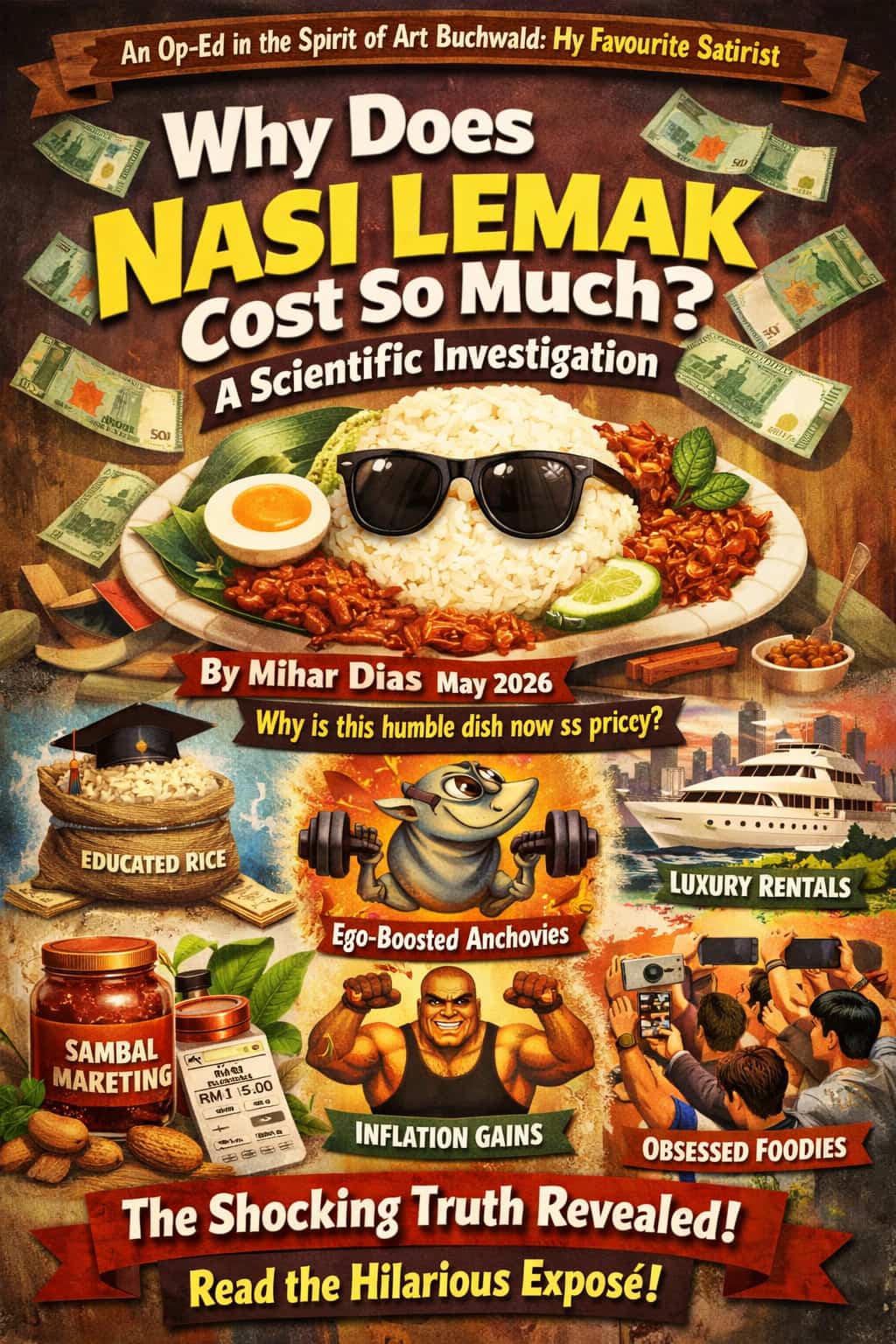
Why Does Nasi Lemak Cost So Much? A Scientific Investigation
An op-ed in the spirit of Art Buchwald: My favourite Satirist
By Mihar Dias May 2026
Anjali asks a perfectly reasonable question: why does simple Malaysian food now come with a premium price tag?https://newswav.com/A2605_r3PtRn?s=A_xvfsIqH&language=en
As a concerned citizen and part-time breakfast consumer, I decided to investigate.
After months of research(an exaggeration), interviews and staring suspiciously at restaurant menus, I have identified several possible causes.
Theory No. 1: The Rice Has Gone to University
In the old days, rice merely sat in a sack waiting to be cooked.
Today's rice appears to possess a master's degree.
Every grain now demands tuition fees, accommodation allowances and career progression opportunities before agreeing to become nasi lemak.
This would explain why a plate that once cost RM4 now costs RM10.
The rice has student debt.
Theory No. 2: Anchovies Have Developed Self-Esteem
For decades, anchovies knew their place.
They were tiny fish.
Nobody interviewed them. Nobody photographed them.
Then social media arrived.
Suddenly anchovies found themselves featured in close-up food videos with dramatic background music.
The attention went to their heads.
Today they insist on being called “artisanal ocean protein.”
Naturally, their rates increased.
Theory No. 3: Every Stall Is Secretly Located in Monaco
Economists blame rent.
This seems plausible because some food operators behave as though their premises overlook the French Riviera.
A humble kopitiam table now carries the financial burden of a luxury penthouse.
You order one teh tarik and unknowingly contribute to the landlord's retirement plan.
Theory No. 4: The Food Has Become Famous
The journey usually begins innocently.
A food blogger discovers a stall selling RM5 nasi lemak.
He posts a video.
Three influencers arrive.
Then twenty.
Then forty-seven thousand people appear before sunrise carrying smartphones and tripods.
The queue stretches into the next postcode.
At this point the stall owner faces a difficult moral dilemma.
Should he continue charging RM5?
Or should he charge RM12 and finally repair the refrigerator purchased during Tun Mahathir's first administration?
History suggests the refrigerator usually wins.
Theory No. 5: The Sambal Has a Marketing Department
The old sambal had one purpose: burn your tongue.
Modern sambal comes with a mission statement.
Menus now describe it as:
“A bold fusion of heritage flavours celebrating Malaysia's multicultural culinary narrative.”
Translated into English, this means:
“It's chilli.”
Unfortunately, every adjective adds RM1.
Theory No. 6: Inflation Has Been Going to the Gym
Inflation used to be a small nuisance.
Today it resembles a bodybuilder who consumes protein shakes and destroys furniture for entertainment.
Cooking oil costs more.
Eggs cost more.
Gas costs more.
Transport costs more.
The plastic spoon costs more.
Soon the air surrounding the nasi lemak may require separate billing.
Theory No. 7: Malaysians Keep Paying
This is perhaps the most uncomfortable explanation.
We complain magnificently.
We grumble.
We write angry Facebook posts.
We tell everyone prices are ridiculous.
Then we join the queue anyway.
Vendors have noticed this curious national habit.
A Malaysian will loudly declare:
“RM18 for nasi lemak? Outrageous!”
Then add:
“Make it two.”
Theory No. 8: Food Is No Longer Food
This may be the real reason.
A nasi lemak used to be breakfast.
Now it is an experience.
An event.
A lifestyle statement.
A content creation opportunity.
Before eating, customers must first photograph the plate from seven angles, record a video, add music, apply filters and consult followers.
By the time they take the first bite, lunch has arrived.
Naturally, experiences cost more than food.
Disneyland understands this.
Apparently nasi lemak vendors do too.
Final Verdict
So why has simple food become expensive?
Because the rice became educated, the anchovies became celebrities, the sambal hired public relations consultants, inflation started weight training and Malaysians keep rewarding the whole process by queuing enthusiastically.
The real mystery is not why nasi lemak costs RM15.
The real mystery is why a tiny packet of peanuts still contains exactly six peanuts.
Some things, thankfully, remain traditional.
Mihar Dias (mihardias@gmail.com) is a content creator under the Newswav Creator programme, where you get to express yourself, be a citizen journalist, and at the same time monetize your content & reach millions of users on Newswav. Log in to creator.newswav.com and become a Newswav Creator now!
The User Content (as defined on Newswav Terms of Use) above including the views expressed and media (pictures, videos, citations etc) were submitted & posted by the author. Newswav is solely an aggregation platform that hosts the User Content. If you have any questions about the content, copyright or other issues of the work, please contact creator@newswav.com.