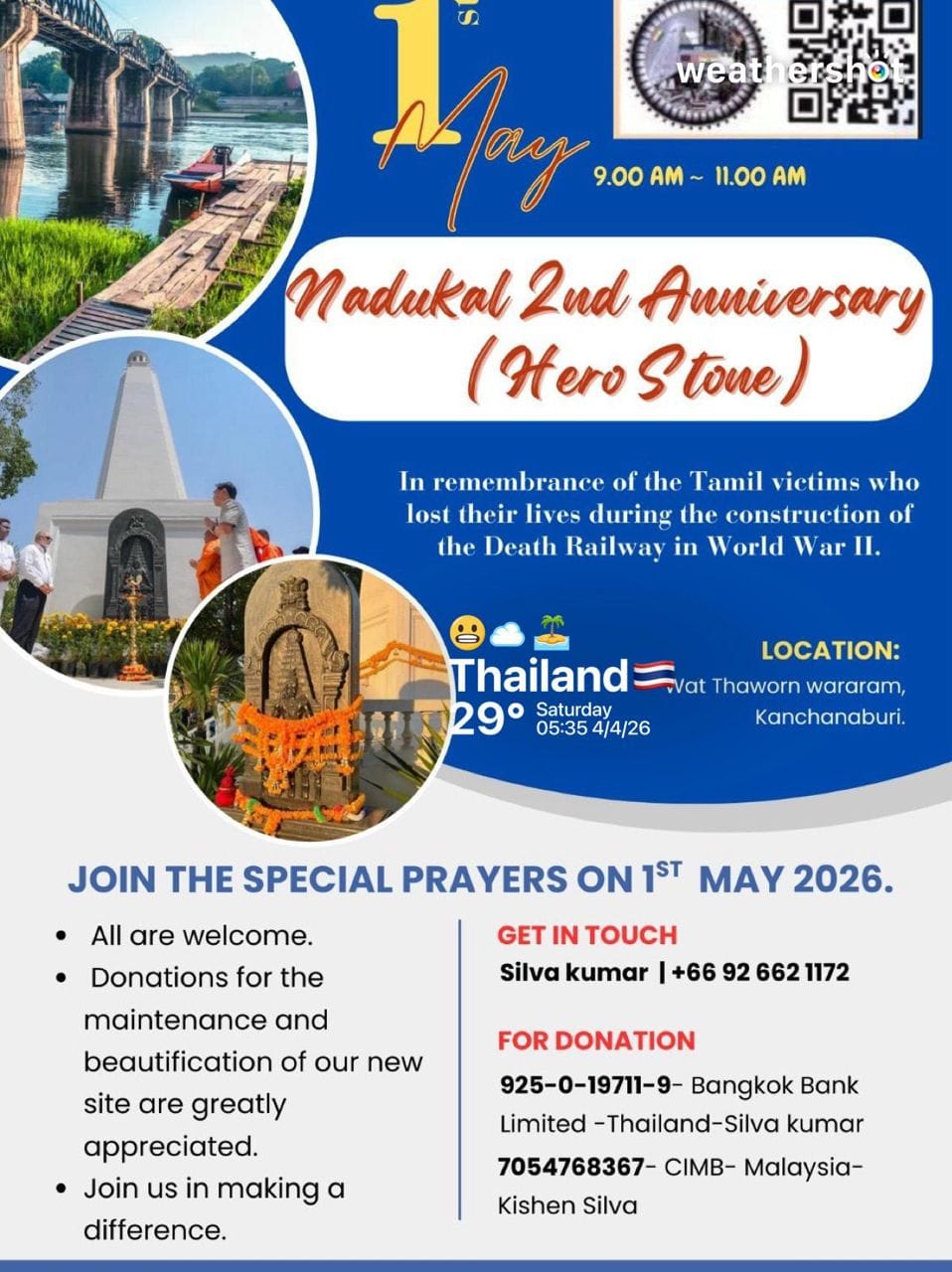
On May 1, people will gather at the Nadukal in Kanchanaburi, Thailand for the second-year memorial service. And among the prayers and silence, a new song will be sung. It’s called “We Will Remember You, Romusha.” But it’s not just a performance. It’s more like a promise—finally made, long overdue.
https://share.google/RoF2B7xXrBnxPgggR. The Star
The word Romusha might not be familiar to many. It refers to the hundreds of thousands of Asian laborers who were forced to build the Burma Railway during World War II. A 415-kilometer track slashing through jungle and mountains between Thailand and Myanmar. Built between 1942 and 1943, it became known as the Death Railway for a reason. The suffering was beyond imagination.
We’ve all heard stories of the Allied POWs who survived that hell. Books, movies, memorials. But the Romusha—mostly men from Malaya, India, and across Southeast Asia—have stayed almost entirely in the shadows. Their names, their faces, their last words… hardly anyone knows them.
And that silence isn’t just a missing page in a history book. It’s wrong. Quietly, deeply wrong.
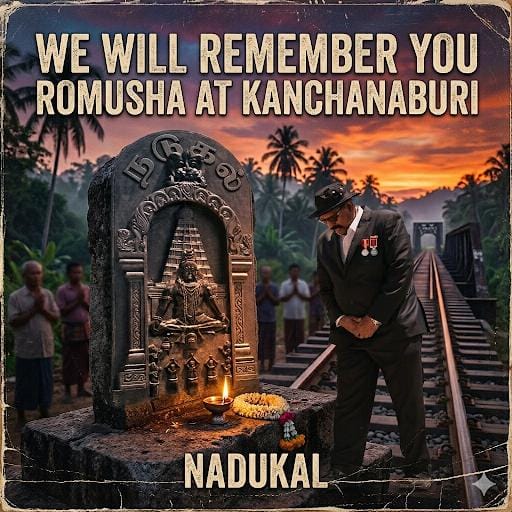
https://share.google/RoF2B7xXrBnxPgggR. Credit image:K.T.Maran
That’s why this song matters. Written in both Tamil and English, it reaches across time and distance. It speaks to the children and grandchildren of those who never came home. And it speaks to the rest of us, too—urging us to listen.
The lyrics are simple, but they hit hard. Broken promises. Journeys that started with hope, from Malayan shores to a nightmare far from home. One line goes: “Mother called… but they never returned…” No drama, just grief. And then the chorus rises—“WE WILL REMEMBER YOU, ROMUSHA!”—part lament, part vow. As if saying their names out loud could begin to make things right.
But here’s the thing: the song doesn’t stay stuck in sorrow. It turns memory into something we all share. A duty, even. And that fits with a growing understanding around the world—that remembering isn’t just about the past. It’s about healing and truth.
Malaysia has a special part to play here. So many of the Romusha came from Malaya. Yet their stories are barely mentioned in schools or public memory. As the country races forward, it also needs to look back—honestly. Not to stir old pain, but to honor the dignity of ordinary people who were treated as less than human. And to make sure such things never happen again.
The Nadukal itself is powerful. Rooted in an old South Indian tradition of remembering fallen heroes, that stone in Kanchanaburi turns a place of horror into a place of reflection and togetherness. It’s a quiet act of defiance against forgetting.
And now, the song will go global—on YouTube, on social media. In a world full of noise and distraction, that might seem small. But for young people who will never open a textbook chapter on the Romusha, a song can reach them. It can stay with them.
Of course, this raises a bigger question: How should we remember painful histories? Ceremonies and monuments matter. But so do real efforts in schools, museums, research, and everyday conversation. Without that, remembrance risks becoming just a once-a-year gesture.
Songs have a special power here. They don’t just inform—they move you. They cross borders and generations. And because this one is sung in two languages, it’s both inclusive and rooted in the culture it honors. A tribute and a lesson, all in one.
As the last line says: “We will never forget.” That’s not a passive wish. It’s a choice, made over and over again. A commitment to truth, to dignity, to empathy.
By finally giving the Romusha a voice, this song does more than look back. It reshapes how we feel about the present. It reminds us that history isn’t just stored in dusty archives—it can be sung. And when we choose to remember, the forgotten are finally, truly heard.
K.T.Maran Social, Environmental & Animal Activist
K.T. Maran (maran.kt@gmail.com) is a content creator under the Newswav Creator programme, where you get to express yourself, be a citizen journalist, and at the same time monetize your content & reach millions of users on Newswav. Log in to creator.newswav.com and become a Newswav Creator now!
The User Content (as defined on Newswav Terms of Use) above including the views expressed and media (pictures, videos, citations etc) were submitted & posted by the author. Newswav is solely an aggregation platform that hosts the User Content. If you have any questions about the content, copyright or other issues of the work, please contact creator@newswav.com.