
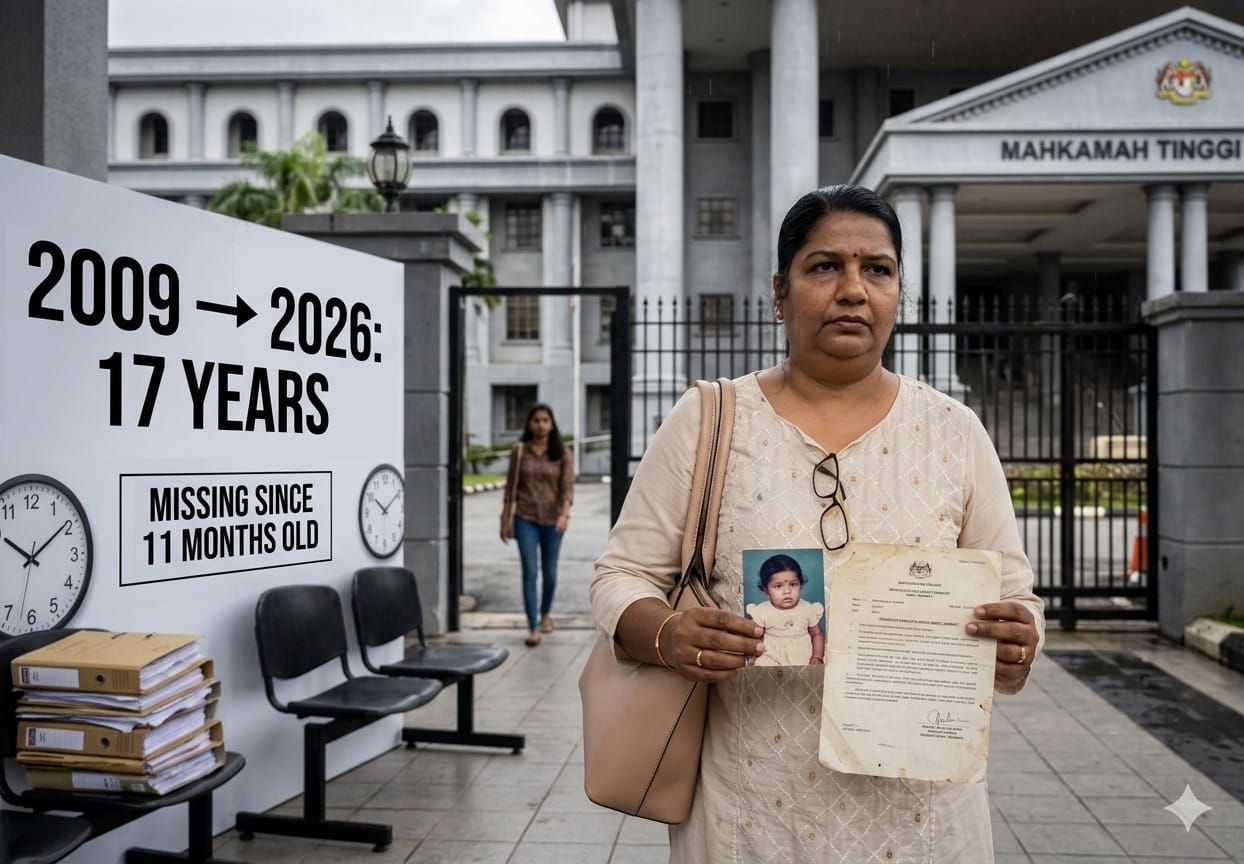
There is a precise, mechanical ritual that unfolds whenever a courtroom attempts to hold the state financially accountable for institutional gaps. When a High Court judge awards multi-million ringgit damages to the families of the missing such as Pastor Raymond Koh or Amri Che Mat the response from the Attorney General’s Chambers (AGC) follows an expected legal path. The state promptly files an appeal and an application for a stay of execution.
The underlying logic presented by government lawyers centers on a familiar administrative argument: distributing large federal allocations prematurely creates an "irreversible financial risk" to the public treasury should the decision be reversed on appeal. Yet, when placed on the scales of national balance, this creates a striking paradox. A potential complication in a government ledger is treated as a matter of immediate legal urgency, while a decade of a family's absolute, bone-deep grief is left to wait in procedural limbo.
This pattern functions as a form of institutional attrition a system structurally designed around extended timelines, where the momentum of public attention often fades long before the legal process reaches finality.
The Paradox of Systemic Capability
Nothing highlights this structural friction quite like the contrast in how the state’s digital architecture operates. Malaysia lives under an administrative grid of immense technical competence. If an ordinary citizen applies for a targeted welfare program or a fuel subsidy under the BUDI MADANI framework, federal networks can audit data, cross-reference household incomes, and process eligibility with remarkable velocity. The modern state possesses the tools to be omnipresent, sharp, and highly efficient when managing public data and financial lines.
Yet, when the highest court in the land issues a mandamus order commanding law enforcement to execute an arrest warrant for a fugitive who abducted an 11-month-old baby, the system appears to slow to a crawl.
For seventeen years, and now actively ongoing into an eighteen-year stretch, the process of locating M. Indira Gandhi’s ex-husband has remained at a standstill. This long-standing delay raises a fundamental question about institutional priorities: how can a state possess the world-class forensic capabilities to solve highly intricate digital and physical crimes, yet face a near-total impasse when executing a single, high-profile arrest warrant within its own borders? The issue is less about technical capacity and more about the presence of a rigid, fragmented bureaucracy that struggles to move with urgency when human tragedies intersect with complex social dimensions.
The Anatomy of Procedural Defenses
This brings us to the recent performance at the Court of Appeal on August 24, 2026. In a ruling that underscored the strict, unyielding nature of our legal framework, a three-member bench unanimously dismissed Indira Gandhi’s RM100 million lawsuit for the tort of public nonfeasance.
To understand how the state successfully defended its position, one must look at the historical common law armor the AGC utilizes whenever a citizen sues the government for a failure to act. The defense relies on an established legal threshold: the police owe a general duty to the public at large to maintain law and order, but they do not owe a specific, actionable private duty of care to individual citizens. Legally, the state argues that opening the floodgates to such private lawsuits would paralyze law enforcement under the constant threat of litigation for every investigative delay. Furthermore, under the Government Proceedings Act 1956, general institutional inertia or systemic breakdown cannot easily be pinned onto the state as a corporate entity unless personal malice by a specific officer is explicitly proven.
The court’s judgment reflected this masterclass in technical hair-splitting. The appellate bench openly flagged and explicitly noted the "material deficiencies" and "procedural shortcomings" in how law enforcement historically handled the search. Yet, under the strict rules of evidence, they ruled that Indira could not definitively establish a direct, legal chain of causation proving that those specific omissions were the sole absolute cause of her prolonged separation from her daughter, Prasana Diksa.
In short: the system's operational shortcomings were acknowledged by the bench, but because they fell under general systemic delays, they did not meet the steep evidentiary threshold required to trigger massive financial damages. The court reminded the nation that the outstanding arrest warrant remains active and binding a piece of paper that continues to echo through the halls of justice but remains unexecuted in the real world.
A Stranger on the Street
Outside the courtroom in Putrajaya, the clinical, detached language of the judiciary collided directly with human reality. Speaking before cameras, Indira issued a poignant, heartbreaking plea to a daughter who crossed into adulthood this year without ever knowing her maternal family:
"Whatever she wants or whoever she wishes to be with is not the issue. I just want to see her... I would not recognise you on the street."
The structural reality behind that sentence is deeply unsettling. A society that prides itself on advanced investigative systems has allowed a child to grow from an infant into a sovereign adult entirely hidden in plain sight. A mother is forced to concede that seventeen years of institutional delays have turned her own flesh and blood into a stranger she might accidentally brush past on a crowded city sidewalk.
The True Price of Legal Delays
Whether it is through the dismissal of a mother's civil claim on technical grounds or the strategic freezing of payouts to the families of the missing through stays of execution, the broader outcome remains identical. The legal framework often functions as a corporate shield, prioritizing fiscal caution and procedural purity over the immediate resolution of shared human suffering.
When accountability is deferred through an endless cycle of appeals and technical thresholds, it hazards becoming a policy of exhaustion. The risk is that if an injustice persists long enough, it ceases to be treated as an active national emergency and transforms into a historical footnote.
A nation cannot fully celebrate its milestones of progress while its citizens continue to bear the emotional cost of unexecuted judicial orders. Until outstanding warrants are pursued with the same operational focus used to manage our federal databases, and until higher court decisions are universalized across all state lines, the structural gaps in our system will remain exposed. The legal arguments may hold up in a textbook, but they fail to satisfy the moral conscience of a society looking for genuine accountability.
When an institution possesses the forensic vision to trace a coin across a digital matrix but lacks the sight to find a stolen child within its own border, its paralysis is not an operational failure it is a moral choice. - Annan Vaithegi
Annan Vaithegi (annanvaithegi@icloud.com) is a content creator under the Newswav Creator programme, where you get to express yourself, be a citizen journalist, and at the same time monetize your content & reach millions of users on Newswav. Log in to creator.newswav.com and become a Newswav Creator now!
The User Content (as defined on Newswav Terms of Use) above including the views expressed and media (pictures, videos, citations etc) were submitted & posted by the author. Newswav is solely an aggregation platform that hosts the User Content. If you have any questions about the content, copyright or other issues of the work, please contact creator@newswav.com.