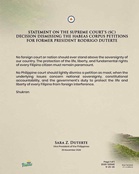
THE Supreme Court’s dismissal of petitions questioning former president Rodrigo Duterte’s arrest and transfer to the International Criminal Court (ICC) has drawn sharp dissent from four justices, who said the ruling leaves serious constitutional questions unresolved.
While the 9-4 majority of the Supreme Court en banc declared the consolidated habeas corpus petitions moot because Duterte is now under ICC custody in The Hague, Senior Associate Justice Marvic Leonen and Associate Justice Ramon Paul Hernando argued that the Court should have confronted the legality of the government’s actions in arresting and surrendering the former president.
Leonen agreed that the petitions should be dismissed but faulted the majority for failing to address what he described as grave constitutional issues that could recur and evade judicial review.
He warned that the Court’s silence deprives judges, lawyers and law enforcement agencies of much-needed guidance on the constitutional limits of government action, particularly when implementing international arrest warrants and the Philippines’ obligations under the Rome Statute.
Leonen emphasized that an ICC arrest warrant cannot simply be enforced in the Philippines without judicial intervention. He also pointed out that Duterte was not given the opportunity to exercise his rights under Article 59 of the Rome Statute, which requires a person arrested under an ICC warrant to be brought before a competent judicial authority in the country where the arrest took place.
Hernando, meanwhile, directly challenged the constitutionality of Duterte’s surrender to the ICC, arguing that the operation violated the former president’s fundamental rights, including due process, protection against unreasonable searches and seizures, freedom of travel and the rights of persons under custodial investigation.
In his dissent, Hernando said the exceptional circumstances and immense public importance of the case warranted the Court’s review even if the petitions had technically become moot.
He also questioned the constitutionality of Section 17 of Republic Act 9851, or the Philippine Act on Crimes Against International Humanitarian Law, Genocide and Other Crimes Against Humanity.
The provision, which allows the surrender or extradition of suspected or accused persons to an appropriate international court, was unconstitutional, Hernando said, because it delegates authority to unnamed “relevant Philippine authorities” without clearly defining the surrender mechanism, identifying the officials empowered to carry it out, or prescribing procedures and safeguards against abuse of discretion.
His position directly challenges the legal basis invoked to justify the government’s transfer of Duterte to the ICC.
Two other justices, Associate Justices Henri Jean Paul Inting and Antonio Kho Jr., also rejected the majority’s conclusion that the petitions had become moot, emphasizing that the legality of Duterte’s arrest and transfer remained a matter for judicial determination.
Inting maintained that the Court could still rule on whether the arrest and surrender complied with the Constitution and Philippine laws, arguing that the question was legal — not merely political.
He also said a Supreme Court ruling could have practical implications for the ICC proceedings, particularly under the doctrine of abuse of process, which allows an international tribunal to suspend or terminate proceedings when improper or unlawful procedures were used to carry out an otherwise lawful process.
Kho, for his part, argued that the government cannot surrender a Filipino citizen to an international tribunal or carry out an extraordinary rendition without a valid domestic law and prior judicial authority.
He maintained that Duterte’s transfer to the ICC without a valid domestic legal basis and court order was unconstitutional.
Kho also warned against dismissing the petitions simply because the government had already completed the transfer, saying this could allow similar government actions in the future to escape judicial scrutiny by being carried out before courts could intervene.
In its Nov. 11 decision, written by Associate Justice Japar Dimaampao, the Supreme Court en banc dismissed the consolidated petitions filed by Duterte’s children Sebastian, Veronica and Paolo. The majority ruled that habeas corpus is a domestic remedy that Philippine courts cannot enforce beyond the country’s territorial jurisdiction.
The Court said it has no authority to compel the international tribunal to produce or release him. Philippine officials named in the petitions also no longer have custody or control over the former president.
However, the Supreme Court emphasized that dismissing the petitions does not mean Duterte’s arrest and transfer were necessarily lawful or that his constitutional rights were not violated.
It said any claims involving alleged violations of his rights, compensation or government liability must be pursued through appropriate legal proceedings.
The decision drew nine votes in favor, with four justices dissenting. Associate Justice Samuel Gaerlan was absent on official business.