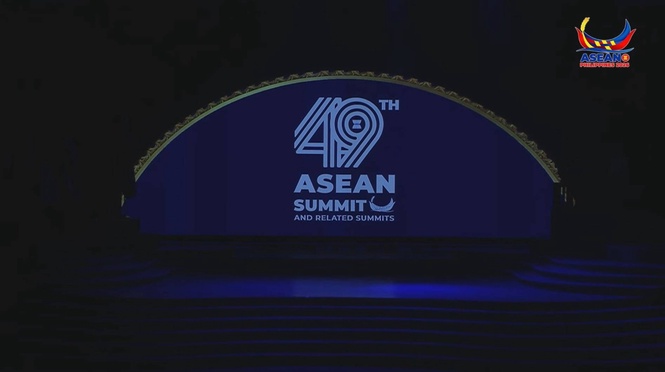
MANILA, Philippines — Global leaders wrapped up the 49th Association of Southeast Asian Nations (Asean) Summit on Tuesday, marking the culmination of the Philippines' year-long chairmanship of the regional bloc.
After several meetings with dialogue partners on Monday—including China, the Republic of Korea, Australia, and the United Nations—the final-day schedule began with the Asean Plus Three Summit, followed by the Asia Zero-Emission Community (AZEC) Leaders' Meeting, then the Asean-Japan Summit, the Asean-India Summit, and the East Asia Summit.
The leaders tackled ways to mitigate the increasing concerns of the volatility of geopolitical shocks, which President Ferdinand Marcos said affected households across Asia more than ever before.
“Our task today is to put our collective strength to work,” Marcos said during the Asean Plus Three summit, urging leaders to congregate to ensure that families are safeguarded.
The summit saw the signing of the world’s first Asean Digital Economy Framework Agreement (DEFA), which aims to empower micro, small, and medium enterprises (MSMEs) and double the region's digital economy from an estimated $1 trillion to $2 trillion by 2030 by integrating the digital market across the region.
Several leaders also arrived at the last minute for the summit. Cambodian Prime Minister Hun Manet attended the summit on Tuesday morning. He was represented by Deputy Prime Minister of Cambodia Hang Chuon Naron, who also arrived in Manila on Saturday and arrived later due to their hosting of the 20th Francophonie Summit, which ended on Monday.
Russia’s foreign minister, Sergey Viktorovich Lavrov, also arrived in Manila on Tuesday morning.
Russia’s participation in the summit builds upon the Russia-Asean Commemorative Summit held in Kazan earlier in 2026.
In the late afternoon, United States President Donald Trump arrived in Manila for the Asean-US Special Summit on Tuesday afternoon, which will conclude the 3-day event of the regional bloc.
Trump will also have a bilateral meeting with Marcos before he leaves for the Asia Pacific Economic Cooperation (APEC) meeting on China, where he is set to meet with Russian President Vladimir Putin and Chinese President Xi Jinping.
The Asean-US Special Summit concluded the 3-day event of the regional bloc in Manila.
During the closing ceremony, Marcos passed the chairmanship through the ceremonial handover of the gavel to Singaporean Prime Minister Lawrence Wong, concluding Manila's year-long tenure at the helm of the regional bloc.
“Throughout our chairship, we have sought to give meaning to our theme, ‘Navigating our future together.’ To be a compass that provides direction and to bring leadership, cohesion, and unity in all our actions,” said Marcos in his closing remarks.
He added that the issues across Asean were “increasingly intertwined,” noting that the true measure of the summit happens long after it is over, and that it is measured in the impact it leaves on families across the region.
“Our institutions must, therefore, become as connected as the challenges are that we fix. And ultimately, every member state must be able to count on Asean, and Asean must be able to count on every member,” said Marcos.
The most important work of us cannot belong to one chair alone. Progress endures when each chair builds on what came before and leaves stronger foundations for what comes next," he added, noting that Asean's duty to better the lives of people continues as the Philippines handed over the chairship to Singapore for its 50th summit next year.