
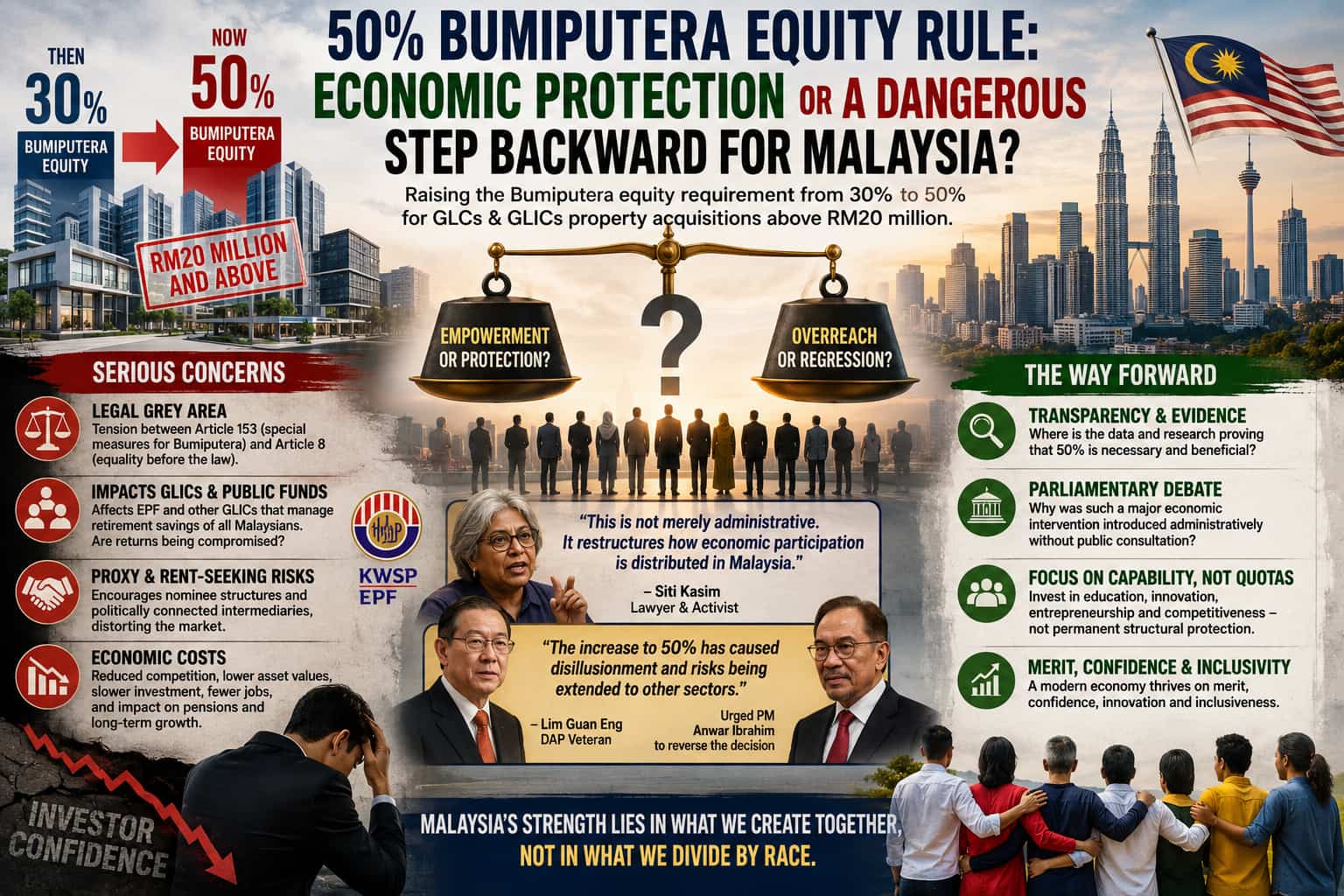
Malaysia’s latest move to increase the Bumiputera equity requirement from 30% to 50% for high-value property acquisitions involving Government-Linked Companies (GLCs) and Government-Linked Investment Companies (GLICs) is rapidly emerging as one of the most controversial economic policy shifts in recent years.
What was once framed as an affirmative action mechanism is now being criticised as an aggressive expansion of racial-based economic control that risks undermining investor confidence, national unity, and Malaysia’s long-term competitiveness.
The policy, introduced under the Ministry of Economy’s updated Property Acquisition Guidelines (PAG), applies to property transactions worth RM20 million and above involving state-linked entities. While supporters argue that the move strengthens Bumiputera participation in strategic assets, critics warn that the increase from 30% to 50% crosses a dangerous line between empowerment and economic overreach.
Lawyer and activist Siti Kasim was among those who raised serious concerns about the implications of the policy. According to her analysis, the change is not merely administrative but represents a significant restructuring of how economic participation is distributed in Malaysia.
Legally, the policy exists in a constitutional grey area. Although Article 153 of the Federal Constitution allows special measures for Bumiputera interests, she argues that expanding the requirement from 30% to 50% may exceed the original spirit of affirmative action and move toward disproportionate racial preference. At the same time, Article 8 guarantees equality before the law, creating growing tension between constitutional protection and modern economic realities.
The issue becomes even more sensitive because the rule affects GLICs such as the Employees Provident Fund (EPF), which manages retirement savings for Malaysians of all races. Questions are now being raised over whether trustees of such funds are prioritising racial compliance over financial returns and fiduciary responsibility to contributors.
Siti Kasim also warns that the policy may unintentionally encourage proxy arrangements, nominee shareholding structures, and rent-seeking behaviour. Instead of creating genuine Bumiputera competitiveness, it could merely enrich politically connected intermediaries while distorting the market through artificial ownership structures.
Socially, the backlash has been equally significant. Many Malaysians view the move as contradictory to the reformist and inclusive narrative long associated with Pakatan Harapan. Even among PH supporters, frustration has begun to grow over what is perceived as a regression into old-style racial economic policies.
DAP veteran Lim Guan Eng openly urged Prime Minister Dato' Seri Anwar Ibrahim to reverse the decision, arguing that the increase to 50% has caused disillusionment among PH’s support base and raises fears that similar racial conditions could later be extended into other sectors of the economy.
Lim stressed that PH’s previous position was to maintain the existing framework while gradually expanding equal opportunities for all Malaysians rather than intensifying race-based ownership requirements. He also highlighted the contradiction between encouraging investment and simultaneously narrowing the pool of eligible buyers through stricter equity rules.
The economic consequences may ultimately prove even more damaging. By effectively forcing investors to surrender half of their ownership based on racial quotas rather than business contribution or merit, Malaysia risks sending a troubling signal to both domestic and foreign investors. Reduced competition in high-value property markets could weaken asset prices, slow investment activity, and eventually affect jobs, pensions, and economic growth.
Siti has argued that genuine economic empowerment should focus on education, innovation, entrepreneurship, and capability-building instead of permanent structural protection. Policies built heavily around quotas risk creating long-term dependency rather than sustainable competitiveness.
The government insists the policy is necessary to protect strategic national assets and strengthen Bumiputera participation in the economy. However, here is a fundamental question: where is the transparent evidence proving that raising the quota from 30% to 50% is economically necessary or socially beneficial?
More importantly, why was such a major economic intervention introduced administratively without broader parliamentary debate or national consultation?
Malaysia’s future economic success cannot depend indefinitely on expanding ownership restrictions based on race. A modern economy thrives on merit, confidence, innovation, and inclusiveness. Policies that deepen division, reduce competition, and create uncertainty risk pushing the country backward at a time when regional economies are accelerating forward.
Ultimately, Malaysia’s strength will not be measured by how much ownership is redistributed on paper, but by how much real value all Malaysians can create together in a fair, competitive, and united economy.
By: Kpost
Information Source:
Kpost (ckhorsk@gmail.com) is a content creator under the Newswav Creator programme, where you get to express yourself, be a citizen journalist, and at the same time monetize your content & reach millions of users on Newswav. Log in to creator.newswav.com and become a Newswav Creator now!
The User Content (as defined on Newswav Terms of Use) above including the views expressed and media (pictures, videos, citations etc) were submitted & posted by the author. Newswav is solely an aggregation platform that hosts the User Content. If you have any questions about the content, copyright or other issues of the work, please contact creator@newswav.com.


