
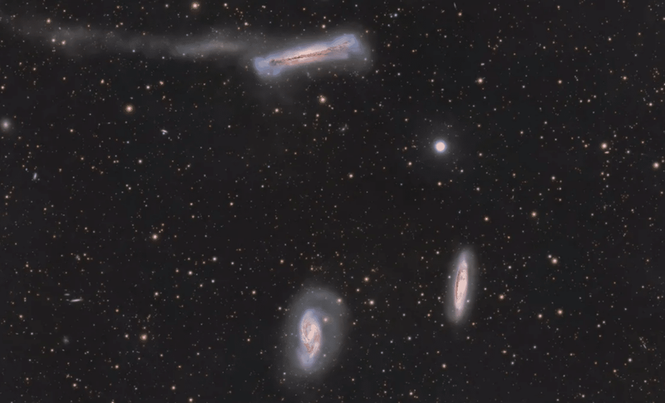
A remarkable image of the Leo Triplet Galaxies has emerged from a small town in the Netherlands, revealing hundreds of distant galaxies in unprecedented detail. The photograph, captured by astrophotographer Cornelis Van Zuilen, combines more than 60 hours of light data to create a cosmic portrait that stretches across millions of light-years. According to NASA, such detailed views of galactic interactions are rare, particularly when captured from a residential setting rather than a major observatory.
A New Level Of Astrophotography From A Personal Balcony
Van Zuilen’s journey into deep-space imaging reflects both patience and technical mastery. “At the end of 2024, I bought my Askar 103APO Telescope, giving me enough focal length to seriously focus on galaxies and begin my long-term project of photographing the entire Messier Catalogue,” Van Zuilen told Space.com in an email. The telescope, paired with a ZWO ASI533MC Pro Camera, allowed him to resolve fine details of distant galaxies from the quiet surroundings of Heiloo, a village in the Netherlands. The resulting images go far beyond casual stargazing, capturing subtle structures in spiral arms and galactic cores with clarity typically reserved for professional observatories.
Van Zuilen explained his motivation for returning to the Leo Triplet after an initial project in 2025:
“After finishing my first image of the Leo Triplet in 2025, I really wanted to see the gigantic tidal tail of NGC 3628 and decided to return with a much more ambitious goal.”
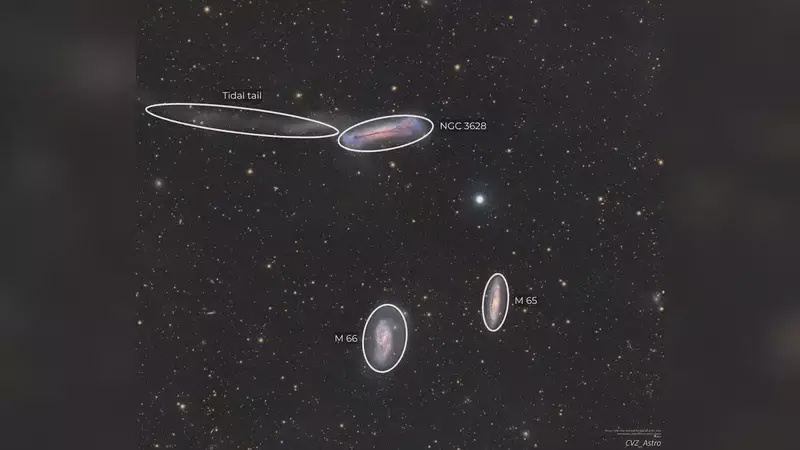
The tidal tail, a stream of stars and galactic material stretching hundreds of thousands of light-years, provides evidence of gravitational interactions that shape galaxies over millions of years, giving viewers a glimpse of cosmic forces at work.
Capturing The Universe Over 18 Nights
The depth and detail of Van Zuilen’s image are the result of meticulous planning and persistent effort. “Beginning on April 6, I photographed the Leo Triplet over 18 clear nights, collecting 85 hours of data, of which exactly 60 hours and 3 minutes met my quality standards,” he continued. Each night required careful alignment, calibration, and repeated exposures to ensure that faint light from distant galaxies was captured without interference from atmospheric or light-pollution effects. The composite of these exposures reveals intricate patterns in M65, M66, and NGC 3628, commonly referred to as the “Hamburger Galaxy” due to its distinctive dust lane.
Processing the image required advanced software techniques. Using PixInsight, Van Zuilen combined and enhanced the data to reveal not only the primary galactic trio but also hundreds of faint galaxies in the surrounding field. This level of detail allows amateur astronomers and enthusiasts to study galactic interactions and structures with a fidelity previously possible only through professional observatories.
Uncovering Hundreds Of Galaxies With Advanced Tools
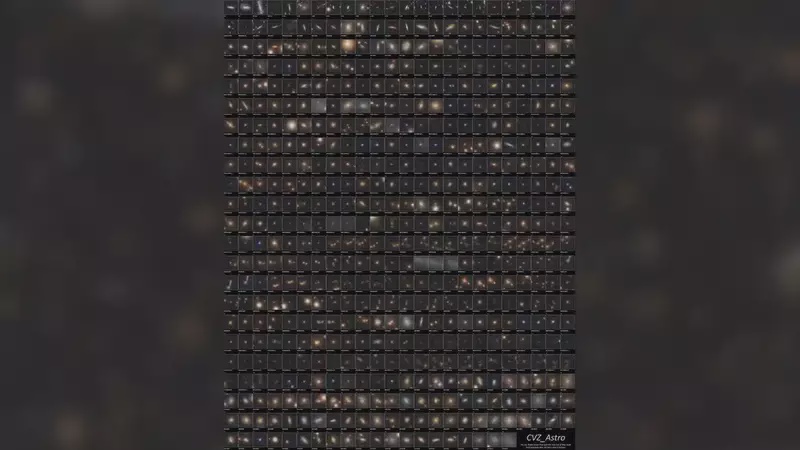
The final composite is both visually striking and scientifically valuable. “Using a PixInsight galaxy identification script, no fewer than 548 catalogued galaxies were identified within the image, highlighting the incredible depth achieved through 60 hours of integration time from my balcony here in Heiloo, a village in the Netherlands,” concluded Van Zuilen. This comprehensive field demonstrates the density of galactic systems in the Leo Constellation and provides context for the gravitational interactions shaping NGC 3628’s tidal tail, as studied by NASA and the National Science Foundation.
The image showcases how amateur astrophotographers can contribute meaningful observations to the field of astronomy. Van Zuilen expressed his personal pride and excitement: “I hope you like this final image as much as I do!” The work has inspired both professional and hobbyist astronomers to push the boundaries of what can be achieved from non-traditional observing locations.
Equipment And Techniques Behind The Cosmic Portrait
The success of this project rests on a combination of high-performance optics, sensitive imaging sensors, and sophisticated software. The Askar 103APO Telescope offers the focal length and clarity needed to resolve distant spiral galaxies, while the ZWO ASI533MC Pro Camera delivers high quantum efficiency and low-noise performance, essential for detecting faint cosmic light. Integrating exposures over dozens of nights allowed Van Zuilen to extract signals invisible to shorter observation periods, illustrating the power of patient, methodical astrophotography.
This achievement is a reminder that with dedication and the right tools, remarkable discoveries can be made even outside the confines of traditional research facilities. It also serves as inspiration for budding astronomers eager to explore the night sky with both scientific curiosity and artistic vision.