
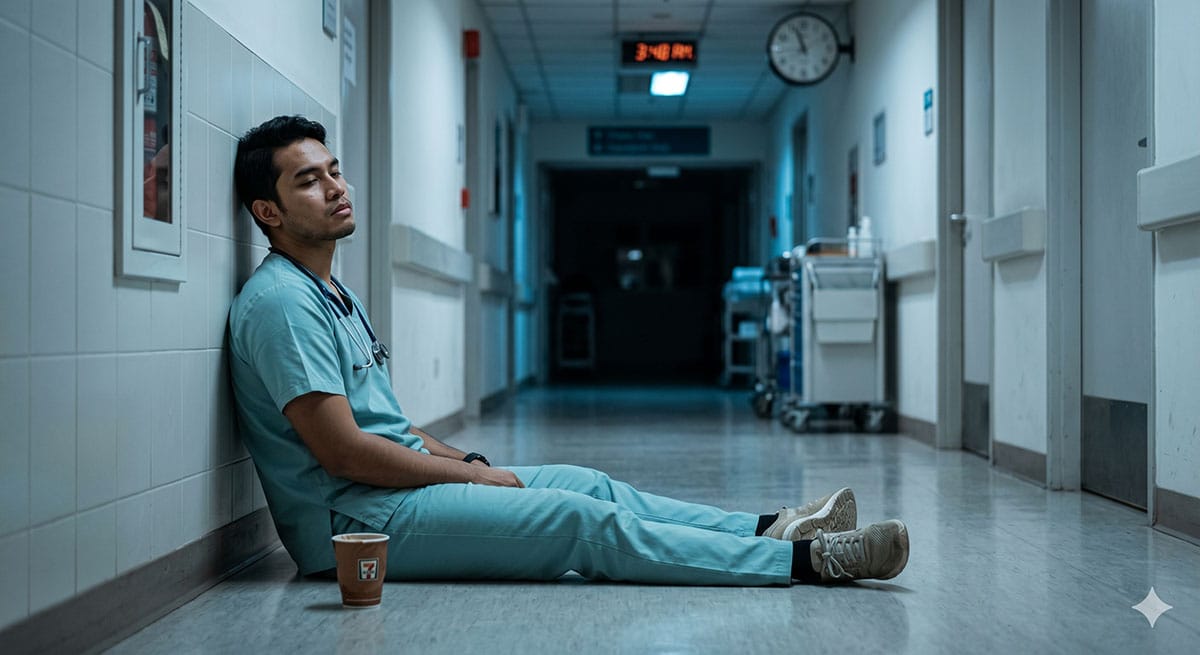
Your government hospital doctor is exhausted. That should scare you a little.
The next time you sit in a government hospital waiting room, look at the doctor who walks in to see you. There is a reasonable chance they have been on their feet for over 12 hours. There is also a reasonable chance they have not been paid for several of those hours. And there is an uncomfortably high chance that nobody in charge thought this was a problem worth fixing until last week.
Malaysia's house officers, the junior doctors completing their compulsory two-year housemanship in public hospitals, have been working between 65 and 85 hours a week. Not as a one-off emergency. Not during a crisis. As a routine. Week after week, in hospitals across the country, the people at the bottom of the medical hierarchy have been grinding through shifts that would make most other professions recoil in disbelief.
And on top of that, Malaysian Medics International (MMI) found that junior doctors are also clocking 10 to 15 hours of unrecorded and unpaid overtime every single week. Hours that do not appear on any timesheet. Hours that nobody is compensating them for. Hours that are simply expected.
What Just Changed
Health Minister Datuk Seri Dr Dzulkefly Ahmad announced on May 7 that the Ministry of Health will issue a new circular capping house officers' working hours at between 60 and 62 hours a week. The circular, to be issued by the Director-General of Health, is described as a measure to strengthen governance of the existing flexible working hours system.
The announcement came directly in response to the MMI report, which laid out in uncomfortable detail just how far the reality of junior doctors' working conditions had drifted from what the ministry's own flexi-system was supposed to allow. The flexi-system was meant to limit house officers to between 65 and 75 hours weekly. The reality was up to 85. The cap was already being broken. Nobody was enforcing it.
To put that in perspective: junior doctors in the United Kingdom typically work around 40 hours a week. UK regulations limit continuous shifts to a maximum of 13 hours, with mandatory rest periods strictly enforced. In Malaysia, rest periods exist on paper. In practice, the ward does not stop needing attention just because a house officer's shift is technically over.
Why This Matters Beyond the Doctors Themselves
It would be easy to frame this as a labour rights issue and nothing more. Junior doctors are overworked and underpaid. That is bad. The government should fix it. End of story.
But there is a much larger issue sitting underneath this one that affects every single Malaysian who has ever walked into a government hospital.
Tired doctors make mistakes. This is not a criticism. It is a documented medical reality. Research has consistently shown that sleep deprivation and excessive working hours impair cognitive function, reaction time, and decision-making in ways that are directly comparable to being legally drunk. A house officer who has been on their feet for 20 hours and is running on two hours of sleep is not the same doctor as one who is rested, alert, and functioning at full capacity.
When a doctor is exhausted and makes an error, the consequences are not a delayed report or a missed deadline. They can be catastrophic and irreversible. This is not hypothetical. Medical errors linked to fatigue are well documented in healthcare systems around the world, and Malaysia's public hospitals, already stretched thin by staff shortages and high patient volumes, are not immune.
So when we talk about capping house officers' working hours, we are not just talking about the welfare of young doctors. We are talking about the safety of every patient in every government hospital in Malaysia.
The Systemic Problem Nobody Wants to Say Out Loud
Here is the uncomfortable truth. The reason house officers are working 85 hours a week is not because the Ministry of Health enjoys exploiting junior doctors. It is because our public healthcare system is chronically understaffed relative to the demand placed on it.
Malaysia has approximately 1.8 doctors per 1,000 population. The World Health Organisation recommends a minimum of 1 doctor per 1,000. We are technically above that threshold. But those numbers do not capture the reality of distribution, where doctors are concentrated in urban centres while rural and semi-urban facilities are severely short-handed. They do not capture the burden of non-clinical administrative tasks that eat into clinical time. And they do not capture the fact that a system that relies on house officers working 85-hour weeks to function is not a well-staffed system. It is a system that has quietly outsourced its staffing problem onto the most junior and least empowered members of the medical profession.
Capping working hours is the right move. But a cap without a plan to fill the resulting gap is going to create pressure somewhere else in the system. More patients waiting longer. Other staff absorbing the overflow. The same problem wearing a different face.
What Needs to Happen Next
The new circular is a start. But it is a starting point, not a solution. What Malaysia's public healthcare system actually needs is a serious, long-term commitment to adequate staffing, proper enforcement of working hour regulations with real consequences for facilities that violate them, fair compensation for overtime that is actually worked, and a cultural shift within the medical profession that stops treating exhaustion as a badge of honour.
The idea that suffering through brutal working conditions is simply part of becoming a doctor is a narrative that has caused enormous harm globally. It needs to be retired.
Our house officers chose medicine because they wanted to heal people. They deserve a system that does not grind them down before they have even properly begun.
And the patients they treat deserve doctors who are rested enough to actually do it well.
Kamarul Azwan (k.azwan@gmail.com) is a content creator under the Newswav Creator programme, where you get to express yourself, be a citizen journalist, and at the same time monetize your content & reach millions of users on Newswav. Log in to creator.newswav.com and become a Newswav Creator now!
The User Content (as defined on Newswav Terms of Use) above including the views expressed and media (pictures, videos, citations etc) were submitted & posted by the author. Newswav is solely an aggregation platform that hosts the User Content. If you have any questions about the content, copyright or other issues of the work, please contact creator@newswav.com.