.jpg)
Making Yourself Heard in a Democratic Country
By Mihar Dias
(C) Copyright January 2022.
In an egalitarian democratic society, ruled by the people through elected representatives, citizens may register their views through the ballot box or voice their displeasure against the government of the day by peaceful demonstrations.
In more mature democracies, the US, UK or France for instance, the people in power use public opinions as an indicator of their popularity when in office. Polls by independent pollsters are taken seriously as a measure of a leader’s approval ratings and the degree to which his policies are accepted by the people. It is used as a thermometer to gauge the temperature of society.
A responsive government would welcome these as feedback, not as a criticism against them and act accordingly to maintain their popularity and keep them in office one election after another.
In such societies, the people may initially express their views through their elected representatives but if this channel persistently failed to produce results, organised groups may often take to the streets to show their displeasure.
In a young democracy, like Malaysia, we have seen some examples of how people reacted in the past when temperatures rose in response to policies that were regarded as unpopular or unpalatable by the general public
The most recent demonstration, although not very widely supported is a good example of how people might register their unhappiness over certain actions or policies. The demonstration grew out of a question over the credibility of a senior civil servant.
Credibility is a quality of being trusted and generally believed by the public. It is a perception of the degree of trustworthiness of a person or an organisation by the general public. In this case, there was a low perception of hid credibility that motivated many to rise in protest.
Sometimes the erosion of a person’s credibility might be the result of unfounded or unfair accusations against a person in the office. A smear campaign could result in a credibility deficit too for the unfortunate victim. If left unchecked the person’s credibility would erode further.
Damage control to restore public opinion would have to be put in place. In the private sector, a public relations consultant would be engaged to put into place damage control measures to avoid a total collapse of confidence in the person or an organisation at the centre of the controversy.
However, if the popular opinion was blowing like wildfire against an officer, it would be best that the individual in question steps aside to allow for an independent investigation to help ease tension.
Continuing to be antagonistic against popular opinion might result in further erosion of his or her credibility to the point where the public may lose faith in the organisation associated with or headed by the individual in question.
In the long run, the company would suffer. An example of the Volkswagen company that misreported a new model with unverified emission control capabilities is a case in point. The CEO had to resign to avoid a further downward spiral of public faith in VW.
Once lost, the credibility might take years to be restored. Organisations have been known to pour money and resources to regain lost support and confidence from the general public. Volkswagen spent millions to win back customers for years after that fiasco. They even took steps to reduce the prices of Volkswagen cars to regain customers lost to competitors.
Sometimes it would be lost forever. To regain lost reputation, a company had to be revamped and reorganised replacing a tainted head with a more credible individual. VW did replace the then CEO and engineers involved in the production of the misrepresented model.
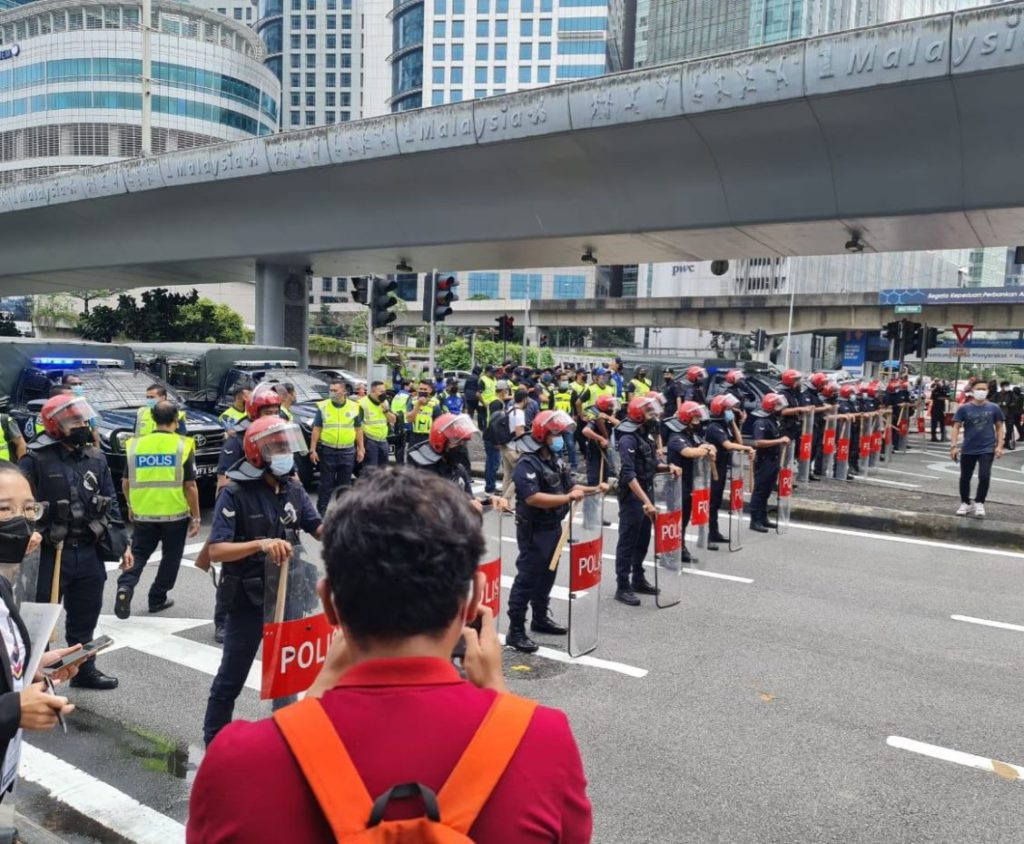
Saturday 22nd of January, 2022 was a day to be remembered for years to come where an issue over the perceived credibility of a civil servant drove some members of the public to the streets to express their displeasure.
It was nothing compared to a Bersih demonstration years ago. But the police deployed a large force closing train stations and diverted traffic away from the route planned by the organisers in anticipation of a big turnout. It was quite a show of force, like using a hammer to swat a fly.
Anyway, if there was a larger group of protesters that could turn rowdy that day the police was prepared to put a stop to it.
On the other hand, a responsive government sensitive to the feelings of the general public would have asked this particular individual to take leave and allow for investigations to be undertaken by an independent body.
In the 1990s, there was a case where a former Director-General was similarly accused. His brother paid for the DG’s dental services through a company that was linked to the agency that he headed.
However, he was only allowed to resume his official duties only after he was cleared of all charges.
His return was welcomed with open arms because his staff knew he was wrongfully accused. He regained his credibility, so did the organisation he headed.
Perhaps this recent issue could have been better handled and the public would not have been motivated to vent their anger on the streets.
The demonstrators dispersed peacefully after having a chance to show their unhappiness over a policy decision that was unpopular. Anyway, we are glad our streets are safe and secure again
Malaysia is certainly a democratic country. In an authoritarian regime, the demonstrators would not have an opportunity to show their discontent at all. They would have been arrested for trying to challenge the government of the day.
Photo Credit: The Star
Mihar Dias is a content writer under Headliner by Newswav, a programme where content creators get to tell their unique stories through articles and at the same time monetize their content within the Newswav app.
Register at headliner.newswav.com to become one of our content writers now!
*The views expressed are those of the author. If you have any questions about the content, copyright or other issues of the work, please contact Newswav.