
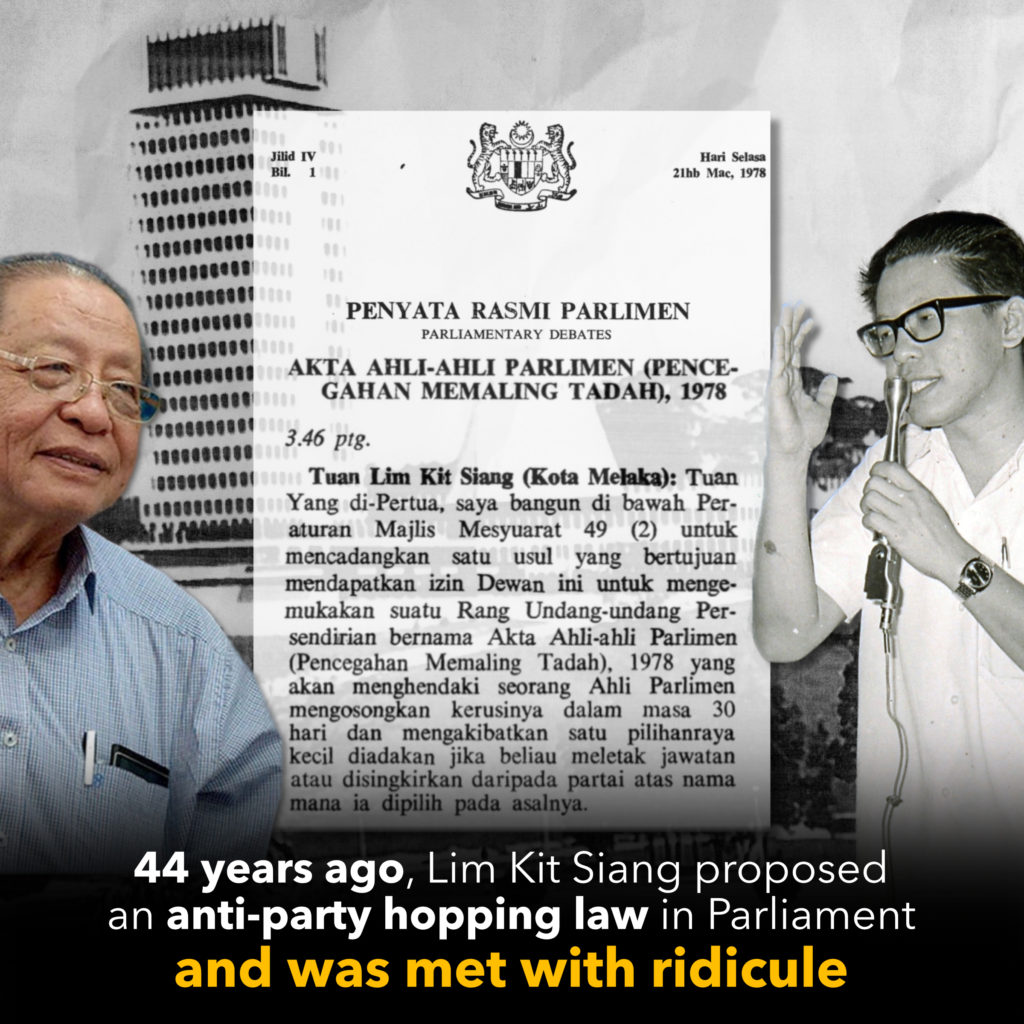
After a tumultuous period that saw Malaysia swearing-in three Prime Ministers in as many years, we may have finally found a solution that can ensure political stability: An anti-party hopping law. Poised to be tabled in the Dewan Rakyat this July, the proposed bill would undoubtedly prevent the ‘frog jumping’ disease that has been plaguing our nation.
So dire was the disease that according to de facto Law Minister Datuk Seri Dr Wan Junaidi Tuanku Jaafar, a whopping 39 MPs have switched political allegiances since 2018. A statistic that unsurprisingly played a critical part in the fall of the Pakatan Harapan (PH) government.
The push for an anti-party hopping law is also a rare bipartisan movement in Malaysia that had gained momentum over the past two years. Championed by a majority of lawmakers across the board, it was even an integral part of the unprecedented Memorandum of Understanding (MoU) between the Federal Government and PH last year.
Yet, the proposal for an anti-party hopping law or something of its ilk is not something new in Malaysia. It was even tabled as a Private Member’s Bill in the Dewan Rakyat on 21 March 1978 by then Opposition Leader and MP for Kota Melaka, Lim Kit Siang.
A man ahead of his time

The new anti-party hopping law, should it pass in Parliament must be a bittersweet moment for the veteran lawmaker. One of the longest-serving MPs in Malaysian history, Kit Siang recently announced his retirement from active politics, meaning that one of his last contributions in the Dewan Rakyat might be to vote in favour of a bill that he had tabled a variation of 44 years ago.
Looking back at his decades-long career in politics, the 81-year-old veteran lawmaker is seemingly always present in major political events in our nation’s history. While undoubtedly a divisive figure, his fiercest critics can’t deny his struggles and determination in making Malaysia a world-class nation with ideas that have been dubbed ahead of his time.
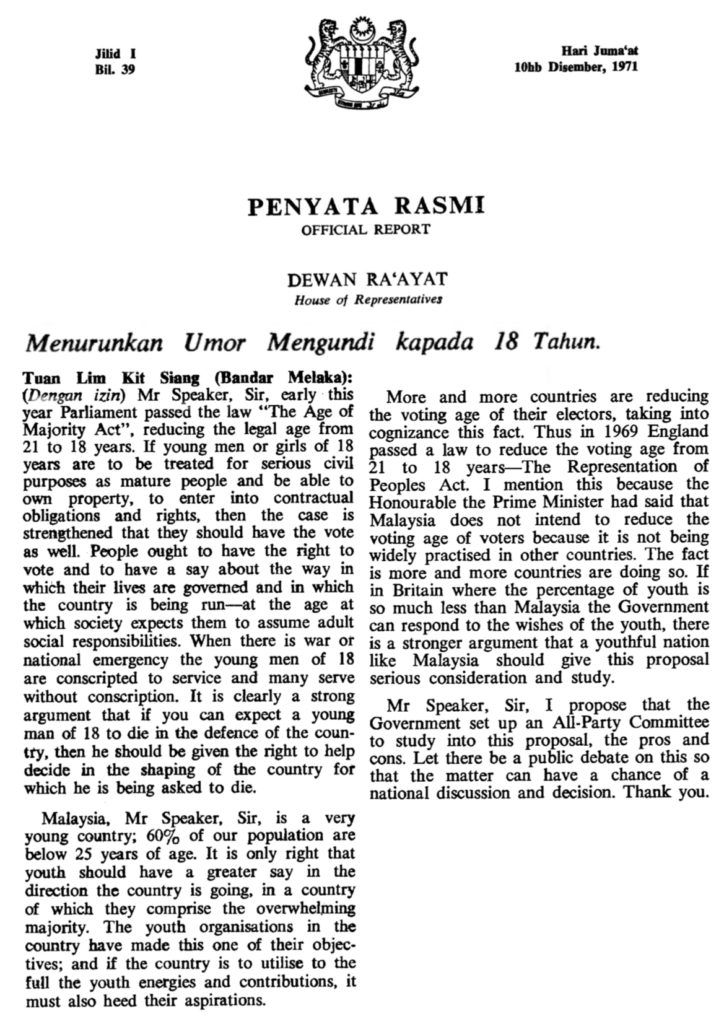
Another reform which was implemented recently – the lowering of the voting age of Malaysians – actually started 48 years ago in 1971 by none other than Kit Siang. A closer inspection of the Dewan Rakyat records on 10 December 1971 detailed the then MP for Kota Melaka’s proposal for our country to lower its voting age from 21 to 18. Kit Siang opined that such a move would help build a democratic core in Malaysia, which at that time was still a relatively new country on the global stage.
Surely, Malaysia’s political landscape would be completely different now should both of his proposals were approved by the Legislative. Well, seeing as how the anti-party hopping law is currently being discussed in the Dewan Rakyat, let’s revisit the events of 21 March 1978 when Kit Siang’s Private Bill on the matter was rejected and worse, ridiculed by the government MPs.
The historic Private Bill
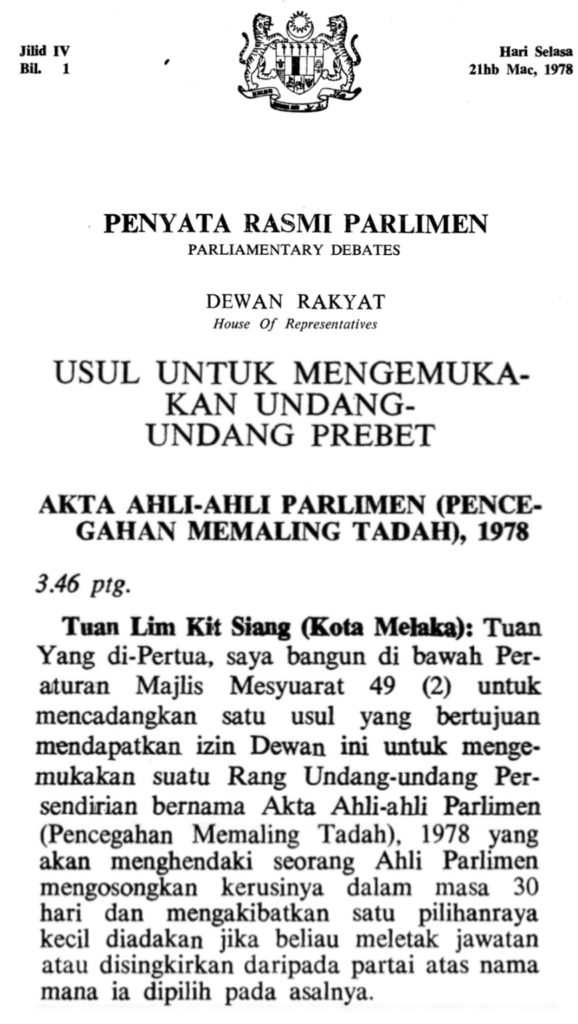
Taking the floor at 3.46 pm on 21 March 1978, Kit Siang tabled a Private Member’s Bill titled the ‘Akta Ahli-Ahli Parlimen (Pencegahan Memaling Tadah) 1978’ or the Members of Parliament Act (Defection Deterrent) 1978. The bill proposed for an MP to vacate their seat and pave way for a by-election within 30 days should they resign or be dismissed by the political party which they originally contested and won the seat with.
Kit Siang claimed that the bill was inspired by one of the questions he received from readers of Tamil Nesan, a national Tamil-language newspaper on what’s the most effective way to deal with MPs that have defected. However, the reason behind the bill may have something to do with a defection of a DAP MP during the same year, which this article will elaborate on more in-depth in the next section.
As for the motion itself, here’s the transcript of Kit Siang’s opening speech during the Parliamentary debate on the private bill:
“Nothing disgusts the Malaysian public more than to see MPs or State Assemblymen elected on one party’s ticket and then betray the Party and the people’s trust by switching parties. This makes them very little different from con-men. Such practices debase politics and strengthen the general impression that ‘politics is dirty when it is the dirty people who get into politics to make politics dirty.
“The defection of MPs or State Assemblymen from parties on whose ticket they got elected is most undesirable and unethical because they are elected not because of their personal qualities, but because of the Party they represent. Such practices also permit elected politicians to be bought and sold as if they are in the marketplace.
“If an elected MP resigns or is expelled from the Party on whose ticket he was originally elected, then he should resign his seat and cause a by-election to be held. If the resignation and expulsion are over a matter of political principle which has the support of the people, then the MP or State Assemblymen concerned should have no qualms about getting re-elected.”
The betrayal of a fellow party member
As alluded to earlier, the tabling of the anti-party hopping bill by Kit Siang in 1978 might have been a reaction to the defection of a fellow DAP MP to Barisan Nasional (BN). Well, at least that was what the defector himself, Oh Keng Seng, then MP for Petaling, claimed it to be.
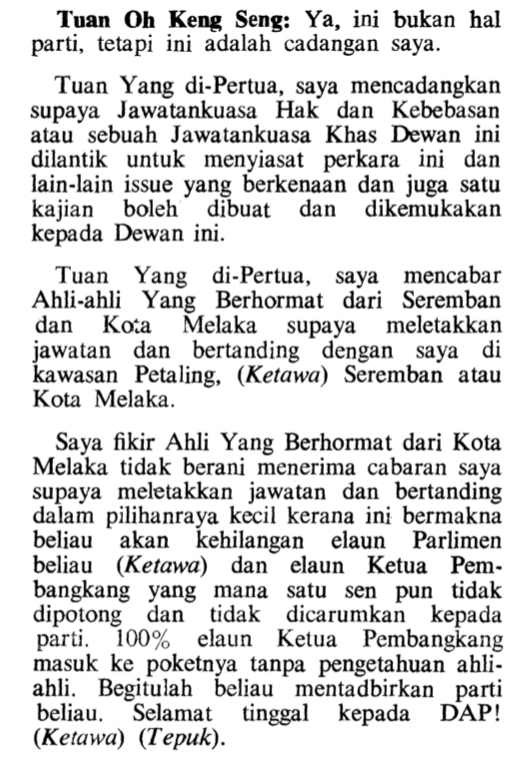
During the debate of the bill, Oh Keng Seng went into a salvo ridiculing and mocking Kit Siang over the proposal. He branded the private bill an act of panic and despair by DAP; a childish act of revenge by the party against his allegiance change to BN.
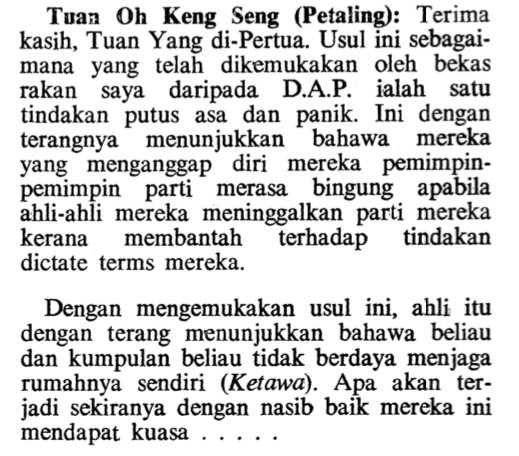
The debate somehow morphed into a personal attack from Oh Keng Seng towards Kit Siang and DAP rather than discussing the bill at hand. So much so that the then Petaling MP was even reprimanded by the Speaker.
He also made several bold, unsubstantiated claims, including how DAP allegedly dictated the terms of its members and would silence any dissenting voices such as himself, accused Kit Siang of receiving ‘orders’ from Singapore and laughingly claimed that the then DAP Secretary-General kept 100% of his Opposition Leader allowance to himself. Calling DAP the ’Duplicity Action Party’, Oh Keng Seng accused the party failed to understand Parliamentary democracy and democracy itself.
The salvo didn’t stop there either, as Oh Keng Seng went on to call DAP hypocrites because the party itself accepted two defecting MPs in 1973 and 1974, Lim Eng Chuan and Ganga Nayar. Then at the tail-end of his speech, Oh Keng Seng challenged Kit Siang to resign from his Kota Melaka seat and contest against him at either Petaling, Seremban or Kota Melaka.
Interestingly enough, just a few months later in July 1978, Kit Siang contested in the Petaling seat held by Oh Keng Seng in the 5th General Election (GE5) and won by a 16,754 majority. Furthermore, Oh Keng Seng didn’t even contest against Kit Siang in Petaling during GE5 with BN fielding Yeoh Poh San instead.
An MP for only one term from 1974 to 1978, Oh Keng Seng never won a Parliamentary seat since. However, he did continue his feud with Kit Siang over the years, including lodging a police report against Kit Siang in 2008.
Other MPs’ reactions to the Private Member’s Bill
Circling back to the Parliamentary debate in 1978, other MPs also participated in the discussion. Nilam Puri MP Datuk Haji Mohd. Asri bin Haji Muda from PAS supported the motion, saying that the bill aligned with the principles of democracy.
Meanwhile, Pontian MP Tuan Haji Ikhwan bin Nasir viewed the motion negatively, saying that such a law would create disorder. The discussion was also made more lively by Kepala Batas MP Datuk Mohamed Sopiee bin Sheikh Ibrahim who stood up and protested the Speaker a few times for not allowing him to speak for more than 10 minutes; without actually contributing anything meaningful to the discussion in the time allocated to him.
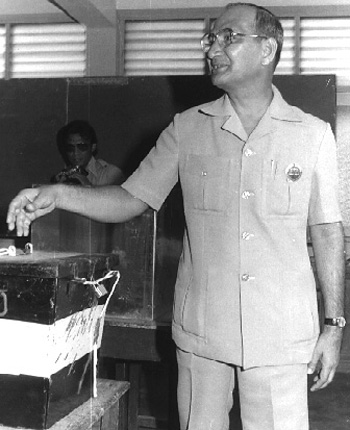
However, the most notable response was from then Prime Minister Tun Hussein Onn who commented that the bill would be ultra vires to the Federal Constitution if passed. He argued that the bill touched upon the disqualification of an MP, which is governed under Article 48 of the Constitution. Speaking of which, such a question of ultra vires or exceeding its powers is still being debated in regards to the latest anti-party hopping bill.
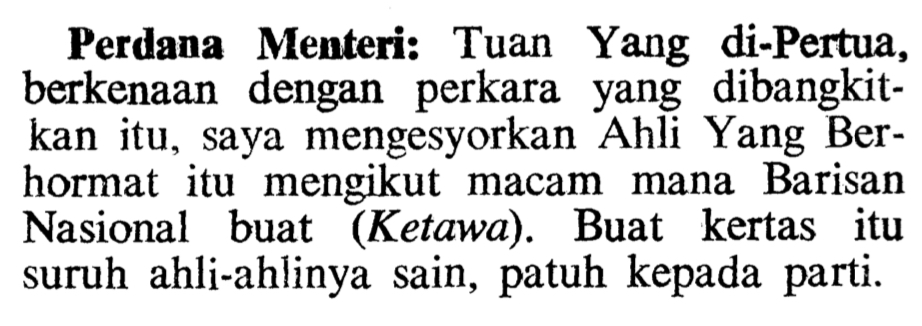
Going back to the 1978 Parliamentary debate, the late Tun Hussein Onn laughingly suggested at its tail-end of discussion for Kit Siang to order his party members to follow UMNO and BN’s practice of making it mandatory for its election candidates to sign a resignation letter which the party would use against them should they defect. However, Kit Siang argued that such secret agreements are undemocratic and against the rule of law.
Ultimately, the bill didn’t get enough support during voting. It was, therefore, defeated.
Will the anti-party hopping bill ever be passed?
Fast forward to 2022, another anti-party hopping bill is currently in the works, though its tabling had been worryingly delayed a few times. Much like the Private Member’s Bill tabled by Kit Siang in 1978, there are legitimate concerns as to whether such a law would be ultra vires to the Federal Constitution.
Specifically, the proposed bill would be ultra vires to Article 48 – as brought up by Tun Hussein Onn in 1978 – as well as to Article 10 of the Federal Constitution. Hence, a bill to amend the Federal Constitution will be tabled first so that the anti-party hopping law can proceed.
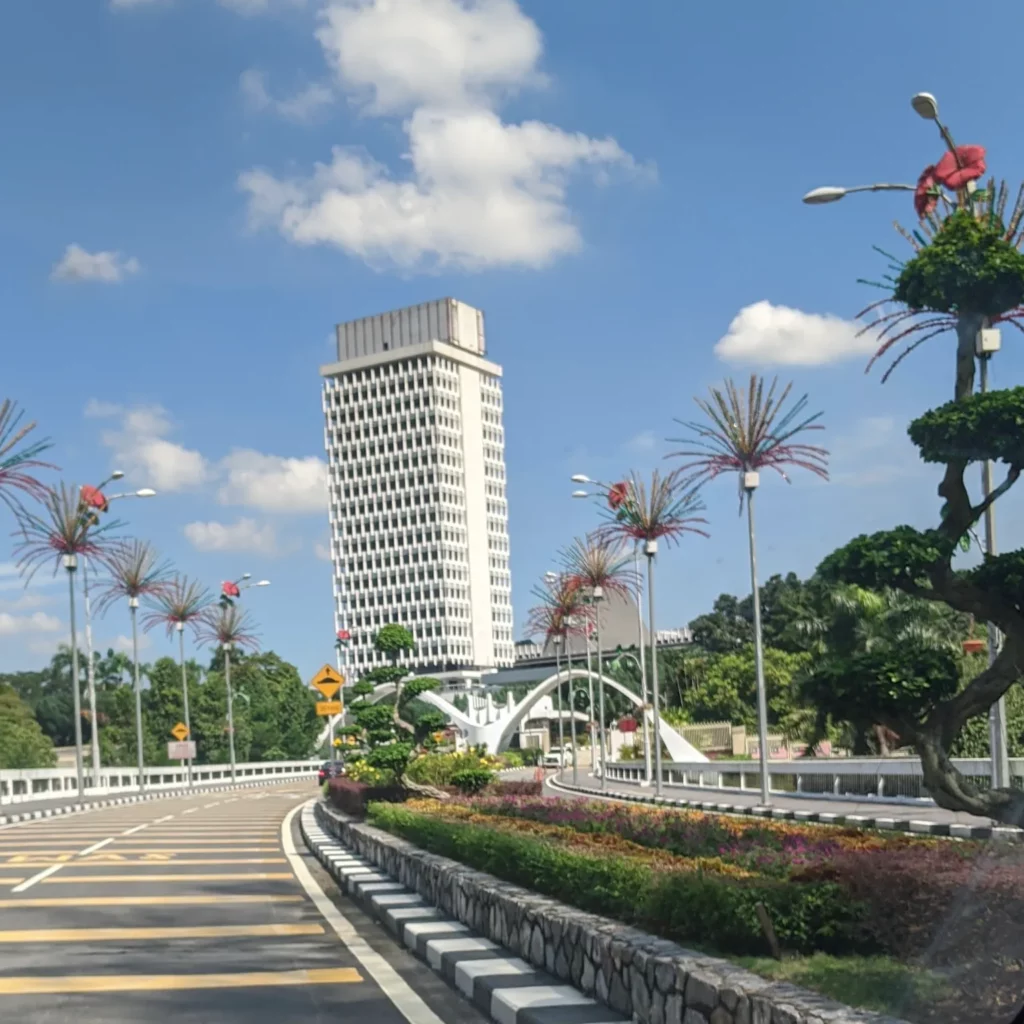
Though, with an amendment to the Federal Constitution requiring two-thirds support from MPs, there are legitimate concerns as to whether it would succeed. There are no guarantees that the required number of MPs would support the amendment, regardless of the MoU between the Federal Government and PH. Heck, the amendment could fail simply by MPs not turning up or skipping the session.
However, seeing as to how a Federal Constitution amendment was successful recently in returning the status of Sabah and Sarawak as equal partners, maybe such concerns of the anti-party hopping law failing are unfounded. One thing’s for sure though, the proposed new law – should it ever be passed – would definitely make our political scene more stable and something that has been pushed for by lawmakers and the general public since the infamous Sheraton Move.
For Kit Siang in particular, an anti-party hopping law being passed would be one final, bittersweet achievement before calling time on his illustrious political career. A victory 44 long years in the making.
Jamie is a content writer under Headliner by Newswav, a programme where content creators get to tell their unique stories through articles and at the same time monetize their content within the Newswav app.
Register at headliner.newswav.com to become one of our content writers now!
Newswav is solely an aggregation platform and hosts the content. The views expressed and content above including media (pictures, videos, etc) were provided by the author. If you have any questions about the content, copyright or other issues of the work, please contact Newswav.
