
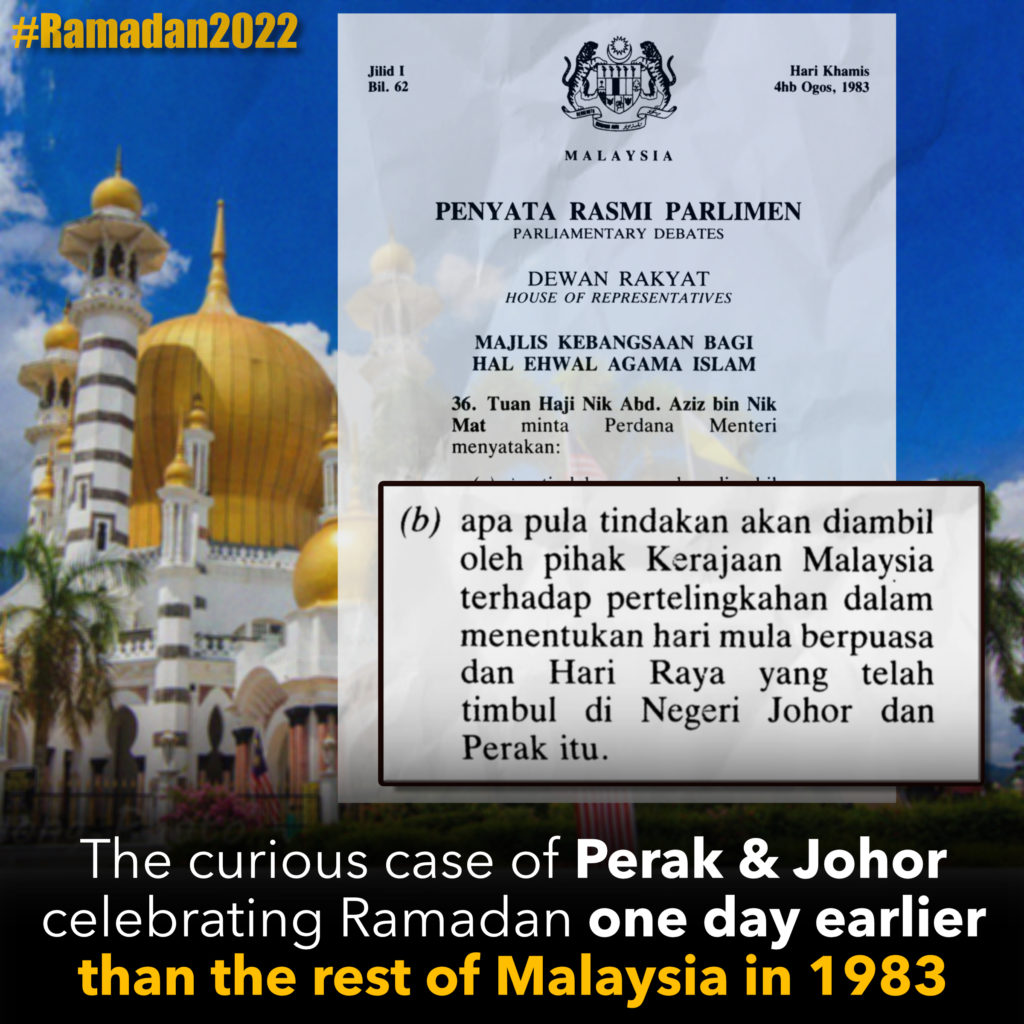
Recently, there have been a debate and speculation on social media on whether Malaysia would be celebrating Hari Raya Aidilfitri a day earlier than expected, hence making the fasting period for #Ramadan2022 also shorter by one day. As reported by Utusan Malaysia, the debate came about due to a viral posting on WhatsApp which alleged that Muslims in Malaysia will be celebrating the first day of the month of Syawal (which Hari Raya takes place on) this Monday (2 May 2022) instead of Tuesday (3 May 2022).
However, the matter has since been clarified by the former Religious Affairs Minister and former Mufti for the Federal Territories, Datuk Seri Dr Zulkifili Mohamad al-Bakri. He elaborated that the decision for when 1 Syawal will be held in Malaysia can only be decided and announced by the Conference of Rulers through the Keeper of the Rulers’ Seal. Hence, Malaysians would simply have to await the announcement from the latter, expect to be given this Saturday (30 April 2022).
Well, the uncertainty of when Hari Raya and Ramadan would be held is not new in Malaysia. Previously, there was even a ruling by the Conference of Rulers that would make the date uniformed throughout the country to avoid panic and confusion amongst the people and circumvent different states celebrating Ramadan and Hari Raya on different days.
In fact, such an occurrence actually happened in 1983 when the states of Perak and Johor celebrated Ramadan and Hari Raya one day earlier than the rest of Malaysia. The matter was discussed in the Dewan Rakyat too in the same year, with then Prime Minister Tun Mahathir Mohamad even expressing disappointment over the events that transpired.
So, what actually happened in Ramadan and Hari Raya of 1983? Here’s everything you need to know:
Methods used to determine the first day of Ramadan and Syawal
New Straits Times shared a pretty comprehensive explanation of the methods used to determine the first day of a new month in the Muslim calendar here. According to the report, the Islamic calendar is determined by the lunar cycle instead of solar as per the Gregorian calendar. Hence, the days within a month vary from 29 to 30 days.
Furthermore, since fasting starts on the first day of the month of Ramadan and Hari Raya Aidilfitri on the first day of the subsequent month of Syawal, determining both dates are important. However, doing so is not as straightforward as it sounds, as entering a new month must coincide with entering a new lunar cycle or the ‘birth’ of a new moon.
There are actually two school of thoughts on the matter, either a traditionalist or a modernist approach. Many Muslim scholars believe that a new month begins when the crescent-shaped new moon can be seen by the naked eye. That’s why on the night when the new moon is expected, Falaq Syarie (Islamic astronomy) committees will observe the hilal (the crescent moon), but even a cloudy night might affect this method.
Hence, in Malaysia, we adopt the rukyah (the sighting of the new moon with the eye after sunset) and hisab (astronomical calculations) in determining the beginning of a new month in the Islamic calendar, known as imkannur rukyah (possibility of sighting). Both methods, which combine the sunnah (exemplary customs and conducts of the Prophet Muhammad) and scientific calculations have been implemented in our country since 1992.
Confusion over the start and end of Ramadan in 1983
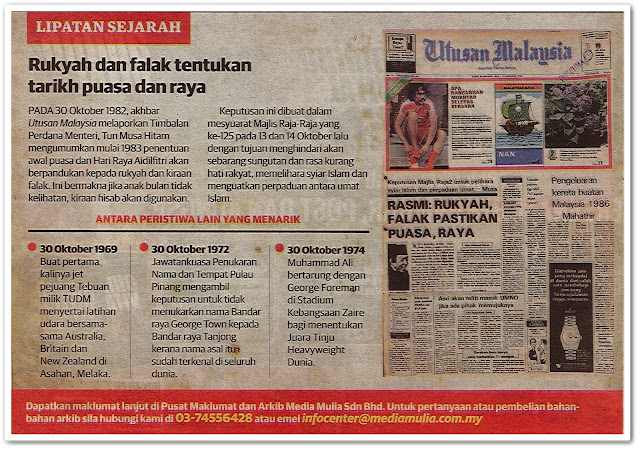
Before 1992, especially during the 1970s, the best method to determine the first day of Ramadan and Syawal was a matter of debate between Muslim Scholars in Malaysia after there was a suggestion to move from the rukyah to the rukyah together with the hisab. In a special report by Utusan Malaysia (which a web archive of can be viewed here), it detailed how confusion as to when the actual dates for 1 Ramadan and 1 Syawal caused the lack of uniformity between ASEAN countries and even states in Malaysia. The latter is because Islamic affairs are under the purview of the state and not the federal.
The Utusan Malaysia special report on 5 May 2019 then referenced the events of 13 June 1983, when the daily newspaper published a report with the headline ‘Keadaan serba salah di Johor dan Perak’ or roughly translated to English as ‘Feelings of uneasiness in Johor and Perak’. The report was regarding how both states celebrated Hari Raya one day earlier on 12 June 1983 compared to the rest of Malaysia. Moreover, both states also started fasting one day earlier than other states in the country then.
This curious event transpired despite Deputy Prime Minister at the time, Tun Musa Hitam actually announcing a year prior in 1982 that starting in 1983, the Conference of Rulers has agreed for hisab to be used as a method to determine the starting date of Ramadan and Syawal when the moon can’t be seen. It was meant to make the dates uniformed but for some undisclosed reason, both Johor and Perak didn’t adhere to the new ruling.
A quick Google search on why both states did so would yield similar stories, such as this article by Soscili about how both states allegedly saw the new moon earlier than expected, hence why the start of Ramadan and Syawal was one day early in both states. However, all of the articles didn’t provide any credible sources to back the claim.
Nevertheless, since 1983, the Malay Rulers agreed for the Yang di-Pertuan Agong to decide on the dates of 1 Ramadan and 1 Syawal and it would be uniformed for the whole country. This is in accordance with Article 38 (2) (b) of the Federal Constitution which prescribes that “the Conference of Rulers shall exercise its functions of (b) agreeing or disagreeing to the extension of any religious acts, observances or ceremonies to the Federation as a whole.”.
The above was shared by Datuk Seri Syed Danial Syed Ahmad, the then Keeper of the Rulers’ Seal during a 2014 interview with Bernama.
Reactions by the Dewan Rakyat
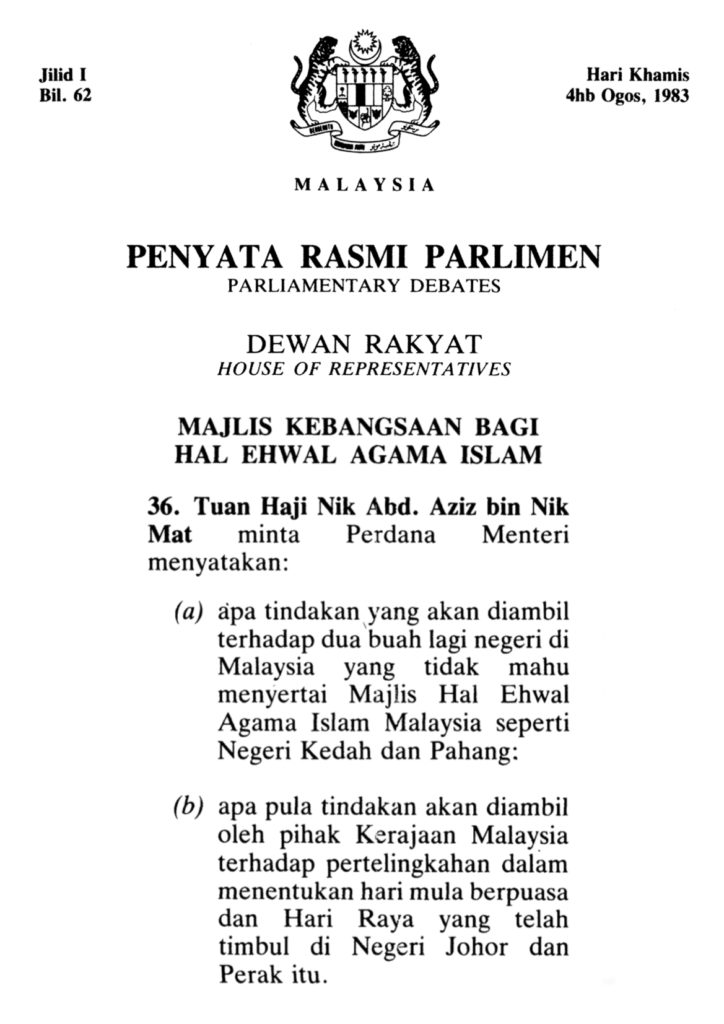
Of course, such an occurrence also caught the attention of lawmakers who discussed the matter briefly in the Dewan Rakyat on 4 August 1983. During a Minister question and answer session on that day, then Pengkalan Chepa Member of Parliament (MP), the late Nik Aziz asked the Prime Minister to elaborate on the actions taken by the federal government on the ‘quarrel’ of determining the first day of Ramadan and Hari Raya by the states of Johor and Perak.
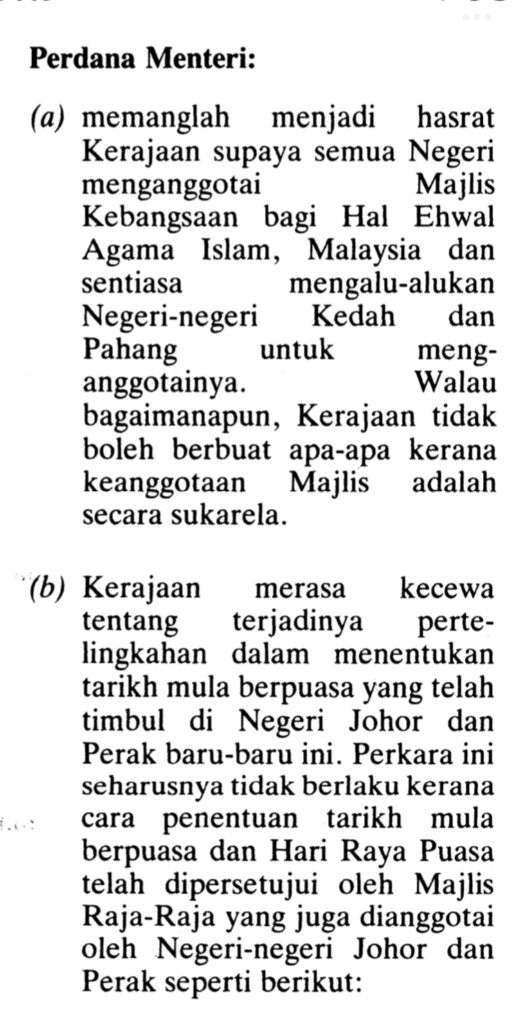
Tun Mahathir, who was serving his first term as Prime Minister during that time answered the question by saying that the federal government was disappointed with the matter. He further elaborated that such an incident should never have transpired as the methods in determining the start of Ramadan and Syawal (as mentioned before) were already agreed upon by the Conference of Rulers, of which both states are a part.
Thankfully, such a peculiar occurrence never happened in our nation again. Hence, this Hari Raya Aidilfitri, let’s be thankful that our date for the celebration has been uniformed, if not, then maybe a lot of people will be flocking to Perak and Johor to celebrate Raya a bit early.
For all the Muslims out there, I would like to wish Selamat Hari Raya Aidilfitri! <3
Jamie is a content writer under Headliner by Newswav, a programme where content creators get to tell their unique stories through articles and at the same time monetize their content within the Newswav app.
Register at headliner.newswav.com to become one of our content writers now!
Newswav is solely an aggregation platform and hosts the content. The views expressed and content above including media (pictures, videos, etc) were provided by the author. If you have any questions about the content, copyright or other issues of the work, please contact Newswav.
