
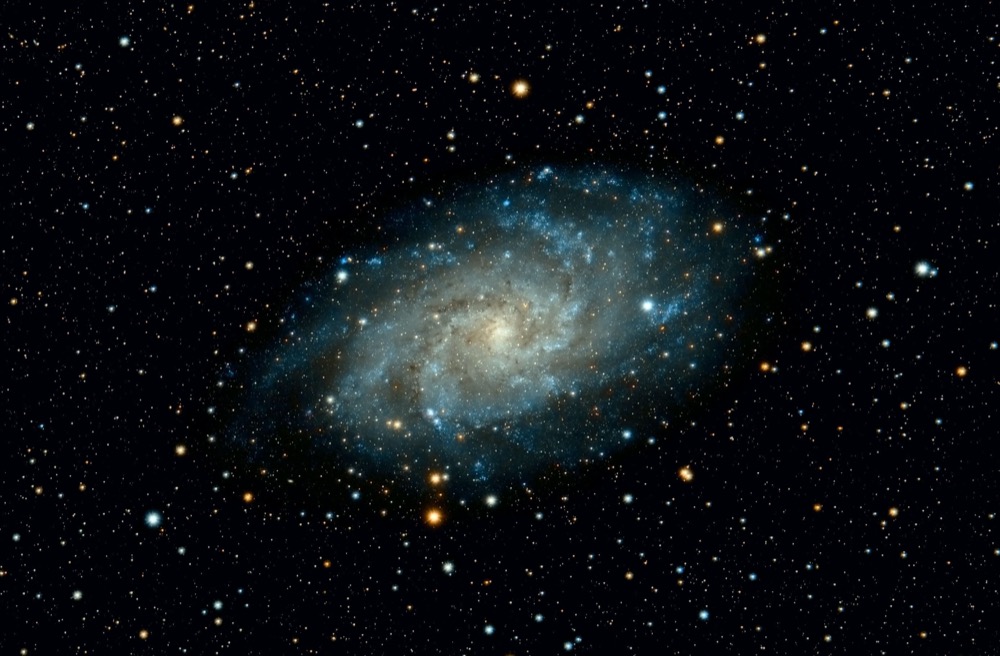
A vast cosmic formation known as the Big Ring has been detected deep in space, stretching about 1.3 billion light-years across and challenging current ideas about how matter is distributed on the largest scales. The structure, reported in work led by astronomer Alexia Lopez of the University of Central Lancashire, appears in the same region of the sky as another enormous feature, the Giant Arc. Both lie at similar distances, adding weight to the mystery.
The light used to map this region has traveled for roughly 6.9 billion years, placing the observation in a distant era of cosmic history. At such scales, the universe is expected to look broadly uniform, without sharply defined patterns that persist over extreme distances.
That expectation is tied to the cosmological principle, which holds that the universe should appear statistically similar in every direction when viewed on very large scales. When structures appear to stretch beyond predicted limits, they force scientists to re-examine both observational data and theoretical boundaries.
A Structure That Resists Simple Classification
The Big Ring was identified through large-scale galaxy mapping work led by Alexia Lopez, with results presented at the 243rd meeting of the American Astronomical Society and later published in the Journal of Cosmology and Astroparticle Physics.
The structure spans approximately 1.3 billion light-years and appears as a near-circular arrangement of galaxies in three-dimensional reconstructions of the sky. Lopez described the finding as difficult to reconcile with current models, noting in a statement from the University of Central Lancashire (UCLan) that:
“Neither of these two ultra-large structures is easy to explain in our current understanding of the universe.”
The Big Ring is not an isolated case. It lies in the same region of the sky as the Giant Arc, first identified in 2021 by the same research team. Both structures sit at comparable distances, forming a spatial pairing that has drawn attention from cosmologists studying the largest known formations in the universe.
When Observations Press Against Theory
Standard cosmological models predict that matter should appear increasingly homogeneous at sufficiently large scales. Estimates cited in the paper place the theoretical upper limit for coherent structures at around 1.2 billion light-years.
The Big Ring, at about 1.3 billion light-years, exceeds that threshold, while the Giant Arc extends across an even larger span. This places both structures at or beyond the range where current theory expects large-scale irregularities to disappear.
A useful point of comparison is the baryon acoustic oscillation (BAO) pattern, which forms spherical distributions of galaxies created by pressure waves in the early universe. BAOs tend to follow a consistent scale and are well integrated into the standard model. The Big Ring, however, does not match this structure. Instead, analysis suggests it may reflect a more complex geometry, possibly appearing ring-shaped due to projection effects of a three-dimensional configuration.
Interpretations Still Under Debate
No consensus explanation exists for the Big Ring. One straightforward possibility is that it represents arare statistical fluctuation, an unusual alignment of galaxies that becomes visible only at extreme scales of observation.
Other interpretations reach into more theoretical physics. The idea of cosmic strings, hypothetical spacetime defects formed in the early universe, has been mentioned in relation to such anomalies. These structures, if they exist, could influence the distribution of matter across vast distances.
Another framework sometimes discussed is conformal cyclic cosmology, proposed by Roger Penrose, which describes a universe undergoing repeated cycles of expansion. In that scenario, large-scale patterns like rings could emerge under specific conditions, although the model remains debated and not widely accepted in its full form. Lopez and her team explained that structures of this size were not expected under current theoretical limits.
“From current cosmological theories we didn’t think structures on this scale were possible. We could expect maybe one exceedingly large structure in all our observable universe. Yet, the Big Ring and the Giant Arc are two huge structures and are even cosmological neighbours, which is extraordinarily fascinating,” she said.
The fact that the Big Ring and the Giant Arc appear in the same cosmic region adds an extra layer of complexity that standard models do not easily resolve.
