
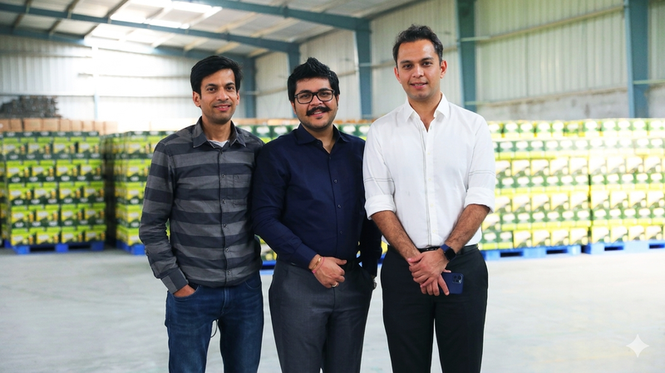
When they started their venture in 2017, their only aim was to capture the local Tricity market, and perhaps eventually Punjab. Today, Chandigarh’s home-grown brand, Lahori Zeera, co-founded by three cousins — Saurabh Munjal, Saurabh (Sunny) Bhutna and Nikhil Doda — is selling across 21 states of India. And this summer, Andhra Pradesh, Karnataka and Telangana have been added to this expanding list. The company, Archian Foods Private Limited, also has plans to launch their product in Sri Lanka and Gulf Cooperation Council (GCC) countries next year, especially the UAE and Saudi Arabia, which has a large diaspora population and hot weather similar to India.
The journey
Saurabh and Nikhil were on the lookout for a new business venture, as their earlier one, a restaurant Heritage Haveli, Ropar, was running smoothly. When Sunny came back from Surat, the three decided to join hands.
Because of their prior experience, they wanted to focus on food and beverages only. Nikhil’s father used to own a small business, selling cola and orange flavours in rural markets around the Tricity. His knowledge about beverage formulations was immense. The cousins used it to their advantage. “There was no ethnic or desi flavour in the fizzy drink market. There were only colas, and India was consuming something that was not natural to them but because these were available, hygienic and convenient,” says Saurabh.
After a 10-month research, the cousins were clear that their product would be different than these colas and have a taste that India could identify with easily — sweet, sour, spicy, something like the golgappa water. “In the past 15-20 years, hardly any new flavours have been launched in India that had a mass connect. Moreover, people had an unhealthy perception about carbonated drinks. We wanted to change that, and decided to add natural ingredients to our fizzy drink. My father created a formulation using sugar, sendha namak, zeera, kali mirch and lemon juice. Also, it was not a just a sugary drink like other colas, but had electrolytes as well,” adds Nikhil. The flavours of India were ready to be bottled.
Because it was a drink for the masses, they were clear about the price point — Rs 10. All other logistics were worked backwards to make this price viable. Initially, a 200-ml bottle, the pet bottle now contains 160-ml drink. “We borrowed around Rs 5 crore from the family, loans were not allowed. So the only option was to manufacture it ourselves. There was simply no money for marketing,” recalls Saurabh.
They made a few batches initially in their home kitchen and took it distributors, retailers, highway dhabas, local kirana stores, even auto wallahs for tasting. Everyone liked it and distributors assured them that it would sell. Encouraged, the brothers bought a small semi-automatic machine that had the capacity to produce 96,000 bottles a day. “We took our first truck to a distributor, the same one who had assured us of our drink’s sale, and asked for an advance. He said leave your product and collect your money if it sells,” recalls Sunny.
That was their first jolt. The cousins were already working with bare-minimum capital money and selling on credit was not an option. “We directly went to the retailers to sell our product. They were happy to pick up a crate for Rs 200,” adds Sunny.
Because in that Rs 10 price point they had built-in the maximum margin for the retailer and the distributor. “By selling a bottle of branded cola in Rs 20 category, the retailer was barely getting a profit of 50 paise. We were giving a margin of Rs 2 per bottle,” says Nikhil. For around five months, they went selling retailer to retailer, but when customers started asking for it, the distributors came on board. The supply chain became their marketing team. Because of its no-credit policy, the company has been profitable from day 1.
The expansion
By 2019, Lahori Zeera was selling all across Punjab. Like most FMCG companies, the 2020 lockdown was profitable for the cousins as well. They expanded their manufacturing capacity, which till date has not been able to match the demand, such is the popularity of their flagship product. With expanding footprint and increasing revenue, Belgian fund Verlinvest offered to invest in their brand. Till then, the young founders had either borrowed money from the family or put back the profits into the company. “We did not know that one could raise funds like this. I actually asked them how much interest would they charge,” laughs Saurabh.
The funds helped them resolve their biggest bottleneck — the production capacity. They also added another plant in Gujarat.
Last year in May, Motilal Oswal Wealth invested Rs 200 crore in the company bringing its valuation to Rs 2,800 crore, according to market reports. One of the most unique aspects has been the brand’s marketing strategy. Till 2023, the company had spent zero rupees on promotion and publicity. “In the initial days, we had no money to spend on marketing. And we were confident that if our product, which is reasonably priced, tastes good, it will sell,” says Nikhil. And it did — by the word of mouth.
The company also has no brand ambassador. “Because every Indian is our brand ambassador,” says Saurabh.
In 2023, the brand created its first ad campaign and another one last year. The campaign has won some major national and international awards. The company has also co-sponsored the last two seasons of ‘Shark Tank’. Aware of its social and ecological responsibility, it also recycles 40 per cent of the plastic used at its plants.
Market disruptors
For MNC brands, perhaps the realisation that this local-but-no-longer-regional brand has become competition came when it got its first funding from Verlinvest. After it became a private limited company from a partnership firm, its numbers became public for everyone to notice. In fact, when the company’s revenue crossed over Rs 300 crore, a multinational beverage brand even did a survey among its retailers about the number of Lahori Zeera bottles sold vis a vis other fizzy drinks.
In fact, the brand’s growing capacity and retail reach did not just attract eyeballs. The company also started attracting leadership talent from these legacy brands. Many of Lahori Zeera’s senior sales and marketing personnel were earlier working with brands like Coca-Cola and Parle.
In recent years, the brand’s significant market capture in India’s $19.5 billion (Rs 1.72 lakh crore) fizzy drink market and widening distribution network has forced MNC brands like Coca-Cola, PepsiCo and other legacy brands such as Dabur India, Parle Agro and Campa Cola (owned by Reliance Consumer Products Limited) to launch their own ‘jeera’ versions at a similar price and quantity.
PepsiCo recently came out with Nimbooz Jeera Soda, Coca-Cola relaunched Rimzim, Campa Cola has Jeera Up in the same category, while Parle Agro’s Dhishoom is also a jeera masala soda drink. In fact, Dabur India, the market leader in India’s packaged fruit juice segment, has for the first time come up with a carbonated drink called, Hajmola Yoodley which has ingredients like sendha and kala namak, and of course jeera. Another market leader, Bisleri, which commands nearly 36 per cent share in the packaged drinking water segment, has also launched for the first time a jeera soda drink, called Bisleri Spyci Jeera. The most flattering part — the beverages launched by these brands have the same signature colour as Lahori Zeera’s bottle.
Though the company has launched other flavours like shikanji, nimboo, masala cola, minty lemon and kacha aam, but Lahori Zeera remains their flagship product. “It has such a high demand that we don’t have the capacity to manufacture other flavours,” says Saurabh.
The company that started with barely 15 persons now has a staff strength of over 3,500. It also owns three plants across India at Ropar, Vapi (Gujarat), and Lucknow, and has contract manufacturing facilities in most other states, a model they are planning to replicate in Sri Lanka and GCC countries. From bottling 1 lakh bottles a day to 1 crore bottles a day, and still falling short, what has taken a start-up from a Rs 19-crore revenue to Rs 775 crore revenue in less than 10 years? In cousins’ own words, “Conviction to back Indian tastes before these were mainstream; discipline, consistency and a commitment to never lose the soul of the brand while growing.”
The Lahore connection
A desi name was inevitable for this traditional drink. “We wanted to call it Amritsari Zeera initially because of its famous street food culture. But it was a mouthful and not poetic enough. Then someone mentioned that sendha namak, that adds to the flavour of our drink, is called Lahori namak. And that was it — it had a mystique; it was poetic, and because initially we wanted to build a brand for Punjab, Lahori Zeera was born,” says Saurabh Munjal, one of the co-founders of the brand.