

Putrajaya has come under heavy fire from experts, analysts, and think tanks for giving the nod to the U.S.-Malaysia Agreement on Reciprocal Trade (ART).
The ART was recently concluded by both countries on the sidelines of the ASEAN Summit. Government leaders have defended the deal in Parliament and outside, with Prime Minister Anwar Ibrahim saying that criticism against the deal is "simply political".
The ART contains some controversial clauses which fuel debate on Malaysia's sovereignty over trade, borders, digital policy and sanctions. Critics have pointed to 𝐀𝐫𝐭𝐢𝐜𝐥𝐞 𝟐.𝟓, 𝐀𝐫𝐭𝐢𝐜𝐥𝐞 𝟐.𝟔.𝟏, 𝐀𝐫𝐭𝐢𝐜𝐥𝐞 𝟐.𝟕, 𝐀𝐫𝐭𝐢𝐜𝐥𝐞 𝟐.𝟏𝟏, 𝐀𝐫𝐭𝐢𝐜𝐥𝐞 𝟐.𝟏𝟕.𝟐 and 𝐀𝐫𝐭𝐢𝐜𝐥𝐞 𝟐.𝟐𝟎 as the most critical part of the deal.
Aside from Perikatan Nasional, the agreement has also drawn criticism from various quarters both within Malaysia and abroad.
1. Tun Dr Mahathir, former PM:
"It is a submission of our economic freedom which we have worked hard to protect and build.
We agree to buy their airplanes, gas and machines, obey their digital rules, that they have the first bite of the cherry of our rare minerals, open our market on their terms and follow their conditions on who we can do or not do business with.
All these for a tariff relief which is merely crumbs."
2. Dr Muhammed Abdul Khalid, Economist and former Khazanah Research Director
"What is absolutely not normal and unprecedented in our nation's history is for the government of Malaysia to sign an agreement that mandates Petronas to purchase LNG from the US.
No previous government in any of our free trade agreements with other countries ever accepted such a term. His defence is not just wrong - it is a blatant attempt to hide a terrible concession."
3. Consumers’ Association of Penang, NGO
"Malaysia commits to purchase US$150 billion worth of American goods over five years—semiconductors, data centres equipment, aircraft, coal, and gas—plus an additional US$70 billion in investments in the U.S over ten years.
More seriously, this spending will plunge Malaysia into massive current account deficits. Our economists warn that Malaysia will face annual deficits of approximately US$23 billion, accumulating to US$115 billion over five years.
We have seen this movie before. In the 1990s, Malaysia ran similar deficits—totalling US$33.5 billion from 1990 to 1997—which contributed to the Asian Financial Crisis of 1997. That crisis devastated our economy and caused immense suffering. We cannot repeat that mistake."
4. Aliran, NGO
"We fear the nature of this agreement could resemble historical colonial patterns: developing nations surrender sovereignty, natural resources and policy flexibility to major powers in exchange for limited market access. Indeed, the office of the US trade representative states of the agreement with Malaysia: “Today’s announcement shows that America can defend its domestic production while obtaining expansive market access with our trading partners.”
5. The Institute for Democracy and Economic Affairs (IDEAS), think tank
“Conversely, the agreement constrains Malaysia’s capacity to forge wider trade partnerships. It ties future trade and investment policies to America’s strategic interests and guarantees equivalent trade policy treatment for the United States in future industries such as digital services.
While Malaysia was not alone in pursuing a bilateral deal with Washington, doing so prioritised individual over collective interest and diverted diplomatic resources away from securing deeper partnerships with countries that are more closely aligned with Malaysia’s economic development interests.”
6. Majlis Tindakan Ekonomi Melayu, trade group
“State-owned enterprises are not merely commercial entities but national policy instruments. Therefore, curbing the autonomy of these enterprises in supporting Bumiputera policies is a form of intervention in our national economic policies."
7. Hanipa Maidin, former deputy Law Minister
"When Article 5.1, inter alia, states - “If the US imposes a customs duty, quota, prohibition, fee, charge, or other import restriction on a good or service of a third country and considers that such a measure is relevant to protecting the economic or national security of the US...” - I really have difficulty rationalising Zafrul’s reason.
The minister also asserted that “the text spells out that such measures are to address a shared economic or national security concern and the keyword is ‘shared’. If it only affects US economic and national security, but doesn’t impact Malaysia... we don’t need to consider it.”
With due respect, I don't think the clause evinces the meaning as ventilated by Zafrul. The clause is too clear, favouring the US, thus it is only interested in protecting the economic or national security of the US and not Malaysia."
8. Bilahari Kausikan, former Singapore diplomat
I was surprised that Malaysia agreed to some provisions that seem to give the US a veto over some aspects of Malaysian trade policy, limit its freedom of manoeuvre in other aspects, and could even be interpreted as placing restraints on the Bumiputra policy.
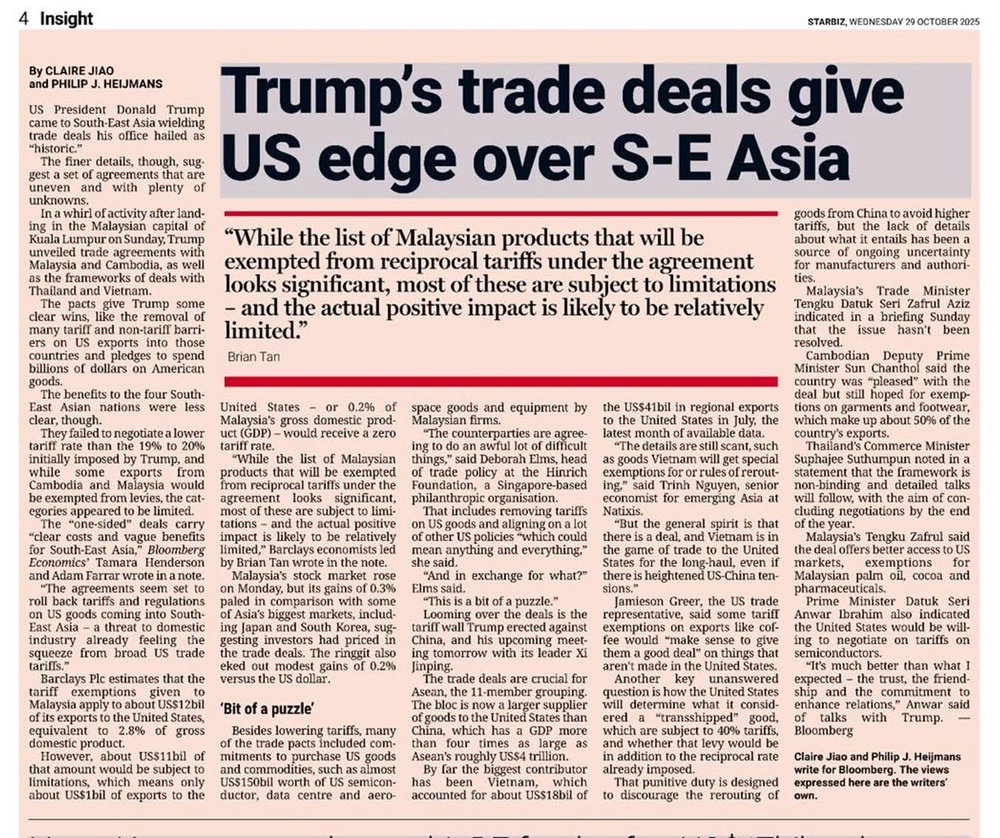
9. Bloomberg, media company
“While the list of Malaysian products that will be exempted from reciprocal tariffs under the agreement looks significant, most of these are subject to limitations- and the actual positive impact is likely to be relatively limited.”
10. Daniel Kritenbrink, a former U.S. assistant secretary of state for East Asia and Pacific affairs
"The U.S. is expected to use the Malaysia deal as a model, and as a means for pressuring the rest of Southeast Asia to conclude similar deals."
Ahmad Mustakim (ahmadmustakim.92@gmail.com) is a content creator under the Newswav Creator programme, where you get to express yourself, be a citizen journalist, and at the same time monetize your content & reach millions of users on Newswav. Log in to creator.newswav.com and become a Newswav Creator now!
The User Content (as defined on Newswav Terms of Use) above including the views expressed and media (pictures, videos, citations etc) were submitted & posted by the author. Newswav is solely an aggregation platform that hosts the User Content. If you have any questions about the content, copyright or other issues of the work, please contact creator@newswav.com.
