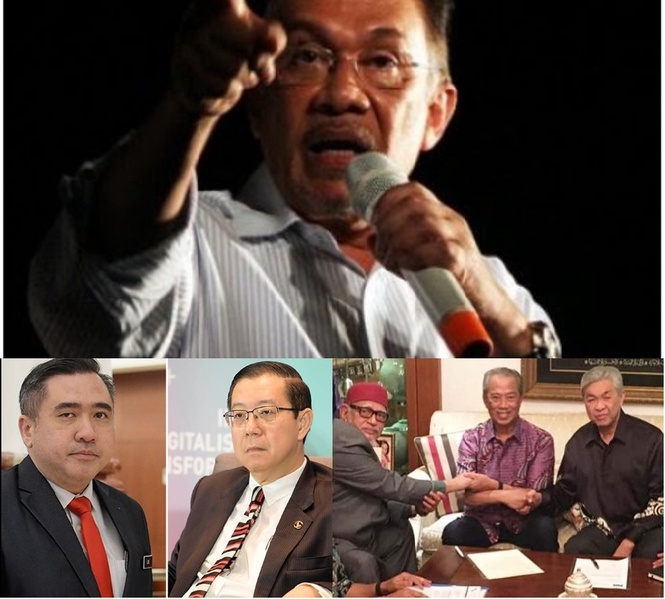
At a fundamental level, the reason for the interminable political instability in Malaysia is due to the imbalance created by a Superchinese party and Supermalay coalition at the opposite end of the political divide.
A lot of Malaysians don’t like to admit it, because it makes it sound as if Malaysians are a people who are absorbed with the subject of race, but it is what it is.
In 2018, PH, which is primarily composed of the Superchinese DAP party and its weaker Malay counterpart PKR, won the 14th general election and formed the government.
The fact that the 2018 PH coalition was seen to be controlled by the Superchinese DAP party then generated a counteraction by the Malays, who organized the Sheraton move, which toppled the PH government and established a Supermalay government, composed of Bersatu, Umno, and Pas, that was headed by Muhyiddin Yassin, and later on Ismail Sabri.
Umno broke off from the Supermalay coalition prior to the 15th general election, but the Supermalay coalition, composed of PAS and Bersatu, remained intact.
The 15th general election saw a contest between the Supermalay PN on one side and the Superchinese DAP on the other. The result saw PH, which is the coalition that the Superchinese DAP is a part of, winning narrowly against the Supermalay PN.
This victory, however, still has not resolved the political impasse in the country, because the imbalance created by having a Superchinese party at one end and a Supermalay coalition at the other end still remains.
This political impasse and its resultant instability are not going to end as long as we have a Superchinese party on one end and a Supermalay coalition on the other, contending with each other.
We can talk until the cows come home as to why this should not be the case, but at the end of the day, this is the cold hard truth.
If we want to resolve this impasse, the only way to do it is to fix the imbalance.
To fix it, there are several ways.
The first way is to create a Supermalay party in the unity government by merging PKR and Umno. If PKR and Umno merge into a Supermalay party, PH will no longer be seen as a coalition that is dominated by the Superchinese DAP.
The second way is to split the Superchinese DAP party into two or encourage a sufficient number of Chinese electorates to throw their support behind another Chinese party like MCA. If DAP breaks into two or if Chinese support is split into two, then DAP will not be the dominant SuperChinese party in PH. Without a Superchinese Dap to justify its existence, the Supermalay PN will also break up into its elemental parties.
The third way is to create a dictatorship that will fix the imbalance by doing away with party politics altogether.
Most democratic countries in the world will eventually settle into a bipartisan political structure.
In the US, we have the Republicans and Democrats.
In the UK, it is Labour and the Conservatives.
In Malaysia however, there is an additional criterion to having a stable bipartisan political structure, which is that both the parties or coalitions in the bipartisan structure will have to be racially balanced.
Currently, the problem with the political arrangement in the peninsula is that we have too many Malay or Malay majority parties and too few Chinese or Chinese majority parties. (We also do not have any Indian or Indian majority parties, but this is a lesser problem because Indians are not a significant factor in the political arrangement in the peninsular)
To fix the problem, we need to either reduce the number of Malay and Malay majority parties or increase the number of Chinese or Chinese majority parties or both.
Ideally, I think that we should have 2, or at most 3, Malay or Malay majority parties, 2 Chinese or Chinese majority parties and perhaps one Indian or Indian majority party.
Such a political arrangement will likely result in us having two Malay-Chinese coalitions, each on the opposite side of the political divide, that can balance our political system the way the Republicans and Democrats, or Labour and Conservatives, balance the American and British political system.
An ideologically free Indian or Indian-based party could also be useful to further stabilize the arrangement, if the Indian party attaches itself to whichever of the Malay-Chinese coalition is stronger, to secure its rule.
Our political instability will only be fixed if we can do this.
The idea that we can convince the Malays to abide by a coalition where a SuperChinese party is the dominant player or for the non-Malays to accept a Supermalay coalition is not realistic. It is not going to happen.
If we cannot reduce the number of Malay parties and increase the number of Chinese parties, then our only other option is to throw our support behind a dictatorship that will end the need to rely on party-based politics.
Dictators or what is euphemistically called an authoritarian ruler, are often required to stabilize the politics in Southeast Asian countries. Whether it be Lee Kuan Yew or Mahathir during his first tenure or Duterte, a benevolent despot is a feature that most Southeast Asian societies have relied on to bring stability to their politics and society, while providing the stage for the economy to function smoothly.
These are our only realistic solutions to our current political problem.
Nehru Sathiamoorthy was a columnist at FMT, a frequent contributor to the South China Morning Post, a mathematics teacher in the Klang Valley, and a seeker of the meaning of life. So far, there are three things that he holds to be unequivocally true. The first is that the purpose of life is to pursue happiness, the second is that you cannot be happy unless you carry your fair share of the world's weight and the third is that you can never underestimate your ability to take your own side.
TheRealNehruism is a content creator under the Newswav Creator programme, where you get to express yourself, be a citizen journalist, and at the same time monetize your content & reach millions of users on Newswav. Log in to creator.newswav.com and become a Newswav Creator now!
The User Content (as defined on Newswav Terms of Use) above including the views expressed and media (pictures, videos, citations etc) were submitted & posted by the author. Newswav is solely an aggregation platform that hosts the User Content. If you have any questions about the content, copyright or other issues of the work, please contact Newswav.