
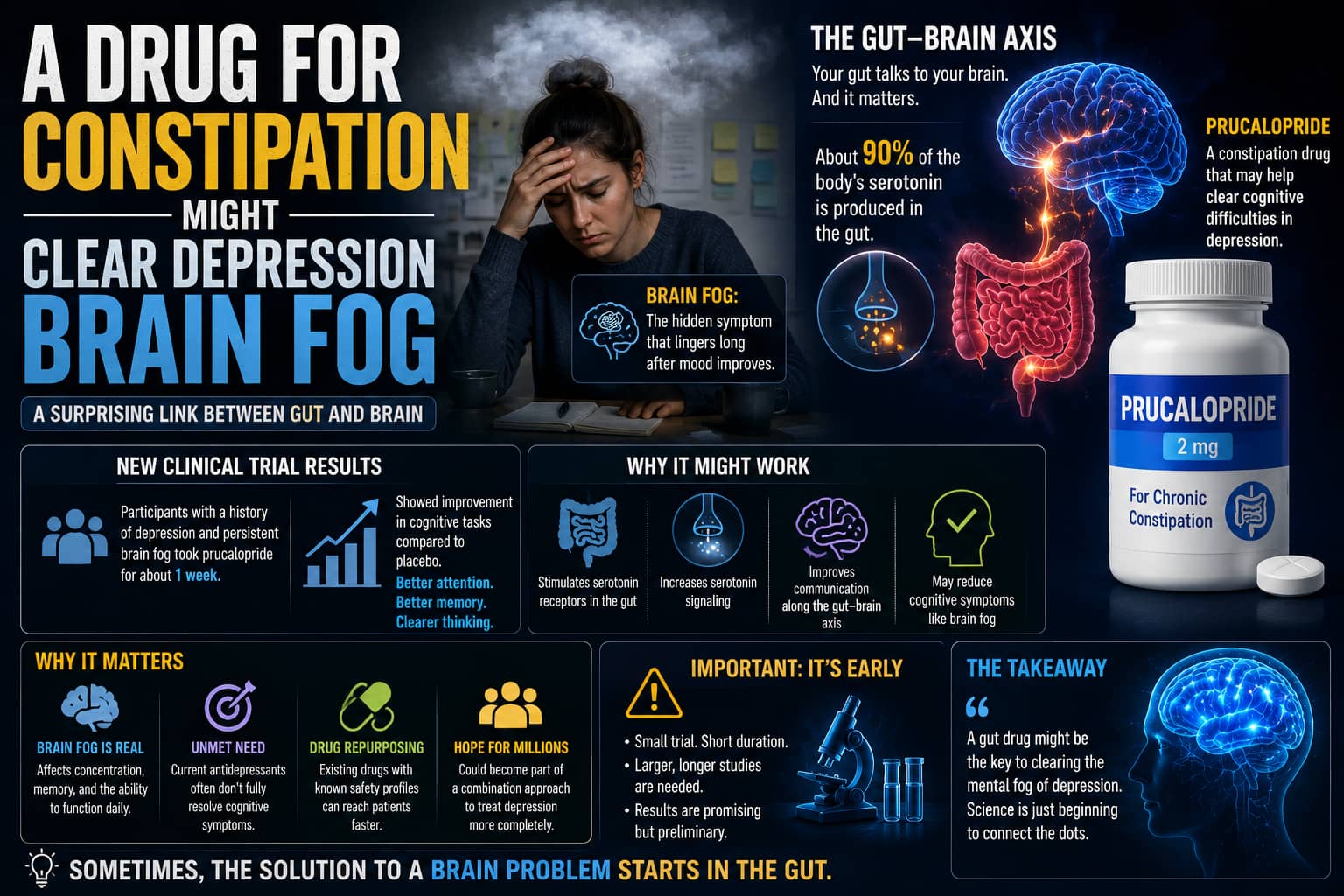
Depression is often described in terms of sadness, hopelessness, and loss of motivation. But many people who have experienced it will tell you about another symptom that gets far less attention: brain fog. The inability to concentrate, think clearly, or hold information in working memory. It lingers even after mood improves, and it makes going back to normal life genuinely difficult.
Now, researchers have found that an existing medication designed for a completely different purpose might help. Prucalopride, a drug commonly prescribed for chronic constipation, showed promise in a small clinical trial for reducing cognitive difficulties linked to depression.
The trial involved participants with a history of depression who reported persistent brain fog. After taking prucalopride for about a week, participants showed improvement in cognitive tasks compared to a placebo group. The improvements were modest but measurable, particularly in areas like attention and memory.
The connection between a gut medication and brain function is less strange than it sounds. Prucalopride works by stimulating serotonin receptors in the gut. Serotonin is a neurotransmitter that plays a central role in mood regulation, and the gut produces around 90% of the body's serotonin supply. The gut-brain axis, as researchers call it, is a two-way communication highway that scientists are only beginning to map in detail.
This is part of a broader trend in medicine where drugs developed for one condition turn out to have unexpected applications elsewhere. Viagra was originally a heart medication. Botox started as a treatment for crossed eyes. Drug repurposing is often faster and cheaper than developing new compounds from scratch because the safety profiles are already established.
For depression specifically, brain fog is a significant unmet need. Standard antidepressants target mood symptoms effectively for many patients but often leave cognitive symptoms untouched. Patients who recover from depressive episodes frequently struggle to return to work or study because their thinking remains sluggish even after their emotional state improves. Existing treatments have limited impact on these cognitive residuals.
The prucalopride findings are preliminary. A small trial with a short duration is not enough to change clinical practice. Larger, longer studies are needed to confirm whether the effect holds up and to identify any risks associated with using the drug for this purpose.
But the fact that a widely available, well-tolerated medication might address one of depression's most stubborn symptoms is reason enough to keep investigating. If larger trials confirm the early results, prucalopride could become part of a combination approach where one medication handles mood while another tackles cognition.
The bigger implication is that brain fog after depression might be more biological and more treatable than previously assumed. For years, lingering cognitive issues after depression were often dismissed as just needing more time to recover. This research suggests there might be specific mechanisms at work that can be directly targeted.
Have you or someone you know ever struggled with brain fog that just would not lift?
Ronny M (ronny76netstuff@gmail.com) is a content creator under the Newswav Creator programme, where you get to express yourself, be a citizen journalist, and at the same time monetize your content & reach millions of users on Newswav. Log in to creator.newswav.com and become a Newswav Creator now!
The User Content (as defined on Newswav Terms of Use) above including the views expressed and media (pictures, videos, citations etc) were submitted & posted by the author. Newswav is solely an aggregation platform that hosts the User Content. If you have any questions about the content, copyright or other issues of the work, please contact creator@newswav.com.