
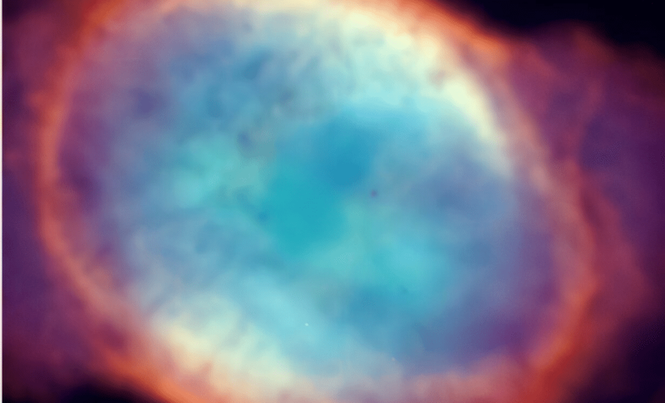
A fresh investigation of the planetary nebula NGC 6563 has revealed that its most unusual structures are far older than the nebula itself. Using powerful spectrographs on telescopes in Chile and Mexico, researchers reconstructed the object’s history and found evidence that its distinctive ear-like lobes formed thousands of years before the main shell appeared. The findings, published in the Galaxies journal, offer a new look at the complex processes that shape dying stars.
A Familiar Nebula Reveals An Unexpected Timeline
Located about 5,400 light-years away in the constellation Sagittarius, NGC 6563 has intrigued astronomers since its discovery in 1826. The planetary nebula is known for its unusual appearance. Its main body resembles an elongated egg, narrower on one side than the other, while two small protrusions extend from opposite ends. These structures became known as the nebula’s “ears.”
Planetary nebulae form when stars similar to the Sun expel their outer layers late in life. The expanding gas glows under intense radiation from the exposed stellar core left behind. Although many planetary nebulae display intricate shapes, NGC 6563 has long stood out because of its asymmetric structure and unusual appendages.
To investigate its history in greater detail, a team led by Zahra Al of Istanbul University combined observations from the Multi Unit Spectroscopic Explorer (MUSE) on the European Southern Observatory’s Very Large Telescope in Chile with data from the Manchester Echelle Spectrograph (MES) at Mexico’s Arcadio Poveda Telescope. These instruments allowed the researchers to map both the structure and motion of gas throughout the nebula, producing one of the most detailed kinematic studies of NGC 6563 to date.
The Nebula’s “Ears” Turned Out To Be Older Than The Main Shell
The observations revealed a remarkably complex object. Researchers identified an ellipsoidal central shell surrounded by a thin outer layer, along with the two famous ear-like protrusions and several smaller structures scattered throughout the nebula. Measurements showed that the main shell expands at approximately 22 kilometers per second, while the nebula as a whole moves through space with a systemic velocity of about -25 kilometers per second.
The most surprising result emerged when the team calculated the ages of the different components. The main ellipsoidal shell and associated ring appear to be about 3,700 years old. The ears, by contrast, are much older, with estimated ages ranging from 7,500 to 8,800 years.
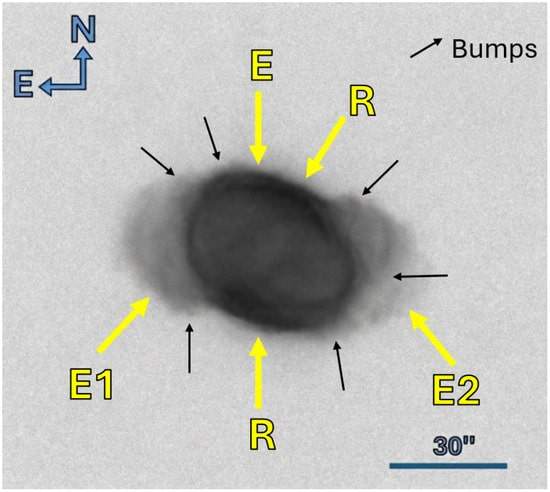
That finding overturns a straightforward picture in which all parts of the nebula formed during a single event. Instead, the data indicate that the ears existed long before the dense shell surrounding the central star was expelled. According to the researchers, this points to a more complicated evolutionary sequence involving multiple episodes of mass loss.
“This supports a scenario in which the ears originated from earlier collimated outflows, likely associated with a binary interaction phase preceding the ejection of the dense shell,” the authors of the paper published in the Galaxies journal wrote.
If that interpretation is correct, NGC 6563 may preserve evidence of interactions between two stars that occurred thousands of years before the planetary nebula reached its current form.
Clues Point To A Violent And Complicated History
The study also uncovered signs that the nebula has not evolved in a perfectly symmetrical environment. One side of NGC 6563 expands faster than the other, creating a noticeable kinematic imbalance. Researchers also detected localized brightness enhancements and distortions across the nebula’s surface.
These features suggest that the expanding gas is moving through an uneven surrounding medium rather than empty space. Variations in density around the nebula could influence how different regions expand and evolve over time. Such environmental effects may explain part of the object’s irregular appearance, though they are unlikely to tell the entire story.
The existence of older ear-like structures adds another layer of complexity. Their age implies that forces were shaping the system well before the formation of the present shell. The researchers argue that multiple mechanisms may have operated during different stages of the star’s evolution, each leaving its own imprint on the nebula.
The observations provide a rare opportunity to examine how several astrophysical processes can combine to produce a single object. Instead of a simple shell expanding uniformly into space, NGC 6563 appears to be the result of several distinct episodes spread across thousands of years.
Why NGC 6563 Matters To The Study Of Dying Stars
Planetary nebulae are relatively short-lived on cosmic timescales, making them valuable laboratories for understanding the final stages of stellar evolution. Their shapes often preserve evidence of events that occurred as stars shed their outer layers and transitioned toward becoming white dwarfs.
NGC 6563 now appears to be a particularly informative example. The older ears, the younger shell, the asymmetrical expansion pattern, and the interaction with the surrounding environment all point to a far more intricate history than astronomers once suspected.
The researchers believe several mechanisms may have contributed to the nebula’s present appearance. Stellar winds, instabilities within expanding shells, interactions between binary stars, and environmental influences may all have played roles at different times.
“Internal wind interaction, thin-shell instabilities, binary-driven mass-loss episodes, and environmental effects may therefore all contribute to the present morphology, operating at different epochs and spatial scales. Further observational and theoretical studies will be necessary to better constrain the relative contributions of these mechanisms,” the scientists conclude.
For an object first cataloged two centuries ago, NGC 6563 still has new stories to tell. Thanks to modern spectroscopic observations, astronomers are now piecing together a timeline that reveals a far richer and more complicated past hidden within one of the sky’s most distinctive planetary nebulae.