

“Thank you, boss”, my patient remarked with a gleeful voice.
“That’s you sorted ma’am”, I replied rather exultantly. Her veins were harder to find than a needle in a haystack, but after much probing and prodding, they finally yielded.
It’s funny how I speak of yield as if I were a proprietor of an oil palm plantation; one of many that dot the Malaysian landscape. My “yield” in this case, however, was not a bunch of profitable oil palm fruits, but rather two tubes full of blood. That is the reality of life as a doctor. Nothing leaves us quite as exuberant as being able to finally draw blood from a patient with “veins as non-existent as water in the Sahara”. As I sauntered towards the laboratory to deliver the tubes in hand, I couldn’t help but ponder upon that one final word she uttered: “Boss”
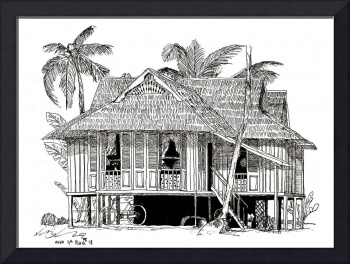
To the majority, it wasn’t a word that would raise an eyebrow. I, however, was not part of that majority. I was a Malaysian doctor, who fortuitously found myself meandering the wards and hallways of a hospital in the Scottish Borders, just 70 km north of the England-Scotland border. It was a Scottish “kampung” that bore no verisimilitude to the kampungs of Malaysia. Everything was different: From the pastures to the trees, from the accent to the cuisine, from the gust of the wind to the feebleness of the rain. Where was the cacophony of the crickets, or the croaks of the frogs? The ears were not greeted by their familiar, but sometimes exasperating decibels in this part of the world.
It is common practice for children to be told to count sheep, aiding them to drift off into deep slumber. The Scottish Borders had more sheep than it did Asians, what more to speak of a Malaysian likely myself. It was far more germane in that sense for kids in the vicinity to be told to count Asians till they hit the sack; unless they favoured a mathematical conundrum. Yet, in a land so foreign, why was I met with a word that touched home base, that ignited memories of vocabulary left largely untouched for as long as I had been here.
Only a Malaysian would use that word in such a context: “Boss”. Maybe Singaporean. How could it be? She was a white woman(Mat Salleh) being managed for delirium. None of the dots connected. I headed home from work that day, engulfed in reverie.
Luckily, the next day, I unraveled the missing piece in the jigsaw puzzle. I walked in to see her and she was in the head nurse’s words: “speaking gibberish”. Any astute doctor will tell you that neologisms are not a hallmark of delirium. The condition itself is characterised by an often reversible, transient period of confusion in the elderly triggered by factors such as an infection or constipation. It does not make you speak “gibberish”. As I walked towards her, it was as if I found a piece of home in every word she uttered: “Raya is coming. I want ketupat. I want rendang. I want lemang”.
Her daughter was in attendance.
“Don’t mind me asking but does your mom have some connection to Malaysia?”
“Yes”, she replied in what was a Eureka moment for me.
“My dad helmed a company for 28 years in Malaysia and mom lived there too for the entirety of that time. In fact, I was born in KL myself”.
“Were you? No wonder”, I remarked. “I am Malaysian too, and I have been cudgeling by brain with regard to some of the stuff your mom has said thus far. Mystery finally solved”.
The daughter smiled and whilst placing a hand on her mom’s shoulder, she said: “Mom, we’ve got a Malaysian looking after you”.
“Do we? I need to go to Malaysia for Hari Raya and attend all the rumah terbukas. They will be expecting me”.
“That might not happen this year ma’am, but hopefully we’ll treat you and get you optimised to do so next year”, I replied.
Her daughter stepped in: “Don’t worry mom, I’ll bring you some beef rendang for Raya”.
“Oh, that would be absolutely lovely”, the patient replied with comforted delight.
I corrected the documentation on the hospital notes to reflect that the patient was speaking intelligible Malay, not “gibberish” as previously documented.
“Raya must mean a lot to your mother”, I exclaimed to the daughter.
She went on to explain how her mom would observe Ramadan in her latter years in Malaysia, and when the month of Syawal finally came, she would don sets of beautifully embellished baju kebayas to rumah terbukas hosted by friends every single year without fail. They were also acquainted with the Sultan of Selangor and had attended His Majesty’s open houses on 7 occasions before moving back to Scotland post-retirement.
“Gosh, it’s a story for the masses”, I remarked. “Definitely not one I’ll forget anytime soon”.
The daughter ended with a very symbolic statement: “Well, we’re talking about 28 years. Raya started off as a festival, but ended up being a tradition for our family”.
Imagine being a confused patient, and the one thing that is at the forefront of your mind is the eagerness to celebrate “Hari Raya”. As different as the Scottish kampung is from the kampungs in Malaysia, there was one uniting theme that day; The spirit of Raya had reached this far-flung domain of the globe. That’s the power of tradition. That is why a celebration like Hari Raya is more than just a festival- For a festival lingers in the mind, but a tradition perpetually resides in it.

Submit any #RAYA2024-related content for a chance to win worth up to RM8,100! T&C apply. Find out how you can participate here.
Thillak Sekaran is a content creator under the Newswav Creator programme, where you get to express yourself, be a citizen journalist, and at the same time monetize your content & reach millions of users on Newswav. Log in to creator.newswav.com and become a Newswav Creator now!
The User Content (as defined on Newswav Terms of Use) above including the views expressed and media (pictures, videos, citations etc) were submitted & posted by the author. Newswav is solely an aggregation platform that hosts the User Content. If you have any questions about the content, copyright or other issues of the work, please contact Newswav.