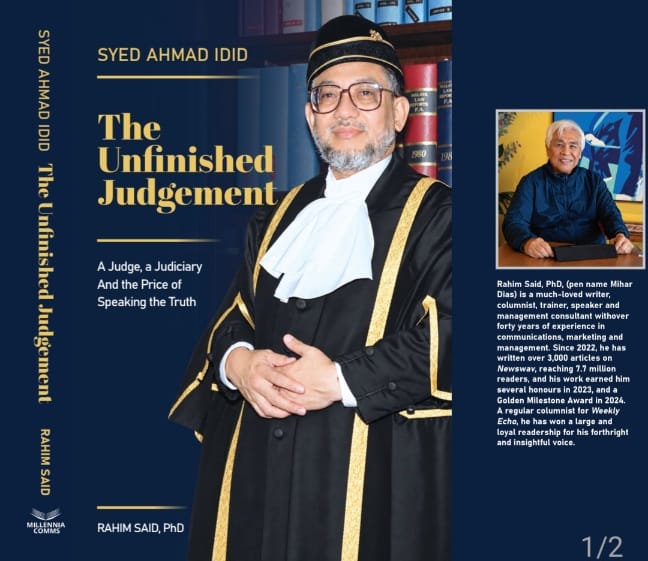
By Mihar Dias October 2026
Unfinished Judgment is more than the story of a judge who walked away from the judiciary. It is a plea to look again, to question our assumptions and to consider whether a man should be remembered forever for the most controversial chapter of his life.
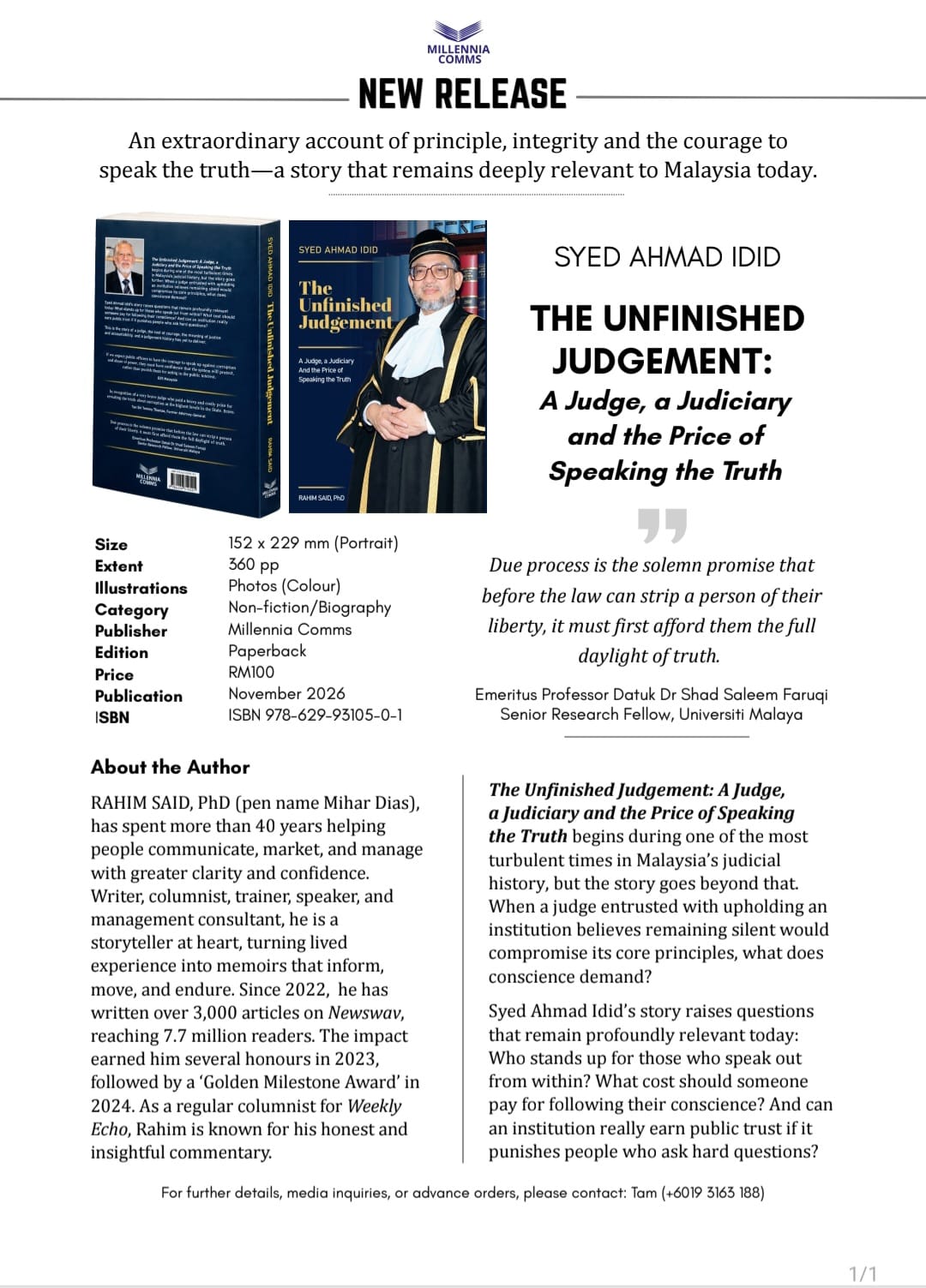
There are some books we read for information. Others we read for entertainment. And then there are books that make us uncomfortable because they force us to confront a question we would rather avoid: Are we prepared to judge a man for the rest of his life by a single episode, without first listening to his side of the story?
Unfinished Judgment, the account of former Malaysian judge Syed Ahmad Idid, belongs to the third category.
I have spent more than five decades studying human behaviour, advising organisations, coaching executives and observing how people behave when their reputations, careers and personal interests are at stake. I have seen how easily perceptions become accepted as facts, how quickly public opinion forms a verdict, and how difficult it can be for a person to escape the consequences of a defining moment.
That is why this book matters.
On 28 June 1996, Syed Ahmad Idid resigned from the judiciary following a controversy that would become inseparable from his name. The circumstances surrounding that episode deserve careful examination, not casual dismissal. His account invites readers to revisit the events, consider the pressures and consequences, and distinguish between what is established, what is alleged and what remains open to interpretation.
A resignation is an event. A human life is a much longer story.
Yet society has a peculiar habit of compressing complicated lives into convenient labels. Once a reputation has been damaged, every subsequent achievement can be overlooked, every explanation treated with suspicion and every attempt to tell one's story dismissed as self-justification. The public moves on, but the person at the centre of the controversy must continue living with the consequences.
This is where Unfinished Judgment becomes more than a personal account. It becomes a study in reputation, institutional power, public perception and the human cost of a judgment that may endure long after the original events have faded from public memory.
Four words that say everything
When I discussed a proverb with Syed Ahmad Idid about three things that cannot be recalled—the arrow once released, the word once spoken and the opportunity once lost—he responded with four words:
“I lost everything.”
Those words stayed with me.
He was speaking about the opportunity to rise to the highest levels of the judiciary, the standing that such an office might have brought him, and the respect and professional recognition he believed he had forfeited.
We cannot know what position he would eventually have attained. But we can understand the loss he describes: the collapse of a future he had worked towards and the disappearance of possibilities that could never be restored in precisely the same form.
For someone who has devoted years to a profession, the loss of a career is not simply the loss of a salary or a title. It can mean the loss of identity, purpose and the opportunity to make a greater contribution. When the profession is the judiciary, the question of reputation carries an additional weight because public confidence is inseparable from the institution itself.
But should the loss of a career also mean the permanent loss of a person's dignity?
That is the question this book places before us.
Justice must also leave room for humanity
I am not suggesting that sympathy should replace evidence, or that every person who claims to have suffered an injustice must automatically be vindicated. Neither should a book be treated as proof of every claim it contains.
What I am advocating is something more fundamental: the willingness to examine a person's account fairly, to consider the evidence and to resist the temptation to substitute public perception for careful judgment.
If Syed Ahmad Idid believes that he lost opportunities, standing and respect because of the events of 1996, he deserves an opportunity to have his account considered seriously. Where the historical record can be corrected, it should be corrected. Where claims can be substantiated, they should be acknowledged. Where questions remain unresolved, they should be identified honestly.
And where there is a legitimate avenue for restoring a damaged reputation, it should not be dismissed merely because the passage of time has made the task inconvenient.
The objective should not be to demand that everyone agree with him. It should be to ensure that his life and his claims are not reduced to a single, unexamined verdict.
After all, the principle of fairness is most meaningful when it is extended to people whose circumstances are complicated, controversial or unpopular.
Can we give back what was lost?
There is an uncomfortable truth about lost opportunities: we cannot turn back the clock.
No book can return the years that have passed. No explanation can recreate the precise circumstances of a career that might have unfolded differently. And no declaration of sympathy can guarantee that professional standing will be restored to what it once might have been.
But not everything is beyond repair.
A historical record can be revisited. An incomplete narrative can be supplemented. A reputation can be reconsidered in the light of additional evidence. And a society can demonstrate that it is capable of looking beyond the headlines that once shaped its understanding of an individual.
This is why I believe Unfinished Judgment deserves to be read and discussed.
It asks us to look at Syed Ahmad Idid not merely as a former judge associated with a controversy, but as a human being whose professional life took a direction he did not anticipate. It asks us to consider the consequences of that turning point without pretending that every question has an easy answer.
More importantly, it reminds us that the passage of time should not automatically close the door to reconsideration.
If there are legitimate grounds for Syed Ahmad Idid to seek recognition, clarification or restoration of his professional dignity, those grounds deserve a fair hearing through the appropriate channels. The book should be the beginning of an informed conversation, not the final word imposed upon its readers.
An Unfinishe Judgment
The title is particularly apt.
A judgment may be recorded in the history books, but the human consequences of the events surrounding it can continue for decades. The legal, institutional, historical and personal dimensions of a controversy are not necessarily identical. Understanding one does not automatically settle the others.
At my age, I have learnt that people are rarely as simple as the labels attached to them. Human beings are complicated creatures. We make decisions, face consequences, suffer setbacks and spend years trying to understand what happened. Some recover their standing. Others never regain what they lost. But all deserve to be understood through a fair consideration of the available evidence rather than through reflexive condemnation.
I therefore hope Unfinished Judgment will reach readers beyond the legal profession. Former judges, lawyers, civil servants, academics, students and ordinary Malaysians all have something to gain from reflecting on its central questions.
How should institutions respond when controversy engulfs one of their own? How does a damaged reputation affect the remainder of a person's life? And how can we distinguish the legitimate demands of accountability from the temptation to condemn someone indefinitely?
These are not questions that belong to Syed Ahmad Idid alone. They concern the way we treat one another and the kind of society we wish to build.
The arrow cannot be recalled. The spoken word cannot be unsaid. The lost opportunity may never return.
But the opportunity to listen remains.
If Unfinished Judgment can persuade us to examine the past with greater care, to distinguish evidence from assumption and to consider whether a man has been denied a fair hearing, it will have achieved something worthwhile.
Syed Ahmad Idid cannot reclaim the years that have passed or the career he believes he might have had. What he can seek is a fair reconsideration of his place in history and an opportunity for his account to be heard.
Perhaps we cannot give him back everything he lost.
But we can begin by giving his story the serious attention it deserves.
Mihar Dias (mihardias@gmail.com) is a content creator under the Newswav Creator programme, where you get to express yourself, be a citizen journalist, and at the same time monetize your content & reach millions of users on Newswav. Log in to creator.newswav.com and become a Newswav Creator now!
The User Content (as defined on Newswav Terms of Use) above including the views expressed and media (pictures, videos, citations etc) were submitted & posted by the author. Newswav is solely an aggregation platform that hosts the User Content. If you have any questions about the content, copyright or other issues of the work, please contact creator@newswav.com.