

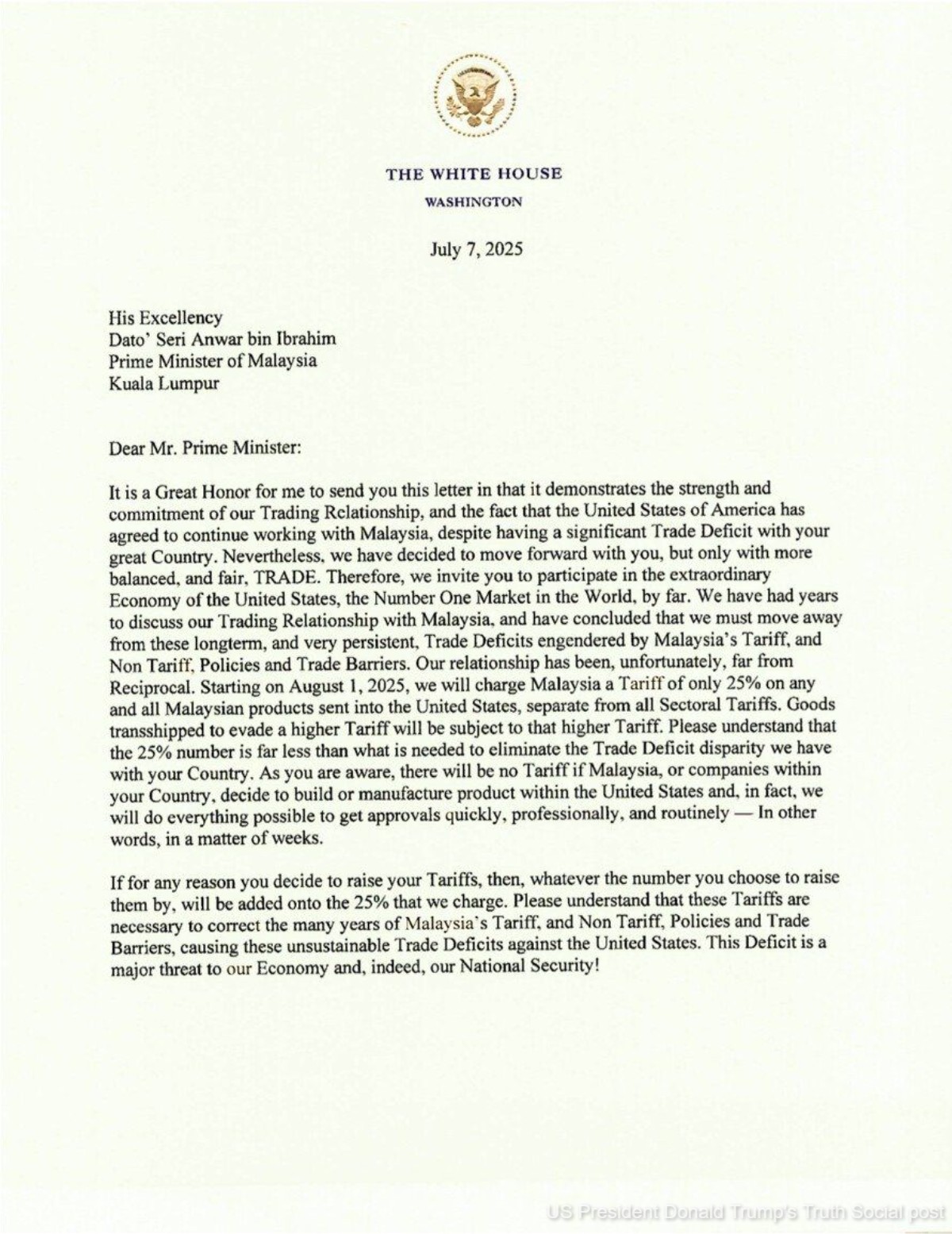
It is difficult to believe that a letter with such high economic and diplomatic stakes could have been crafted with so little formality or care. Reportedly sent from the Trump administration to Malaysia's Prime Minister, the letter announcing a 25% blanket tariff on Malaysian goods entering the United States reads more like a marketing flyer or political speech than a diplomatic communication between nations.
Coming from a country often seen as the gold standard in education, governance, and diplomacy, it raises one serious question: How did this even happen?
Why This Letter Fails Diplomatically
The letter, despite its heavy consequences, does not formally address the Prime Minister of Malaysia.
Tone and Language. The tone is informal, assertive, and at times overly transactional, not aligned with standard diplomatic language. Capitalizing words like “TRADE”, “Number One Market”, or “National Security” in mid-sentence for emphasis comes across as rhetorical or populist, not professional.
Structure. The letter reads more like a public statement or press release than an official diplomatic communication.
To reflect on how far we’ve moved from careful, intentional communication, I remember how things were 20 years ago when I started browsing the internet. I read more than I posted. Blogging was a space to write thoughtfully about my lifestyle, and I took comments seriously. I triple checked everything grammar, tone, structure, even sentence alignment before hitting publish. The worst case scenario? If my father read it and spotted a spelling mistake, I was doomed. “What the hell did you write?” he’d say. And for a whole year, like any true Indian father, he’d remind me of that one mistake until I corrected it.
Then Facebook arrived. The tone shifted we uploaded a photo and added a casual caption. No need to think too hard, the picture told the story. But even as things evolved, I found myself sticking to the same habit. No matter what I posted or wrote, I had to think: what if my father reads it?
Now, with tools like ChatGPT, I can write faster and more fluidly but without a valid point or reference, it still only gives a general response. That personal touch, emotional nuance, and meaning? It has to come from us humans. ChatGPT can help tighten grammar or smoothen structure, but the soul of what we want to say has to be ours.
And honestly, that’s why I’m still scratching my head: how could the Trump administration send out such a letter with zero regard for basic formalities? Coming from a country known for its world-class universities and elite policy schools, it’s baffling. Where was the human filter? The care? The standard we expect from a global power that prides itself on leadership and example?
In short, this is not how two nations with long-standing ties communicate certainly not when addressing issues that affect jobs, economic stability, and national relationships.
Let us also be clear: trade is a two-way relationship. Malaysia does not merely receive we contribute. We supply critical goods to American consumers and companies, often at highly competitive prices. Our exports support their industries, from technology and electronics to agriculture and manufacturing. If the U.S. views itself as the 'Number One Market in the World,' then it should also listen respectfully to the voices of those who supply that market.
Our demand was never rude. It was reasonable. We asked for fair treatment not blind punishment. We engage in business in good faith, and we expect fairness in return. Reducing our exports through blanket tariffs does not correct a deficit it damages partnerships. It punishes trust. Worse still, it threatens our domestic job market. When exports decline, the first to feel the blow are our workers particularly in export dependent sectors like electronics, palm oil, textiles, and automotive components. These industries are not merely economic statistics; they represent real people, families, and livelihoods across Malaysia. A slowdown in export demand often means factories cutting shifts or halting production lines. Subcontractors many of whom are small and medium sized enterprises may shut down altogether due to lack of business.
The effect ripples far beyond the industrial zones. When workers lose income, local economies suffer. Children’s education gets disrupted, household debt increases, and national consumer spending slows down. A weakened workforce today means a delayed recovery tomorrow. In a country where nearly one in five workers is tied directly or indirectly to export-related industries, this is not just an economic issue it is a national concern. Tariffs like these don’t just strain trade they ignite a chain reaction that leads to unemployment, hardship, and long term economic insecurity. Another serious consequence we must confront is the weakening of the Ringgit.
When confidence in Malaysia's economy is shaken by external shocks like tariffs or trade restrictions, investors become hesitant. This leads to capital outflows and a drop in demand for the Ringgit, weakening its value further. In recent months, we’ve already seen the Ringgit under pressure due to global economic uncertainty and a strong U.S. dollar. An unjustified tariff hike from the United States only worsens this situation.
A weaker Ringgit means imported goods become more expensive, raising costs for businesses and everyday Malaysians alike. Fuel, food, medicine, and essential technology could all see price increases. The middle and lower income groups who already bear the brunt of inflation will be hardest hit.
To protect the Ringgit, Malaysia must take a multi-pronged approach. First, we should strengthen regional trade ties and reduce dependency on any single market. Second, we need to continue pursuing sound fiscal management and transparent governance to inspire investor confidence. And third, we must support our export sector through innovation and diversification so that no tariff, however unjust, can derail our national resilience. Another consequence of this instability is the chilling effect it has on foreign investment. When investors see unpredictability especially stemming from diplomatic actions they tend to stay away. Scaring away investors doesn’t just delay new projects; it discourages capital infusion that fuels innovation, job creation, and long term economic growth.
Malaysia has more to offer than just raw exports. We produce valuable goods the world needs from cutting-edge semiconductors to sustainable palm oil, from medical gloves to precision components used in global supply chains. Our value isn't just in price it's in quality, reliability, and ethical standards. By destabilizing our trade environment, the U.S. also risks undermining its own access to these essential goods.
We should not be treated as a dispensable source of cheap goods. We are partners in a shared global economy. If trust and confidence are compromised, not only do we lose opportunities, but so does the wider global system that depends on cooperation and fairness.
A better path forward would be one where concerns are discussed, not dictated. If the U.S. values our trade and regional cooperation, it must also value our voice. Trade should not be weaponized; it should be respected as the foundation of mutual growth. One of the most concerning outcomes of this tariff move is the rising risk of a full blown trade war. The moment punitive tariffs are used as a blunt instrument, countries naturally start preparing to retaliate. But let us be honest this should not worry us as much as it appears.
Why? Because Malaysia's products are not easily replaceable. Our exports are not built on dependence they are built on demand. The global market, including the United States, needs what we produce: high-quality semiconductors, specialty rubber and medical products, sustainable palm oil, and strategic industrial components. These are not luxuries they are essentials in today’s interconnected global supply chains.
Raising the risk of a trade war may grab headlines, but it won’t change the fact that Malaysia remains a key supplier of critical goods. Punitive policies may create temporary barriers, but long-term trade flows are driven by market needs and product value. What we offer is needed, not negotiable.
But perhaps the deepest harm is not economic it is diplomatic. When formal respect between nations is bypassed, even long standing friendships can suffer. Trust is not just built through trade deals and summits; it’s reinforced in the way we speak to each other, the tone we use, and the value we place on each other's sovereignty.
This moment should be a turning point not for division, but for dignity. Let our business dealings not just be about goods exchanged, but values shared. Malaysia, as part of a rising Asia, stands ready to partner with nations that believe in fairness, mutual respect, and strategic cooperation. We do not want conflict we want collaboration.
Let this be the start of a new chapter where America chooses to lead with grace, and Asia responds with strength built on mutual respect.This is the starting point of a longer discussion on the implications of such a communication, and how it reflects the erosion of traditional diplomacy during the Trump era. More to follow. All this to be done needs good governance, right? All I see is that Tunku Abdul Rahman was a leader capable of delivering what he promised. Under his leadership, Malaysia earned its place on the global stage with dignity and clarity. But from Rahman to Anwar today… the contrast is telling.
Still, I thank you for reading. At the very least, reading helps the brain function and hopefully, it helps the nation think too.
Signed: Annan Vaithegi – A columnist with a deep belief that words should carry both purpose and respect. Whether in trade or leadership, we deserve a Malaysia that speaks clearly, stands tall, and reminds the world of our worth not just in goods, but in grace.
Annan Vaithegi (annanvaithegi@icloud.com) is a content creator under the Newswav Creator programme, where you get to express yourself, be a citizen journalist, and at the same time monetize your content & reach millions of users on Newswav. Log in to creator.newswav.com and become a Newswav Creator now!
The User Content (as defined on Newswav Terms of Use) above including the views expressed and media (pictures, videos, citations etc) were submitted & posted by the author. Newswav is solely an aggregation platform that hosts the User Content. If you have any questions about the content, copyright or other issues of the work, please contact creator@newswav.com.


