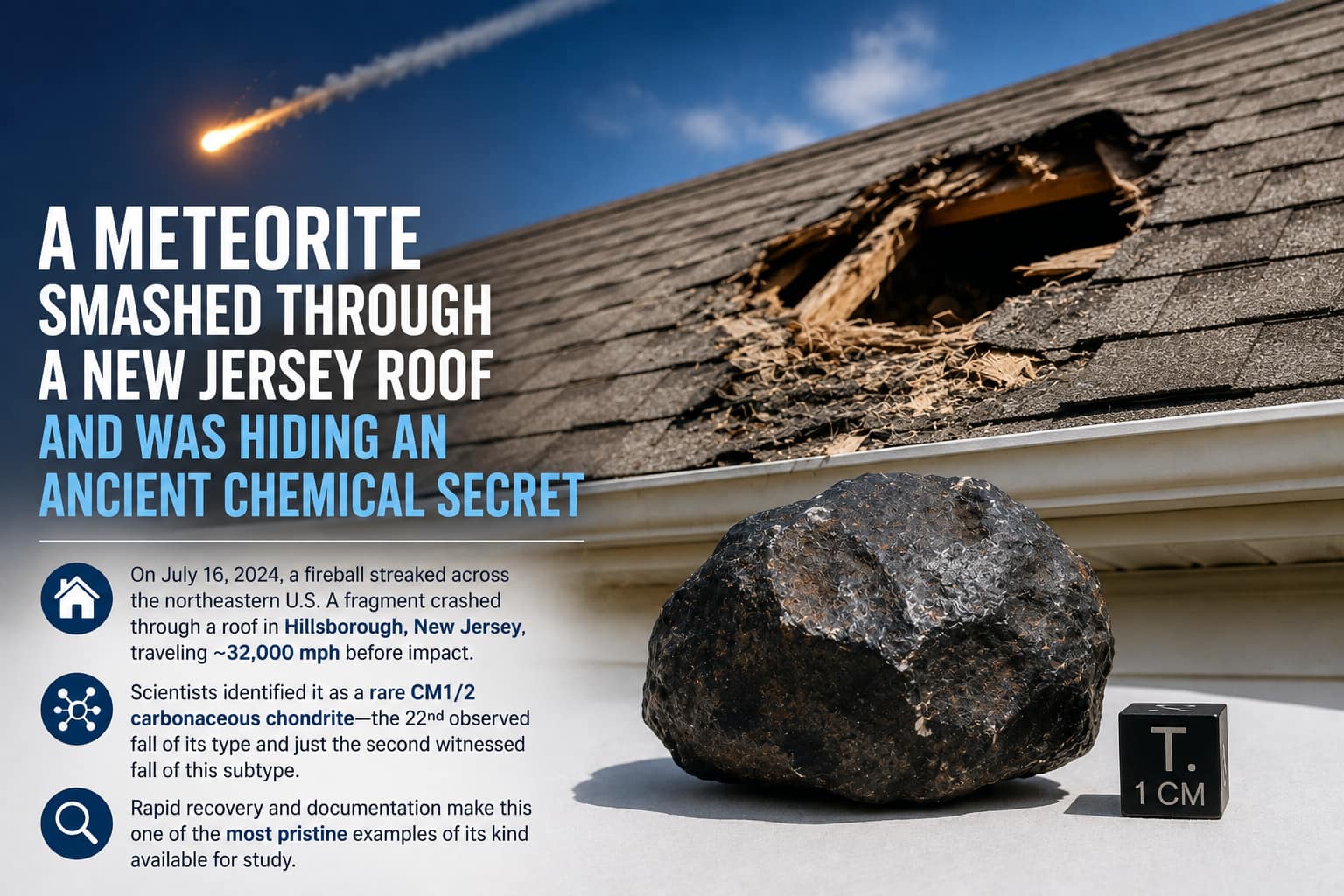
On July 16, 2024, a fireball crossed the sky over five northeastern US states, visible to more than 60 witnesses, before a fragment weighing over two pounds tore through a roof in Hillsborough, New Jersey, travelling at roughly 32,000 miles per hour before impact. Scientists have now finished analysing what it was actually carrying inside.
ScienceDaily reported that the meteorite is a rare CM1/2 carbonaceous chondrite, only the 22nd observed fall of its type on record and just the second ever witnessed fall of this specific subtype. Because homeowners documented and recovered it so quickly after impact, researchers describe it as one of the most pristine examples of this meteorite class currently available for study.
What Was Actually Inside It
The fragment contains preserved salty fluids dating back to the near surface region of its parent asteroid, along with 1.8 percent carbon and 0.07 percent nitrogen by weight, plus a range of organic compounds including amino acids, the basic building blocks used to construct proteins in living organisms. Live Science's coverage described the find as evidence of extensive water alteration having occurred on the parent asteroid long before the fragment ever made its way to Earth, essentially a frozen snapshot of chemistry from the early solar system.
Who Studied It
Lead author Peter Jenniskens of the SETI Institute and NASA Ames worked alongside Mike Zolensky of NASA Johnson Space Center, Queenie Chan of Royal Holloway University, and Danny Glavin of NASA Goddard, with the specimen ultimately curated by the American Museum of Natural History in New York.
Why a Meteorite That Wrecked Someone's Roof Matters to Science
Most primitive meteorites of this type degrade quickly once they hit Earth's atmosphere and environment, losing the delicate chemical signatures scientists actually want to study. Because this one was recovered so fast, it preserved organic material and brine chemistry that would normally be lost within days. Jenniskens summed it up directly, calling these "the most pristine CM1/2 meteorites we know of," a fairly remarkable outcome for something that started its trip to Earth by putting a hole in someone's house.
A House That Became a Research Site
The family whose roof the meteorite went through cooperated quickly with researchers, which is exactly the kind of fast recovery that made this specimen so scientifically valuable in the first place. A fragment left exposed to rain, humidity or even a few days sitting in an evidence bag can lose the delicate organic signatures researchers care about most, which is why speed mattered here nearly as much as the meteorite's rare classification.
Ronny M (ronny76netstuff@gmail.com) is a content creator under the Newswav Creator programme, where you get to express yourself, be a citizen journalist, and at the same time monetize your content & reach millions of users on Newswav. Log in to creator.newswav.com and become a Newswav Creator now!
The User Content (as defined on Newswav Terms of Use) above including the views expressed and media (pictures, videos, citations etc) were submitted & posted by the author. Newswav is solely an aggregation platform that hosts the User Content. If you have any questions about the content, copyright or other issues of the work, please contact creator@newswav.com.