
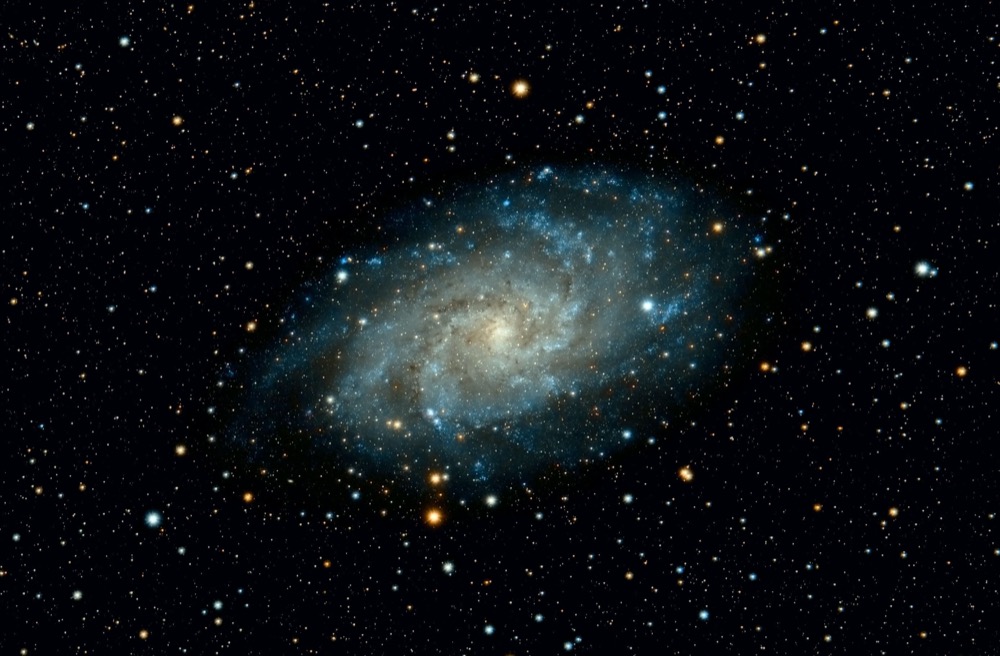
A close stellar encounter from deep time may still be shaping the path of icy visitors entering the inner Solar System today, according to new research posted on arXiv. The study examines how a nearby star, HD 7977, may have passed close enough to the Sun roughly2.5 million years ago to disturb the distant Oort Cloud, sending waves of long-period comets inward. The findings suggest that what we observe in comet trajectories today may carry the imprint of that ancient flyby. If confirmed, this would link modern comet observations directly to a specific stellar encounter reconstructed through Gaia mission data.
A Stellar Encounter Hidden In Comet Orbits
The idea that a single passing star could still be influencing comet paths millions of years later emerges from a growing ability to reconstruct stellar motions in three dimensions. Using Gaia measurements, researchers traced the past trajectories of nearby stars and identified HD 7977 as a strong candidate for a close passage through the Sun’s outer gravitational boundary. Depending on the model, that approach may have brought it within a few thousand astronomical units, close enough to disrupt the fragile balance of icy bodies in the Oort Cloud. That disturbance would not produce an immediate, short-lived spike alone, but a long and evolving cascade of comets entering the inner Solar System over extended periods.
In this interpretation, long-period comets become a kind of fossil record, preserving evidence of gravitational disturbances long after the triggering event. The outer Solar System is not static; it is constantly shaped by the weak tug of the Milky Way’s disk, passing stars, and internal gravitational interactions. A sufficiently close stellar passage can temporarily overpower the galactic tide, reshaping the orbits of distant icy bodies and redirecting them inward. What makes HD 7977 compelling is that simulations of comet orbital distributions appear to match the signature expected from such an encounter. That alignment suggests the possibility that the Solar System is still moving through the tail end of a comet shower initiated millions of years ago.
The Role Of Gaia Data
The analysis is detailed in a study available on arXiv, where researchers combine observational comet data with dynamical simulations of stellar encounters. Gaia’s precise measurements of stellar positions and velocities provide the backbone of this reconstruction, allowing scientists to rewind stellar motions far into the past. This approach transforms the way the outer Solar System is studied, shifting from isolated orbital measurements to a broader galactic context. By comparing simulated comet distributions with real observations collected since the late 20th century, the researchers attempt to identify whether a single event can explain patterns seen today.
“The distribution of comet orbits suggests we are living through an unusual time where HD 7977 has dominated the generation of new comets and not the larger gravitational field of the Milky Way, as it usually would. This would also mean we’re living through the late stages of a pretty rare and powerful comet shower,” says Kaib.
The implication is that the gravitational environment of the Solar System may not be as uniform as often assumed. Instead, it may fluctuate significantly depending on rare stellar passages that leave long-lasting dynamical fingerprints. In this case, the comet population observed today may not reflect a steady-state balance but a transitional phase still recovering from a past disruption. The models suggest that older comets, those on repeat passages, show different orbital characteristics consistent with the Milky Way’s broader influence, while newer arrivals retain the signature of a more localized stellar trigger.
Limits Of Current Models And Remaining Uncertainties
While the simulations show promising alignment with observed comet distributions, the picture is not fully resolved. One of the main challenges lies in matching the predicted sizes of comet orbits with what is actually observed. This discrepancy suggests that some physical processes may still be missing from the models or not fully captured by current assumptions about the Oort Cloud’s structure. The difficulty of modeling such a distant and diffuse reservoir of icy bodies adds uncertainty to any attempt at reconstructing past events.
“Like many other works that simulate long-period comet production, we find that our comets’ orbit sizes aren’t a great match for the observed distribution. It’s possible we’re missing some important physics from our simulations, and it’s conceivable that this has caused us to misinterpret comet orbit data,” said Raymond.
This gap leaves room for alternative explanations. The Oort Cloud may have a more complex internal structure than a simple spherical shell, or additional forces could be influencing comet trajectories over time. Non-gravitational effects, such as outgassing jets or subtle radiation forces, may also play a role in altering orbits after comets enter the inner Solar System. These factors complicate efforts to isolate the signature of a single stellar encounter, making it difficult to distinguish between overlapping influences that accumulate over millions of years.
A Testable Prediction Emerging From Future Observations
Despite the uncertainties, the study offers a prediction that can be tested with upcoming data. Gaia continues to refine measurements of stellar motions, which should improve the reconstruction of HD 7977’s past trajectory in the near future. As additional comet observations accumulate, researchers will gain a more statistically robust dataset to compare against simulation outcomes. This growing body of evidence may confirm whether the observed distribution truly reflects the influence of a single stellar passage or a more complex combination of galactic effects.
“The nice thing about our prediction is that it will be testable pretty soon. Gaia is still publishing new data on the motions of stars, and in 6–12 months, it should be able to improve our understanding of HD 7977’s motion and tell us if we are right or wrong,” said Kaib.
The next decade of observations, particularly from wide-field surveys, is expected to dramatically expand the catalog of known long-period comets. As that dataset grows, patterns in orbital orientation and energy distribution will become clearer, offering new ways to trace their origins. Whether HD 7977 remains the leading candidate or is replaced by another stellar encounter, the broader implication remains significant: the Solar System’s distant reservoir of comets may be far more sensitive to its galactic environment than previously understood.
