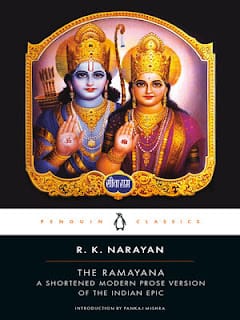
The Ramayana (1972)
Author: R. K. Narayan
A Shortened Modern Prose Version of the Indian Epic
It does not matter whether the Ramayana is sacred history, cultural myth or literature. The epic remains a symbol of the country's long cultural existence. It does not necessarily need to be taken as a religious text, but it can be a talking point for people to question and reflect on life decisions.
Indians do take their narration seriously. What started long ago as oral traditions, before script writing was known to humans, slowly evolved into different scripts, ranging from Sanskrit to Awadhi, Tamil, Bengali, many other Indian languages, even Urdu, and local Southeast Asian languages. Jains and Buddhists have their own versions of the Ramayana. The Malay Ramayana, told in wayang kulit (shadow puppet) shows, incorporates Islamic teachings into the story. All in all, there may be over 300 versions of the epic poem. This book refers to Kamban’s version told in Tamil in the 12th century.
Ramayana is serious business. In 1987, when Doordarshan TV decided to screen its 78-episode Ramayana, the streets went empty every time the show aired. It became the most-watched TV series in the world. Viewers used to shower before watching the series, garlanded the TV set, and saluted the characters as they appeared on screen. Ramanand Sagar, who wrote the series, ended it with Rama's return to Ayodhya and his coronation. That is when all hell broke loose among the sanitation workers in Ludhiana and Jalandhar. They traced their lineage to Valmiki, the author of the epic. They wanted Sagar to continue the show with the final book of the Ramayana, Uttarkanda.
Ramayana, as seen in Valmiki's, Tulsidas' and Kamban's, has six books: Balakanda (Rama's early years, display of his powers and marriage to Sita), Ayodhakanda (Rama's planned enthronement and his stepmother's opposition), Aranyakanda (Rama's exile and Sita's abduction), Kiskindakanta (Rama's interaction with the Vanara kingdom) and Yuddhakanda (the great clash with Ravana and final return to Ayodhya).
The final book, the Uttarakanda, is not accepted by many Hindu scholars as part of Valmiki's Ramayana. It was probably retrofitted to the existing text, as the writing style and Rama's compassionate, egalitarian demeanour may seem different. It also contains two controversial events. There is the execution of Shambuka, a sudra who was seen performing a ritual that can only be performed by Brahmins. Then, there is Rama banishing a pregnant Sita after overhearing gossip. The manner in which Lakshmana makes an exit is also unbecoming of Rama's nature.
This book offers a good, comprehensive look at the events surrounding the Ramayana as told by the Tamil poet Kamban. Kamban's original Tamil writing is said to be par excellence and is still highly regarded today. Legendary Tamil cinema songwriter Kanadasan is said to have drawn many of his ideas from it.
The Kamban version has a few subtle differences from Valmiki's, offering a different perspective on Rama and aligning with the sensitivities of the times. In Kamban's Ramayana, Sita first spots Rama from the balcony. In Valmiki's, it is after the breaking of Shiva's son that the challenge to take Sita's hand in marriage occurs. Rama's characterisation differs in how his identity and emotions are framed. In Kamban's version, Ravana never lays his finger on Sita, as he had been cursed to die if he touched anyone against her will after misbehaving with Rambha, a celestial nymph. So, Ravana cut a piece of earth Sita stood on and carried her to Lanka on his Vimana.
The controversies surrounding Rama's actions in the Ramayana have always centred on these. In the Balakanda book, the dust from Rama's footprint reversed the curse her sage husband, Gautama, placed on Ahalya for infidelity. Rama found it appropriate to cancel Ahalya's curse, as she never intentionally meant to play truant. It was just that Lord Indra, enchanted by her beauty, disguised himself as her husband and entered the household during his absence. If Rama could find it in his wisdom to forgive a wronged wife as in Ahalya’s case, why could he not do the same for Sita? Why did he ask Sita to perform Agni Parisha (trial by fire) to prove her piety after Ravana kept her against her will? Defenders say he was merely fulfilling the duties of a true king, who reclaims his powers only with his citizens' approval.
The biggest point of contention in the whole epic must surely be Rama’s slaying of Vali, ruler of the Vanara kingdom of Kiskinda. Sugriva, Vali’s brother, initially ruled the kingdom. Demons attacked them. Vali entered a cave to hunt him down. Sugriva was told to guard the entrance and close the doors if Vali did not return within a year. After about a year, Sugriva assumed Vali had died after hearing some commotion and blood spilt from within. Sugriva placed a boulder at the entrance to trap the demon in the cave. Actually, Vali survived the duel and kicked himself out of the cave, livid, thinking his brother had wronged him. Vali went on a rampage, usurping the throne and Sugriva’s wife. That was when Sugriva asked for help in return, offering the Vanara Army to rescue Sita from Lanka.
The manner in which Vali was slain is described as ungentlemanly. Rama shot his arrow at Vali’s chest while hiding behind a tree, when Vali and Sugriva were engaged in a duel. It seems that codes of duelling do not apply to vanaras, as they were wild creatures.
Whatever the Ramayana may be, it serves as a good starting point for debating complex human dilemmas, moral philosophy, ethics, leadership, and governance.
P.S. I was struck by the striking similarity between the story of Jatayu, the vulture, of the Ramayana and Icarus in Greek mythology. Icarus escapes imprisonment in Crete with his father, Daedalus, using wings made of feathers held together with wax. In the excitement of flying, Icarus flew too close to the Sun, dissolving the wax. He fell into the sea and drowned. Jatayu and his brother Sampati were testing their flying abilities. They got carried away and flew too close to the Sun. Sampati spread his wings to protect Jatayu and was scorched by the sun's rays. He fell to the ground and lost his ability to fly. The lessons in both the somewhat similar stories differ. Icarus's story was a cautionary tale; the lesson was to know one's limitations and not overstep boundaries. The Jatayu-Sampati interaction highlighted brotherly selfless sacrifice, and their later actions show how, despite their limitations, they can still be useful to others.
Farouk Gulsara (asokansham@gmail.com) is a content creator under the Newswav Creator programme, where you get to express yourself, be a citizen journalist, and at the same time monetize your content & reach millions of users on Newswav. Log in to creator.newswav.com and become a Newswav Creator now!
The User Content (as defined on Newswav Terms of Use) above including the views expressed and media (pictures, videos, citations etc) were submitted & posted by the author. Newswav is solely an aggregation platform that hosts the User Content. If you have any questions about the content, copyright or other issues of the work, please contact creator@newswav.com.