By Dr Victor SL Tan
One of the greatest dangers facing a successful organisation is not always a sudden crisis. It is the quiet comfort of carrying on as usual while the world around it is changing. Customers change. Competitors reinvent themselves. Technology reshapes industries. Yet management can become so absorbed in daily targets, meetings and operational pressures that it loses sight of the bigger picture.
I have long believed that leadership is not merely about keeping the business running. It is about ensuring that the business remains relevant, resilient and ready for tomorrow. This is why I advocate a purposeful Strategic Retreat for the top management team: time away from the office, away from routine interruptions, to think deeply, speak candidly and make the decisions that everyday busyness often postpones.
Having spent decades in banking, change management and working with leaders across industries, I have observed a recurring truth: activity is not the same as progress. A management team may be working extremely hard and still be moving in the wrong direction. The real value of a retreat is therefore not the venue, the presentations or even the conversations. It is the clarity, alignment and action that emerge from them.
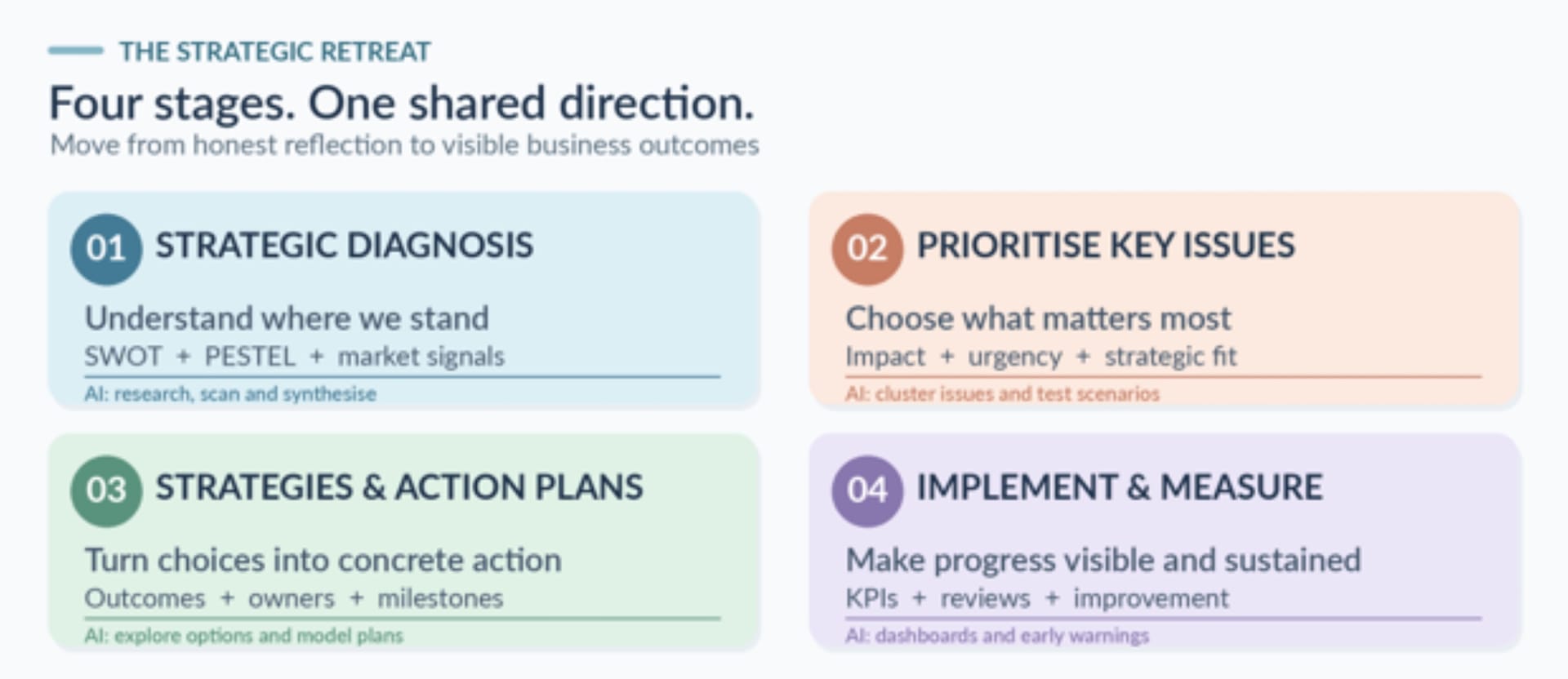
1. DIAGNOSE THE REALITY BEFORE DEFINING THE FUTURE
Every meaningful retreat must begin with an honest strategic diagnosis. Before asking, ‘Where do we want to go?’, we must first ask, ‘Where are we now, and why?’ Too many organisations rush into solutions based on assumptions that have never been challenged. A retreat provides the space to replace comfortable opinions with evidence and shared understanding.
I encourage leadership teams to undertake a rigorous SWOT analysis, examining the organisation’s strengths and weaknesses alongside the opportunities and threats in its environment. What distinctive capabilities are truly valued by customers? Which processes, behaviours or outdated beliefs are holding us back? Where are competitors gaining ground, and what opportunities are we failing to see?
The diagnosis must extend beyond the company walls. A PESTEL analysis examines political, economic, social, technological, environmental and legal forces that could reshape the industry. These forces are not academic headings. They influence costs, customer expectations, regulation, talent, sustainability and even the fundamental business model.
Artificial intelligence can strengthen this phase by helping teams scan industry developments, organise customer feedback, compare competitors and synthesise large volumes of information. However, I would never allow an AI-generated summary to replace managerial judgement. Leaders must verify important findings, challenge the data and listen to the voices of customers and employees. Technology can illuminate the landscape; leadership must interpret its meaning.
2. PRIORITISE THE ISSUES THAT MATTER MOST
A good diagnosis often reveals more issues than any organisation can reasonably address. This is the moment when strategic discipline becomes essential. If everything is a priority, nothing is. I ask management teams to distinguish between symptoms and underlying causes, between urgent noise and genuinely important threats or opportunities.
Consider the difficult questions: Are we losing customers because of pricing, inconsistent service or a weak value proposition? Is declining productivity really a people problem, or does it stem from fragmented processes and obsolete systems? What single decision, if made now, would most improve our position over the next two years?
Issues should be assessed against their likely impact, urgency, strategic fit and feasibility. Leaders must be willing to challenge cherished projects, reconsider historical assumptions and agree on a small number of enterprise-wide priorities. AI tools can assist by clustering recurring themes, modelling alternative scenarios and comparing possible consequences. Yet the final choices require courage, experience and collective ownership.
A retreat succeeds at this stage when the management team leaves with a clear, shared answer to a deceptively simple question: ‘What matters most, and what are we prepared to stop doing so that we can do it well?’
3. TRANSLATE STRATEGIC CHOICES INTO CONCRETE ACTION
Insight without action is little more than an interesting discussion. Once priorities are agreed upon, the leadership team must craft specific strategies and practical action plans. Each strategy should spell out what will change, who will lead it, what resources are needed and which measurable business outcome it is intended to achieve.
Instead of declaring, ‘We must improve customer experience,’ we might commit to reducing customer complaints by 30 per cent within 12 months, supported by redesigned service processes, frontline coaching and faster complaint resolution. Rather than saying, ‘We need to embrace digital transformation,’ we should identify the particular journeys to redesign, the benefits to deliver, the investment required and the milestones by which we will know we are succeeding.
I favour action plans that identify accountable owners, cross-functional dependencies, resources and clear 30-, 60- and 90-day milestones. Teams should also specify the assumptions behind each initiative and the obstacles that might derail it. AI can help generate alternatives, test scenarios, draft implementation roadmaps and stress-test plans. These tools accelerate thinking, but they cannot substitute for hard choices, sound judgement or the willingness to take responsibility.
Above all, a strategy should be understandable to the people who must carry it out. When staff can see how their daily work contributes to a meaningful business outcome, strategy begins to move from the boardroom into the bloodstream of the organisation.
4. IMPLEMENT, MONITOR AND MEASURE WHAT MATTERS
I have seen many well-intentioned plans lose momentum once leaders return to overflowing inboxes and familiar routines. For this reason, implementation must be designed during the retreat, not added as an afterthought. What matters is not what we promised in the retreat room, but what changes in the organisation afterwards.
Each priority needs a sponsor, a responsible owner, the right decision-making authority and a disciplined review rhythm. Agree on a concise set of key performance indicators that measure results, not just activity: customer retention, turnaround time, margin improvement, productivity, employee capability or another outcome that reflects the strategic intent. Establish a baseline, set targets and make progress visible.
I recommend a first review within 30 days, followed by regular management check-ins and quarterly strategic reviews. Celebrate early wins, tackle obstacles quickly and adjust plans when facts change. AI-enabled dashboards can bring together performance data, highlight deviations, identify emerging patterns and provide early warnings. But the numbers are only the beginning of the conversation. Leaders must ask what they mean, what we are learning and what we should do differently.
The purpose of monitoring is not to punish teams for falling short. It is to build accountability, encourage learning and sustain forward movement. An effective retreat creates an ongoing management discipline, not a one-off event on the corporate calendar.
A RETREAT THAT CHANGES WHAT HAPPENS NEXT
There is one more ingredient that no framework or AI tool can provide: the quality of conversation among leaders. A retreat must be a place where differing views are welcomed, difficult truths can be voiced respectfully and individuals are prepared to place the organisation’s future above departmental interests. Without trust and openness, even the most sophisticated analysis will produce only polite agreement.
My message to top management is simple. Do not wait for a crisis to force a rethink. Make time to step away while you still have the freedom to choose your future. Diagnose honestly. Prioritise decisively. Plan concretely. Execute and measure relentlessly. Use AI intelligently throughout, but never surrender the human responsibilities of judgement, conviction and leadership.
Sometimes the most productive thing a leadership team can do is to leave the workplace for a short while—so that it can return with a clearer vision, a united purpose and renewed determination to move forward. Step back, not to retreat from the future, but to leap towards it.
Dr Victor S. L. Tan is the Chief Executive Officer of KL Strategic Change Consulting Group. He is the author of 21 books, including Changing Mindsets, Releasing Trapped Minds, Changing Your Corporate Culture, and Lessons of Tan Sri Teh Hong Piow. He was the former Corporate Planner of Public Bank Berhad and Manager of Accenture in the Change Management Division . For a free assessment of your organisation’s Change Readiness, email him at victorsltan@klscc.com or contact at 012-390 3168. www.klscc.com KL Strategic Change Consulting Group is the winner of The BrandLaureate International Award for making the most positive and profitable impact on organisations through corporate training.
THINK BEYOND TODAY. ALIGN FOR TOMORROW. ACT WITH PURPOSE.
Dr Victor SL Tan (victorsltan@klscc.com) is a content creator under the Newswav Creator programme, where you get to express yourself, be a citizen journalist, and at the same time monetize your content & reach millions of users on Newswav. Log in to creator.newswav.com and become a Newswav Creator now!
The User Content (as defined on Newswav Terms of Use) above including the views expressed and media (pictures, videos, citations etc) were submitted & posted by the author. Newswav is solely an aggregation platform that hosts the User Content. If you have any questions about the content, copyright or other issues of the work, please contact creator@newswav.com.