
In every organization, business, and even in our personal lives, we often face two competing priorities: solving today's problems and preparing for tomorrow's opportunities. Many people believe they must choose one over the other. They either spend all their energy putting out fires or focus entirely on growth while ignoring underlying issues. However, truly effective systems are designed to achieve both.
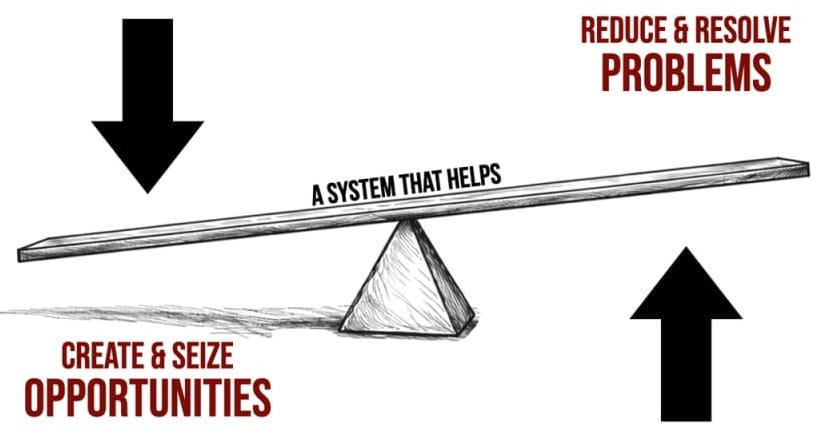
The image of a balanced lever illustrates this concept perfectly. On one side is "Create & Seize Opportunities." On the other is "Reduce & Resolve Problems." The fulcrum supporting both sides is "A System That Helps." This simple illustration carries a powerful message: a well-designed system creates stability while enabling progress.
Why Systems Matter
A system is more than just technology or software. It is a structured way of working that includes processes, people, tools, and continuous improvement. Good systems remove unnecessary complexity, improve consistency, and make it easier for people to perform at their best.
Without a reliable system, organizations often rely on individual effort. While talented individuals can achieve remarkable results, sustainable success comes from repeatable processes that deliver value consistently.
Reducing and Resolving Problems
Every organization encounters challenges such as inefficiencies, communication gaps, customer complaints, delays, or quality issues. If these problems are not addressed, they consume valuable resources and limit growth.
An effective system helps by:
- Identifying the root causes of recurring issues.
- Standardizing processes to reduce errors.
- Improving communication across teams.
- Monitoring performance with measurable data.
- Encouraging continuous improvement.
Rather than reacting to problems after they occur, a strong system prevents many issues before they happen. This saves time, reduces costs, and builds trust among employees and customers alike.
Creating and Seizing Opportunities
While solving problems is important, organizations cannot grow by focusing only on fixing what's broken. Growth requires innovation, adaptability, and the ability to recognize new possibilities.
A strong system creates opportunities by:
- Freeing employees from repetitive tasks.
- Providing accurate information for better decisions.
- Supporting innovation through structured processes.
- Improving customer experiences.
- Enabling faster responses to market changes.
- Encouraging collaboration and knowledge sharing.
When routine work becomes more efficient, people have more time to think creatively, develop new ideas, and pursue strategic initiatives.
The Balance Between Stability and Growth
The image reminds us that success is not about choosing between reducing problems and creating opportunities. Instead, these goals reinforce one another.
When problems are minimized, organizations gain the capacity to innovate. Likewise, when new opportunities are successfully captured, organizations often gain additional resources to improve their systems further.
The strongest organizations continually improve both sides of the equation:
- Fewer problems lead to greater efficiency.
- Greater efficiency creates more opportunities.
- More opportunities generate growth.
- Growth provides resources for further improvement.
This creates a positive cycle of continuous success.
Characteristics of a Helpful System
An effective system should be:
Simple: Easy for everyone to understand and follow.
Reliable: Produces consistent results over time.
Flexible: Adapts to changing business needs.
Measurable: Tracks performance using meaningful metrics.
Scalable: Supports growth without creating unnecessary complexity.
People-Centered: Empowers employees rather than replacing their judgment.
Practical Applications
This principle applies across many industries:
- Healthcare: Systems improve patient safety while enabling better care.
- Education: Structured learning systems reduce learning gaps while encouraging creativity.
- Manufacturing: Standardized processes improve quality while increasing productivity.
- Business: Operational systems reduce costs while creating new revenue opportunities.
- Government: Efficient public services solve community challenges while supporting economic development.
Regardless of the industry, the objective remains the same: build systems that make organizations stronger, smarter, and more resilient.
Leadership's Role
Leaders play a critical role in designing and maintaining systems. They must encourage continuous learning, invest in improvement, and create an environment where employees are empowered to identify problems and propose solutions.
Rather than asking, "Who made the mistake?" effective leaders ask, "How can we improve the system so this doesn't happen again?"
This mindset shifts the focus from blame to improvement.
Conclusion
The image captures a timeless principle of organizational excellence: great systems do more than solve problems—they create opportunities. They provide the foundation that allows individuals and organizations to operate efficiently while remaining agile enough to innovate and grow.
Success is not achieved by constantly reacting to challenges or by pursuing opportunities without structure. It comes from building systems that balance both objectives.
When organizations invest in systems that reduce and resolve problems while simultaneously creating and seizing opportunities, they establish a foundation for sustainable growth, continuous improvement, and long-term success.
William Lee (kokwei67@gmail.com) is a content creator under the Newswav Creator programme, where you get to express yourself, be a citizen journalist, and at the same time monetize your content & reach millions of users on Newswav. Log in to creator.newswav.com and become a Newswav Creator now!
The User Content (as defined on Newswav Terms of Use) above including the views expressed and media (pictures, videos, citations etc) were submitted & posted by the author. Newswav is solely an aggregation platform that hosts the User Content. If you have any questions about the content, copyright or other issues of the work, please contact creator@newswav.com.