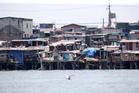
WHAT do you make of a Philippine society where a newly minted trillionaire probably owns more assets than the bottom 49 percent who recently rated themselves as either “poor” or “very poor” — the same cohort that often suffers from the pangs of involuntary hunger?
If we were in the late 1960s and early 1970s, the national democratic movement would turn what the Left calls “objective condition” into a recruitment poster. That was a time of massive, student-led anti-government and anti-establishment protests, aptly called the “First Quarter Storm.” That was a time when Marxist intellectuals openly lectured on the grievous contradictions of Philippine society at universities. That was the period when Jose Ma. Sison was finishing the chapters of his magnum opus, “Philippine Society and Revolution.” Elsewhere, that was during the time Tom Hayden, then-husband of actress Jane Fonda and author of “The Port Huron Statement,” was one of the more prominent leaders of the Students for a Democratic Society; and Daniel Cohn-Bendit, also known as “Danny the Red” and a self-proclaimed anarchist, was a central figure in the Paris-based student movement.
Today, as Marxist academics have mostly vanished from universities, and the determinism that proclaims “capitalism is collapsing and socialism is surging to worldwide victory” has been shattered by the triumphal dominance of unfettered capitalism in the economic order, very rarely is the great economic divide being examined. I do not know of any prominent Filipino economist who has done pioneering work on the great economic divide and attempted to provide comprehensive answers to this question: What is a society where a trillionaire owns more than the poor and very poor — and often hungry — Filipinos at the bottom 49 percent?
And a complementary question: What should policymakers do to, at least, bridge that great divide?
What about the so-called think tanks? There are some so serious that their fellows include Ben Bernanke, and then we have the Philippine version that produces position papers for vested interests and press releases, rather than intellectual treatises. No, not a single Manila-based think tank has turned out a serious paper on our great economic divide.
What about the universities? The Marxist intellectuals who could take the lead in seriously discussing how the “whole-of-government” approach is exclusively applied by the ruling political powers to enable and empower capital, instead of labor primarily through favorable fiscal policies, have not only vanished from the universities. Universities today are training grounds for next-generation economic and political elites with no concern for the abject poverty and deprivation experienced by the bottom 49 percent. Not a single position paper-cum-indictment emerged out of universities when the administrations of Rodrigo Duterte and Ferdinand Marcos Jr. plotted to cut the corporate income tax rate to a rock-bottom 20 percent while taxing wages at a higher rate of 25 percent.
Or, they are more focused on lecturing on transitioning everything to the artificial intelligence (AI)-dominated universe, never mind who wins or loses? Universities today have mostly set aside humanities and civics courses that nurture egalitarianism.
What about Congress, that branch of government with the mandate to set fiscal policy and write economic laws to, at the very least, bridge that great chasm separating the ultrarich from the rest? A Congress determined to do just that can even override a presidential veto on progressive taxation, or on trailblazing legislation such as the ultrawealth tax recently proposed by Mamamayang Liberal Party-list Rep. Leila de Lima.
Congress, with its pro-rich and pro-business predisposition, is hopeless. De Lima’s bill proposing a wealth tax on taxable net assets of P1 billion and above has yet to be deliberated on the committee level and would probably be archived and forgotten by the majority of the members of the House of Representatives who are generally deferential to the interests of the ultrawealthy. Even the supposedly fearless former representative Kiko “Meow-meow” Barzaga walked back on his statement accusing Enrique Razon Jr., the Filipino trillionaire, of paying off politicians after the latter threatened to file a cyberlibel case. Who knew Barzaga, even at his most reckless, was afraid of crossing Razon, who has more wealth than the combined assets of the bottom 49 percent?
Men of a certain age still remember that the last senator to propose an antitrust, antimonopoly piece of legislation to prevent corporate giants from owning everything in this country was Teofisto Guingona Jr., and that was in the Eighth Congress, which was the first to convene after martial law. That congress was supposed to be imbued with an egalitarian spirit, but even that failed to take up Guingona’s challenge to pass such a measure.
We know the brutal wages of failing to pass such a law. The business news is dominated by stories of corporate giants buying everything they covet. Or tycoons buying and selling from each other, even in the midst of typhoons and other calamitous events that kill or maim those at the bottom 49 percent. The business punditry enables that arrangement, and some even have fever dreams of having a “billionaire-president.” Wow.
What about President Marcos? He is unapologetically pro-business, and his administration fast-tracked the reduction of the corporate income tax to a rock-bottom 20 percent. On his economic and fiscal policies, I am reminded of how the great journalist Molly Ivins described former US president George W. Bush: a wholly owned subsidiary of corporate America.