.jpg)
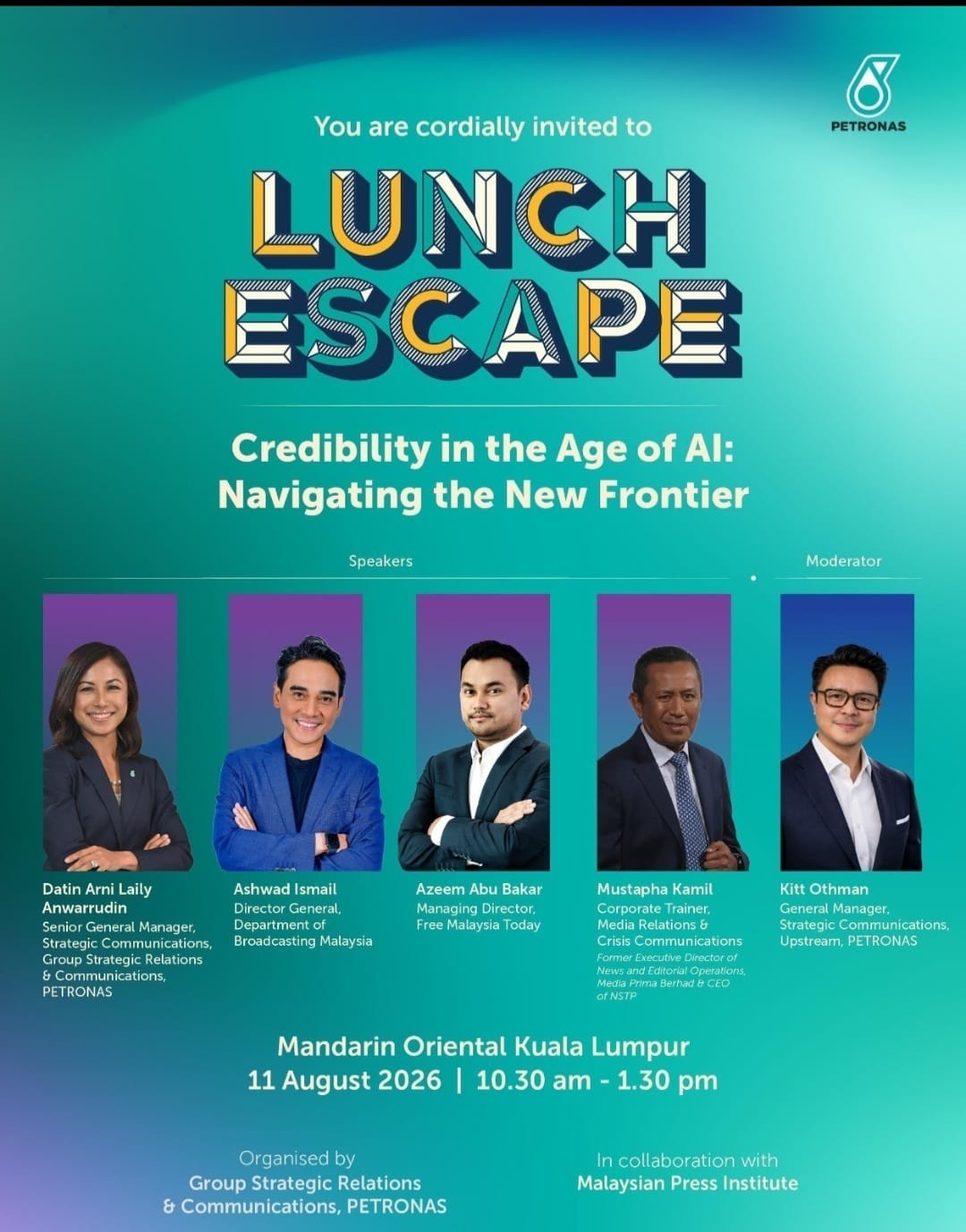
A Very Good Lunch, and a Slightly Under-Cooked Conversation at “Lunch Escape: Credibility in the Age of AI — Navigating the New Frontier”
By Mihar Dias August 2026
There are some invitations one accepts for the intellectual stimulation. There are others one accepts because the venue is the Mandarin Oriental.
The invitation to Lunch Escape: Credibility in the Age of AI — Navigating the New Frontier, organised by PETRONAS Strategic Communications in collaboration with the Malaysian Press Institute (MPI), fortunately promised both.
I was invited by the President of MPI, and I arrived with the usual journalistic expectation: that distinguished people on a distinguished panel might tell me something I did not already know.
The lunch, I am pleased to report, did not disappoint.
The chefs at the Mandarin Oriental produced an excellent spread. The company was equally pleasant, particularly the ladies from PETRONAS Strategic Communications, whose hospitality and warmth made the occasion thoroughly enjoyable.
So, on the important matters of food and fellowship, full marks.
The panel, however, was another matter.
And before anyone from PETRONAS or MPI starts sharpening their corporate communications pencils, let me say this: the hosts did a perfectly good job. My disappointment was entirely with my own expectations.
Perhaps I had expected too much.
The title Credibility in the Age of AI is the sort of title guaranteed to make a journalist sit up. AI and credibility are perhaps the two most combustible ingredients in today's information business.
So I arrived expecting fireworks.
Instead, I got something closer to a polite exchange of familiar observations.
AI is changing journalism.
AI can create misinformation.
AI can be useful.
Humans must verify facts.
Credibility remains important.
Quite true.
But then again, so is gravity.
We already know these things.
What I was hoping for was something more dangerous — an idea that would make me uncomfortable.
Something that would make me think: Good Lord, I hadn't considered that.
Unfortunately, the artificial intelligence on the panel seemed to be having more difficulty hallucinating than the audience.
The panel consisted of people with considerable experience in broadcasting, journalism, corporate communications and crisis communications. Between them, there was enough institutional memory to fill several books.
That is precisely why I thought we might hear something more provocative.
For instance, what happens when AI can produce a credible-looking news story in 30 seconds?
Why should anyone continue paying for journalism when machines can summarise a 200-page report before the journalist has finished reading page five?
If a fake video of a prominent person appears online at 2am and goes viral by 2.15am, what exactly does a corporate communications department do?
And perhaps the most uncomfortable question of all:
If everyone can produce information, who gets to decide what is true?
Those are questions worth fighting over.
Instead, panels of distinguished people sometimes fall into the trap of being too distinguished.
Everyone is polite.
Everyone agrees.
Everyone nods.
The moderator asks a sensible question.
The panelist gives a sensible answer.
The audience nods sensibly.
And somewhere outside the ballroom, AI is probably laughing.
This is not entirely the panel's fault. It is a disease of the modern forum.
We have perfected the art of assembling intelligent people and then asking them questions that allow them to remain intelligent, comfortable and completely unthreatened.
Perhaps we should do the opposite.
Give each panelist seven minutes to make one controversial proposition.
No corporate boilerplate.
No “AI presents both opportunities and challenges.”
Tell them to choose a side.
For example:
AI will make most journalists redundant.
Or:
AI will make good journalists more valuable than ever.
Or:
Traditional media has already lost the credibility war.
Or:
Corporate communications will become more important than journalism.
Now we might have a conversation.
Better still, invite the panelists to disagree with one another.
Not the theatrical disagreement sometimes manufactured for television, but genuine disagreement.
Let the journalist challenge the corporate communicator.
Let the corporate communicator challenge the journalist.
Let the broadcaster tell both of them why they are wrong.
And let the moderator throw in the occasional hand grenade.
The audience might even wake up before dessert.
There is another perspective that deserves more attention — the audience itself.
The future of credibility is not being decided by journalists sitting in newsrooms or communications executives sitting in corporate towers.
It is being decided by people scrolling through TikTok, Instagram, YouTube, Facebook and whatever new platform has been invented by the time this column is published.
Many young people do not ask, “Was this published by a reputable newspaper?”
They ask, “Is it believable?”
And sometimes, more worryingly, “Is it interesting?”
That is a profound challenge.
The media's traditional authority rested partly on scarcity. Newspapers controlled access to information. Television controlled the airwaves. Editors were gatekeepers.
AI has just handed everybody a printing press.
The gate has disappeared.
What replaces it?
That, I thought, was the conversation we should have been having.
Still, let me not sound too ungrateful.
I had a wonderful lunch, delightful company and the pleasure of being in the company of people who clearly care about communications and the future of the media.
And perhaps the real lesson was unintentionally appropriate.
In an age when AI can produce thousands of answers in seconds, the scarce commodity is no longer information. It is an interesting question.
The lunch was excellent.
The hospitality was first class.
The panel was perfectly respectable.
I simply came hoping to escape with a few new ideas.
Perhaps next time, we should make the Lunch Escape a little more adventurous.
Less agreement. More argument. Less conventional wisdom. More inconvenient questions.
After all, if humans are going to compete with artificial intelligence, we should at least give ourselves one advantage.
We should be capable of surprising one another.
Mihar Dias (mihardias@gmail.com) is a content creator under the Newswav Creator programme, where you get to express yourself, be a citizen journalist, and at the same time monetize your content & reach millions of users on Newswav. Log in to creator.newswav.com and become a Newswav Creator now!
The User Content (as defined on Newswav Terms of Use) above including the views expressed and media (pictures, videos, citations etc) were submitted & posted by the author. Newswav is solely an aggregation platform that hosts the User Content. If you have any questions about the content, copyright or other issues of the work, please contact creator@newswav.com.