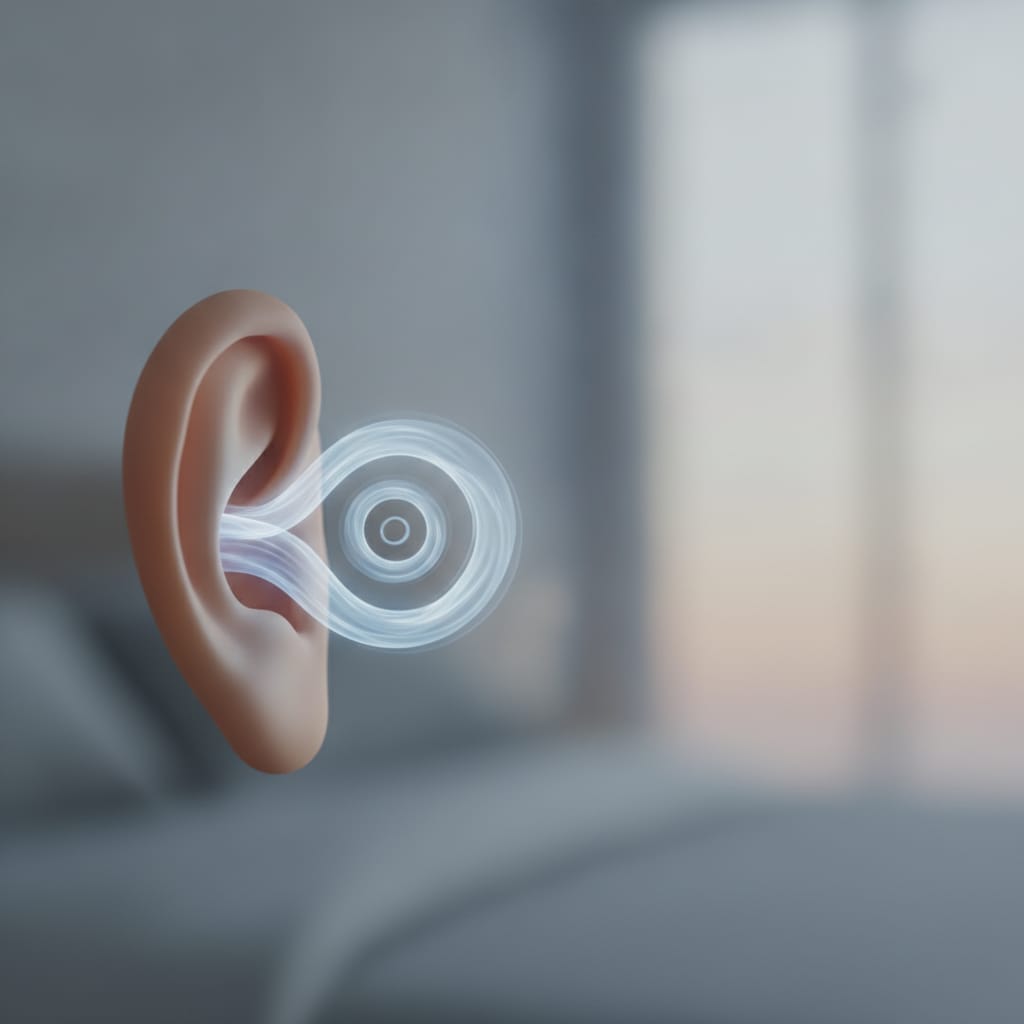
Have you ever been sitting quietly, watching television or lying in bed, when you suddenly hear a whooshing sound in your ear?
It might resemble wind blowing, water running through a pipe or the rhythmic swishing of blood. Sometimes it disappears when you get up and move around. At other times, it returns repeatedly, particularly at night when everything is quiet.
People often tell me, “It’s not ringing in my ears. It’s a whooshing sound.”
That distinction matters to them, and understandably so. But there is an important medical point worth knowing: if the sound follows the rhythm of your heartbeat, it may be a form of tinnitus called pulsatile tinnitus. It sounds different from the familiar ringing or buzzing, and it deserves a different approach to assessment.
The question is not simply how to stop the noise. It is to find out what is causing it.
First, listen to the rhythm
One of the most useful questions is whether the sound beats in time with your pulse.
If it does, you may notice a regular “whoosh, whoosh, whoosh” that seems to follow your heartbeat. It might be heard in one ear or, less commonly, both.
This can happen because blood flowing through vessels near the ear produces sound that becomes noticeable. Changes in blood flow or the structures surrounding the ear can sometimes make that sound more apparent.
There are several possible explanations, ranging from treatable medical conditions to less common problems involving blood vessels or pressure around the brain.
The important point is that you cannot identify the cause from the sound alone.
NICE recommends that people with pulsatile tinnitus are offered imaging to investigate the underlying cause. The appropriate scan depends on the clinical assessment and the suspected problem. (NICE – Tinnitus: assessment and management)
Could it be your blood pressure?
This is a reasonable question, particularly if the sound seems to pulse with your heartbeat.
High blood pressure may be relevant, but it is not the only explanation. A person can have normal blood pressure and still experience pulsatile tinnitus.
Anaemia is another possible contributor. When haemoglobin levels are low, the body may compensate by increasing blood flow, which can sometimes make vascular sounds more noticeable.
Other possible causes include changes in blood vessels, atherosclerosis, increased pressure around the brain and certain abnormalities in or near the middle ear. Some are uncommon, but they are important enough to consider when deciding how to investigate persistent symptoms. (NICE – Evidence review on imaging for pulsatile tinnitus)
This is why taking a blood pressure reading is useful, but it is not a complete investigation.
If you have a recurring whooshing sound, do not assume that high blood pressure is responsible, and do not change your prescribed blood pressure medication without medical advice.
What if your ear feels blocked as well?
Not every whooshing sound is caused by blood flow.
Earwax, middle-ear problems and changes in pressure within the ear can affect hearing and produce unusual sensations or sounds. You might also notice muffled hearing, a feeling of fullness or discomfort.
A healthcare professional can examine the ear to look for these problems.
However, finding earwax does not automatically prove that it explains a heartbeat-synchronised sound. If the whooshing continues, particularly if it follows your pulse, further assessment may still be needed.
Avoid pushing cotton buds or other objects into the ear. This can push wax deeper and injure the ear canal or eardrum.
What would I ask at the pharmacy counter?
When someone describes a persistent whooshing sound, a few simple questions can help establish what needs to happen next.
Is it in one ear or both? Does it follow the heartbeat? Is it constant or intermittent? Has it started recently? Is there any hearing loss, dizziness, ear pain or headache?
I would also ask about relevant medical conditions and medicines, and whether the person has noticed any other new symptoms.
These questions do not provide a diagnosis, but they help determine the appropriate next step. An ear examination, blood pressure measurement, hearing assessment and, where indicated, blood tests or specialist investigations may all form part of the assessment.
A pharmacist can help identify possible causes and advise on appropriate referral, but persistent pulse-synchronous whooshing should not be managed simply by trying one ear product after another.
When should you see your GP?
If the whooshing keeps returning, is persistent or appears to follow your heartbeat, arrange an urgent GP appointment. NHS advice is to seek urgent GP assessment for tinnitus that beats in time with the pulse. (NHS – Tinnitus)
Your GP can examine your ears, check your blood pressure and assess your hearing and other symptoms. Depending on the findings, you may need referral to an ear, nose and throat specialist or an audiology service.
Imaging may be recommended to look for a cause that cannot be identified by examination alone. This does not mean that a serious condition is necessarily present. It means the symptom warrants appropriate investigation rather than guesswork. (NICE – Tinnitus recommendations)
Make a note of when the sound occurs, whether it is in one ear or both, and whether it seems to match your pulse. This information can be useful during your appointment.
When is it an emergency?
A whooshing sound on its own does not automatically mean you need an ambulance. However, certain accompanying symptoms must not be ignored.
Call 999 if you develop sudden facial drooping, weakness or numbness on one side of the body, difficulty speaking or other signs of a possible stroke.
Sudden hearing loss that develops over three days or less needs urgent assessment, generally within 24 hours when it has occurred in the previous 30 days. Do not wait for a routine appointment or assume that the hearing will return on its own. (NICE – Tinnitus referral recommendations)
New neurological symptoms, severe sudden dizziness or symptoms following a significant head injury also warrant urgent medical attention.
Don’t just learn to live with it
Many people put up with unusual ear sounds for months because they assume there is nothing that can be done. Others search online for remedies without knowing what they are treating.
Neither approach is ideal when the sound is persistent or follows the heartbeat.
The reassuring news is that there are several possible causes, and identifying the underlying problem may allow it to be treated. But the first step is getting the right assessment.
As a community pharmacist, I would encourage anyone experiencing repeated whooshing in the ear to pay attention to its pattern, especially whether it matches the heartbeat. It is a useful clue that should be shared with a healthcare professional.
You do not need to panic, but you should not dismiss it either.
If you can hear a regular whoosh in time with your heartbeat, get it checked rather than assuming it is just another ear noise.
Until next time, look after yourself.
This article is for general health information and is not intended to replace individual medical advice.
Health Matters (zaynp100@yahoo.com) is a content creator under the Newswav Creator programme, where you get to express yourself, be a citizen journalist, and at the same time monetize your content & reach millions of users on Newswav. Log in to creator.newswav.com and become a Newswav Creator now!
The User Content (as defined on Newswav Terms of Use) above including the views expressed and media (pictures, videos, citations etc) were submitted & posted by the author. Newswav is solely an aggregation platform that hosts the User Content. If you have any questions about the content, copyright or other issues of the work, please contact creator@newswav.com.