
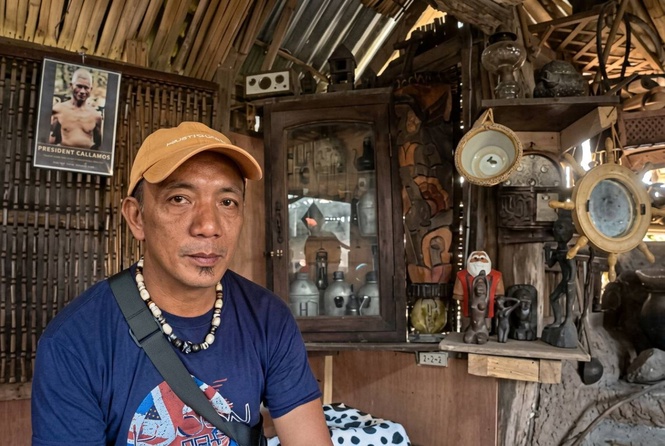
TABUK, Kalinga — Winston Awing’s museum does not announce itself with grand arches or ticket booths. Instead, it greets visitors quietly through wooden doors salvaged from an old ancestral home, their surfaces worn smooth by decades of hands and history.
Named after his great-grandfather, the Gallamoy Mini Museum serves as both a personal archive and a cultural sanctuary in Bulanao, Tabuk. Many of its items were sourced directly from Gallamoy’s original home in Lubuagan, passed down through generations as silent witnesses to the province’s evolution.
“Wala kasing museum dito sa Kalinga, eh (Kalinga does not have a museum),” Awing told the Philippine News Agency. It is a statement that suggests the space was born as much out of necessity as it was out of a love for heritage.
Established in 2017 and registered with the Department of Trade and Industry, the museum is open to the public without an entrance fee. Awing intends to keep it that way until he can further improve the space, reorganize the expanding collection and address the challenges of his limited room.
A century of service
The history housed within these walls traces back to the early 20th century.
Following the onset of American colonial rule, the township of Lubuagan was established in 1905 under the administration of the Lepanto-Bontoc sub-province.
By 1907, Kalinga was organized as a distinct sub-province, with Franklin Walter Hale appointed as its first lieutenant governor. Hale, fondly called “Sapao” by locals, organized a police force from among the pangats (tribal leaders) and village headmen. Among these leaders was Gallamoy, who served as municipal president from 1920 to 1922 and again from 1927 to 1930.
Awing shared that his great-grandfather’s service earned him a trunk filled with Japanese government-issued currency and Commonwealth-period bills — tokens of friendship and historical markers of the shifting political tides in the Cordilleras.
Visual narrative
Inside, the collection unfolds like a visual narrative of Kalinga life and its encounters with the outside world. The shelves hold clay pots and jars, woven rattan bags, wicker baskets and coconut ladles. Wooden skulls from Ifugao sit alongside replica shields and spears, while paintings depict the iconic rice terraces of the highland.
One section holds metal water containers once carried by American and Japanese soldiers during World War II, resting near the currency gifted to Gallamoy.
For Awing, these objects are more than collectibles; they are tangible proof of how global history brushed against a remote mountain community.
“The things that came from our ancestor, Gallamoy — those are the ones I don’t sell,” Awing emphasized. While he occasionally sells common ceramics from his personal collection to fund the museum’s upkeep, the family heirlooms remain sacred.
Toward a provincial landmark
Awing’s private efforts are now being mirrored on a provincial scale. To safeguard the region’s legacy, Republic Act 11770 was signed on May 24, 2022, creating the Kalinga Cultural Center and Museum (KCCM) in partnership with the National Commission for Culture and the Arts.
The measure envisions a dynamic institution dedicated to preserving Kalinga’s artistic, archaeological and historical heritage — from traditional epics and oral literature to artifacts linked to the Rizal Archaeological Site.
On Dec. 4, 2025, the Provincial Development Council of Kalinga approved the design for the proposed KCCM. With P175 million in partial funding secured through Congress, the project is moving toward implementation on a 5,000-square-meter site. The facility will be operated by the provincial government to ensure that Kalinga’s stories are not just exhibited, but professionally archived.
Keeping the flame
Despite the progress, safeguarding such a collection remains difficult. Awing has faced the loss of items to unscrupulous visitors in the past, prompting him to be more vigilant in completing broken narratives.
Beyond historical artifacts, the museum showcases natural heritage. Awing collects and polishes gemstones like jasper, agate and rose quartz from the municipality of Rizal, shaping them into accessories such as lubay (fertility necklaces). These pieces remain intertwined with local belief, often undergoing traditional rituals to imbue them with meaning.
Looking toward the future, the 51-year-old museum owner has already instructed his nephews and nieces on the management of the space. He wants the next generation to understand that they are the stewards of a story that belongs to all of Kalinga.
For now, Awing continues to welcome visitors, offering them more than a tour. He invites them into a living history where the past is not locked behind glass but lovingly kept alive, one artifact at a time. PNA
***
DECENTRALIZING HERITAGE CONSERVATION
THE passage of Republic Act (RA) 11770, which established the Kalinga Cultural Center and Museum, marks a watershed moment in the Philippines’ efforts to decentralize heritage conservation.
By institutionalizing a dedicated space for Kalinga’s history in the town of Pasil, the law moves beyond mere tourism; it provides a statutory shield for the “Living Heritage” of a people whose identity is inextricably linked to their land, their craftsmanship and their indomitable spirit.
The significance of a local museum lies in its role as a guardian of collective memory. For the people of Kalinga, whose history includes the world-renowned Batok (traditional tattooing) and the intricate Ullalim chants, a local museum ensures that these traditions are not just relics of the past but active components of the present.
Unlike national museums that provide a broad overview, a local museum offers a “micro-lens” that captures the specific nuances of a community’s soul. It serves as an educational hub where the youth can encounter their ancestors’ wisdom without the filter of an external perspective.
Furthermore, RA 11770 serves as a tool for cultural sovereignty. In a globalized world where indigenous knowledge is often commodified or misrepresented, a local museum provides a platform for the community to tell its own story. It validates the Kalinga way of life, from their sustainable agricultural practices to their traditional peace pacts (Bipak), ensuring these are documented and protected from cultural erasure.
Ultimately, the Kalinga Cultural Center and Museum is more than a building; it is a living archive. Its establishment proves that for a nation to move forward, it must be firmly rooted in the diverse stories of its provinces. By protecting the tangible and intangible treasures of Kalinga, we are not just preserving a province’s pride — we are enriching the entire Filipino tapestry for generations to come.