
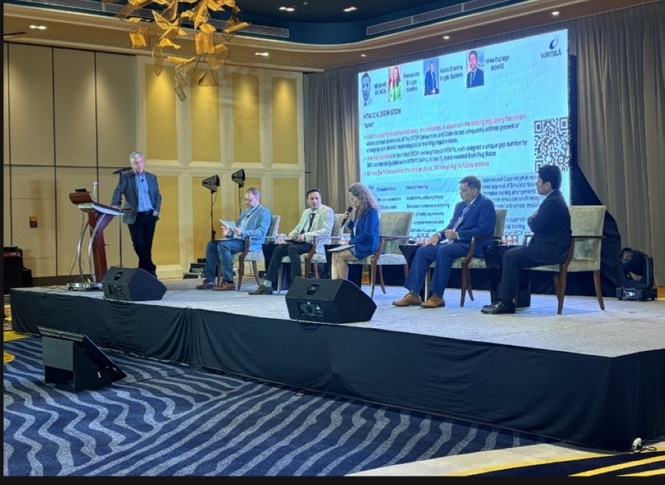
MANILA, Philippines — Advanced simulation technology must quickly replace traditional training methods to prepare seafarers for dynamic digital navigation, automated systems, and updated global standards, industry leaders warned at the Wärtsilä Simulation User Conference 2026.
More than 350 Asia-Pacific maritime professionals, naval leaders, and regulators gathered at Manila’s Solaire Resort on Oct. 19 to address how seafarer instruction must adapt to rapid operational and technological shifts.
Discussions focused on expanding simulator deployment across three key areas: tactical naval readiness, the civil fleet’s transition to the S-100 digital navigation standard, and modernizing compliance under the International Maritime Organization’s (IMO) comprehensive review of the STCW Convention.
“The pace of change in maritime operations continues to accelerate, from digitalization and automation to evolving competency requirements,” said Johan Ekvall, director of simulation and training at Wärtsilä.
“Bringing together industry leaders, regulators, educators and operators in Manila allowed us to have meaningful conversations about how simulation can help the industry prepare for the future.”
Morning sessions concentrated on naval readiness. Keynote addresses by Atty. Julius Yano, assistant secretary for maritime concerns at the Office of the President of the Philippines, and Rear Adm. Marco Gines highlighted simulation’s role in honing decision-making under high-pressure conditions. Kiran Kumar, Wärtsilä’s regional simulation sales head for the Middle East and Africa, demonstrated how integrating mission rehearsal, tactical training, and wargaming into one environment builds mission confidence prior to deployment.
Afternoon discussions turned to commercial bridge operations and the rollout of the S-100 digital framework. Neil Bennett, general manager of simulation sales at Wärtsilä, noted that while S-100 improves situational awareness, international trials reveal risks of mariner data overload and cybersecurity threats. Simulator-based instruction, Bennett argued, is critical to building new competencies alongside these digital systems.
The conference also targeted pending regulatory reforms following the IMO HTW 12 sub-committee meeting. A panel featuring officials from the Philippines’ Maritime Industry Authority (Marina), the UK Maritime and Coastguard Agency, STI Maritime Training Academy, and AESM debated regulatory shifts — including substituting simulator hours for sea time, training for alternative fuels, and integrating shore-to-ship blended learning.
Wärtsilä concluded the event by unveiling updates to its simulation product roadmap, focusing on cloud-based training tools and Global Maritime Distress and Safety System (GMDSS) simulators.