
COP29 in Baku Azerbaijan in 2024 had continued to sustain the momentum gained by nuclear power at COP28 in Dubai, UAE last year in 2023
The International Atomic Energy Agency had reported that Nuclear power is in the spotlight at the United Nations Climate Change Conference (COP29) in Azerbaijan, where both countries and industries presented plans to deploy the carbon-free energy technology, building on the historic consensus to accelerate its use that emerged from last year’s climate summit. (Source: iaea.org)
More meetings, conferences and activities were organized to share the needs, benefits of nuclear power and nuclear technologies to a wider audience at COP29.
As COP29 draws to a close on 22nd November 2024, this article highlights selected Nuclear events at COP29
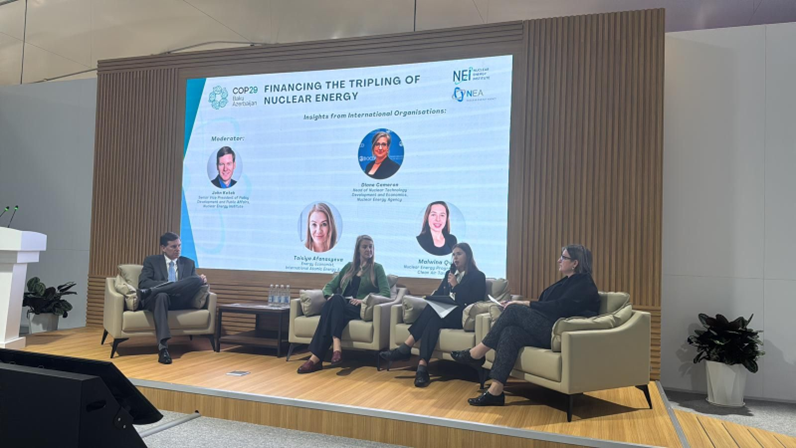
Financing had taken centre-stage at COP29 with two key Financing events organized including Financing Low Carbon Technology, Including Nuclear Energy and Financing the Tripling of Nuclear Energy.
The IAEA highlighted that this high-level event featured speakers including DG IAEA Mr Rafael Grossi and Minister of Energy of Azerbaijan- Parviz Shabazov,; Deputy Minister of Energy of Ghana- Herbert Krapa,;, IEA Executive Secretary- Fatih Birol;, Director-General of the International Renewable Energy Agency (IRENA)- Francesco La Camera;, Executive Secretary of the United Nations Economic Commission for Europe (UNECE)- Tatiana Molcean;, Vice President for Policy and Partnerships, European Bank for Reconstruction and Development (EBRD)- Mark Bowman;, Director General of the World Nuclear Association (WNA)- Sama Bilbao y Leon; and, Director of Renewable Energy at the Ministry of Energy of Ghana- Seth Agbeve. (Fig1)
Fig1: COP29 high-level event on Financing Low Carbon Technology, Including Nuclear Energy in Baku, Azerbaijan.
Reaching global decarbonization targets by 2050 will require a significant expansion of nuclear power. This was acknowledged at the first Nuclear Energy Summit in March 2024 as well as in the Global Stocktake at COP28 and the pledge by more than 20 countries to seek to triple nuclear capacity. But to get there, capital is urgently needed, said IAEA Director General Rafael Mariano Grossi. “Finance institutions need to evolve with the changing demands of the market—and there’s a clear demand for and growing interest in nuclear,” Mr Grossi said at a high-level event co-hosted by the COP29 Presidency and the IAEA that focused on financing low-carbon energy projects including nuclear power.
In conjunction with this event, several agreements were signed
The IAEA reported that the event followed the signing of a memorandum of understanding by the IAEA and Azerbaijan in which the Agency agreed to provide energy planning capacity building services, including a joint analysis under the Atoms4NetZero initiative on the potential role of nuclear energy in Azerbaijan’s clean energy transition. (Fig2)
Fig2 IAEA DG Dr Rafael Grossi and Azerbaijan Minister of Energy Parviz Shahbazov signatories of the Memorandum of Understanding between IAEA and Azerbaijan
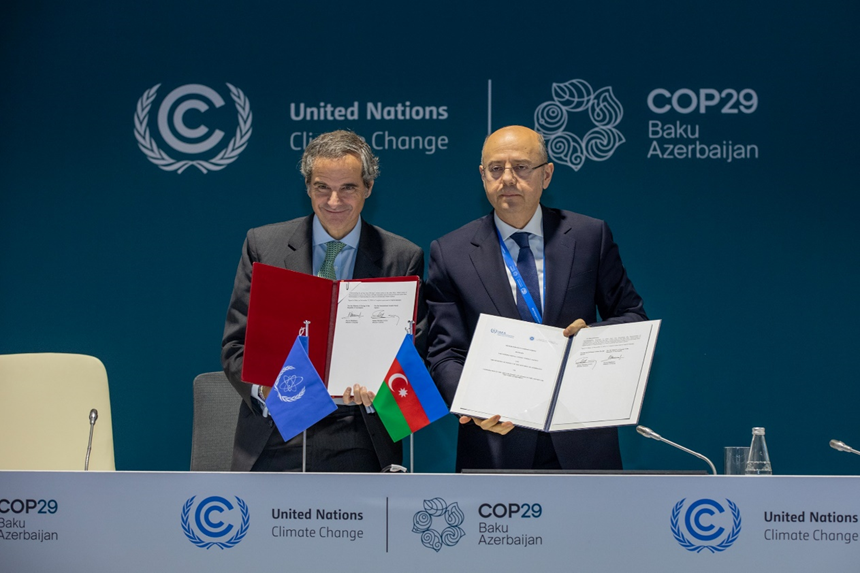
Noting the importance of nuclear energy for Azerbaijan’s future, Azerbaijan Minister of Energy Parviz Shahbazov said at the event that “Azerbaijan sees opportunities for nuclear energy to be part of its energy mix in the future, as clean energy.”
Presently 31 countries have joined the pledge launched last year at COP28 to work towards tripling their nuclear energy capacity by 2050.
A new IAEA Report (Source: iaea.org) dovetailed that achieving this ambitious goal will require significant financing, to the tune of about 150 billion USD annually, representing a threefold increase from the 50 billion USD invested in the industry annually from 2017 through 2023. Getting there will require innovative thinking and new financing approaches.
This event explored recent progress in nuclear financing and how to foster greater investment. Senior officials from governments, nuclear organizations and the private sector took part in the discussion. (Fig 3)
Six More Countries Endorse the Declaration to Triple Nuclear Energy by 2050 at COP29
Previously at COP28 in Dubai, UAE, 22 World Leaders signed the Declaration triple global nuclear energy capacity by 2050. This was followed by another
3 countries making it 25 countries from four continents as signatories; Armenia, Bulgaria, Canada, Croatia, Czech Republic, Finland, France, Ghana, Hungary, Jamaica, Japan, Moldova, Mongolia, Morocco, The Netherlands, Poland, Republic of Korea, Romania, Slovakia, Slovenia, Sweden, Ukraine, United Arab Emirates, United Kingdom, and the United States. (Source: https://www.state.gov/the-united-states-welcomes-additional-endorsers-of-the-declaration-to-triple-nuclear-energy/)
At COP29 UN Climate Change Conference in Baku, Azerbaijan, six additional countries joined the declaration to triple global nuclear energy capacity by 2050.
New endorsers of the Declaration include El Salvador, Kazakhstan, Kenya, Kosovo, Nigeria, and Türkiye. (Source: https://www.state.gov/the-united-states-welcomes-additional-endorsers-of-the-declaration-to-triple-nuclear-energy/)
The announcement was made on the third day of the World Climate Action Summit by Ministers and high-level officials representing the signatory countries, at an event co-organized by the COP29 Presidency, the International Atomic Energy Agency, the United States of America, and World Nuclear Association.
The announcement brings the total number of countries endorsing the declaration to 31.
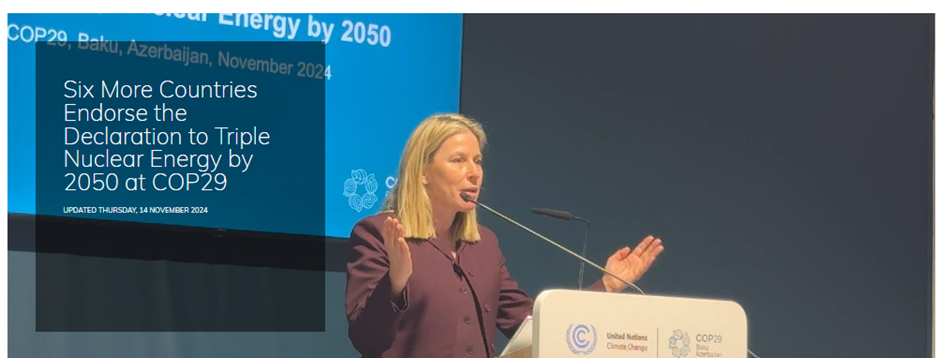
Opening the event, Dr Sama Bilbao y León, Director-General, World Nuclear Association, representing the global nuclear industry said: "We warmly welcome these six new countries to the Coalition of the Ambitious. Today's announcement highlights the essential role of nuclear energy in meeting the Paris Agreement goals in a cost-effective and equitable manner. (Fig4)
Fig4: Dr Sama Bilbao y León, Director-General, World Nuclear Association delivering the Opening Address
“Nuclear can now count on the world’s biggest banks to back the growth of the nuclear industry. Nuclear has attracted the interest and investment of the world’s largest and most advanced technology companies. And nuclear has ever-increasing support from the public, who recognize that in nuclear they have an answer to their demands for energy security, reliable supply and prices, and a response to climate change. This is truly a global coalition of the ambitious. And thank you all for being part of it.”
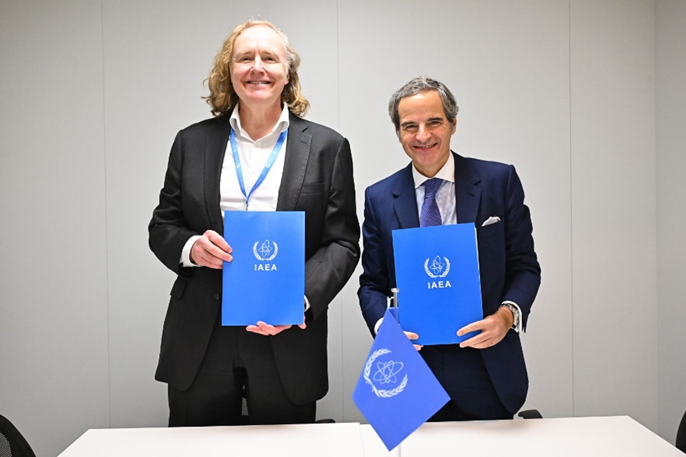
i)The IAEA and LinkedIn entered into a partnership at COP29 that will benefit the nuclear energy workforce, including women in STEM, by supporting capacity building and workforce development. The partnership will provide training and research opportunities, and access to LinkedIn’s extensive global network. The agreement was signed by IAEA Director General Rafael Mariano Grossi and the co-founder of LinkedIn, Allen Blue (Fig5)
ii) The IAEA and IRENA agreed to cooperate on joint missions, training, data sharing and case studies to support energy planning and clean energy goals.
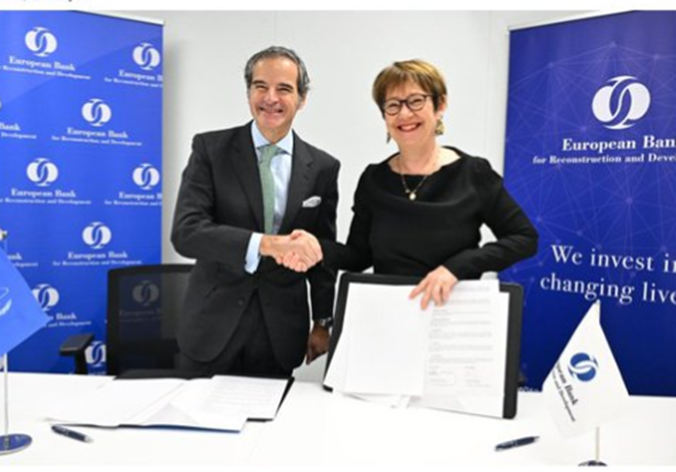
iii) The European Bank for Reconstruction and Development and the IAEA agreed to cooperate on nuclear safety, decommissioning, environmental remediation and nuclear energy. ( Fig6)
Fig6: The IAEA and European Bank for Reconstruction and Development (EBRD) are expanding collaboration in nuclear energy
Accelerating Early Deployment of Small Modular Reactors co-organized by IAEA and the USA at COP29
The IAEA highlighted that this SMR focused event focussed on supporting nuclear infrastructure for the SMR deployment, including regulation, and hearing from the industrial off-takers, established and emerging end-users and SMR vendors. The discussion highlights the unique role of industrial demand, how embarking countries are conceptualizing SMR deployment, and how each stakeholder is overcoming challenges and bringing opportunities to fruition.
Speakers include amongst others, Mr. Rafael Grossi, Director General, IAEA , Mr. John Podesta, Senior Advisor to the US President for International Climate policy.
Additionally the event showcased new partnerships, including a deal between Google and Kairos Power to deploy 500 MW of SMR capacity by 2035, and emerging oortunities for financing.
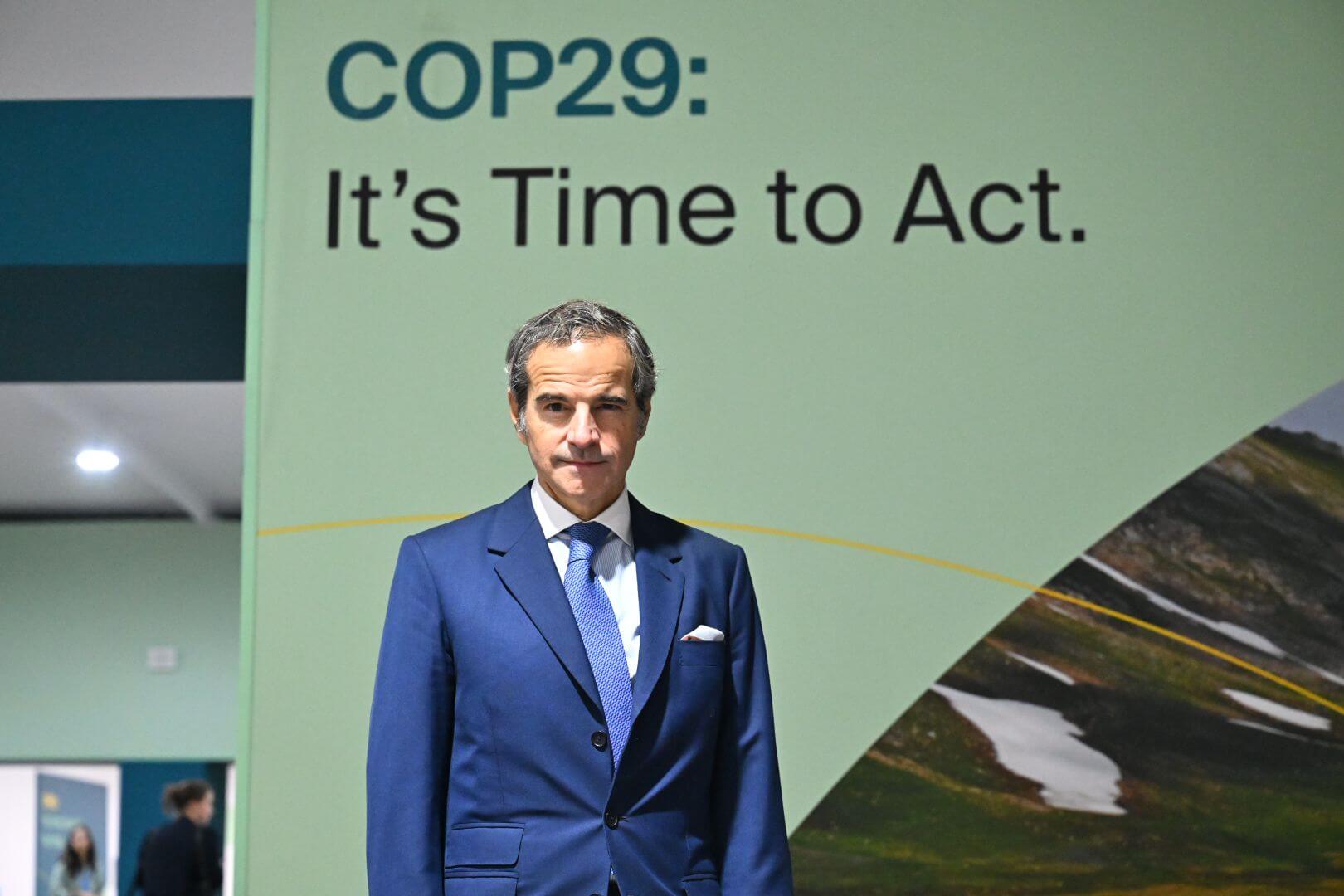
For the second year, IAEA DG has been provided a key platform to deliver his remarks at COP.
Last year in 2023 at COP28, Mr Grossi had delivered the IAEA Landmark Statement that “ Net-zero Need Nuclear” and this year at COP29 For 2024, Rafael Grossi had stated “At COP29 in Baku, the world must discuss concrete steps to get nuclear from consensus to construction—and financing is central to making that happen…
“Over the past five COP meetings, nuclear has gone from the sidelines to being part of the solution. At COP29, it’s time to shift from agreeing what’s needed to finding ways of getting it done.” (Fig7)
Fig7: IAEA Director General's Message to COP29
UK and US sign civil nuclear collaboration deal at COP29
The UK Government has reported that the United Kingdom and United States have joined forces at COP29 to speed up the deployment of cutting-edge nuclear technology to help decarbonise industry and boost energy security.
The UK Energy Secretary Ed Miliband and US Deputy Secretary of Energy David Turk have today (Monday 18 November) signed a new agreement while in Baku for climate talks that will help pool together billions of pounds worth of nuclear research and development – including the world’s leading academic institutions and nuclear innovators. ( Fig 8)
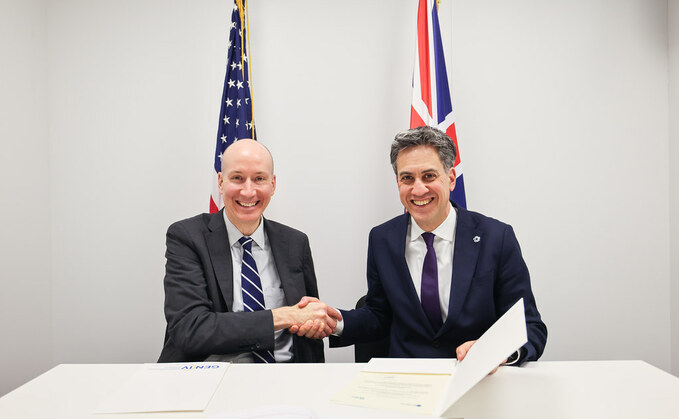
Power Technology reported that the agreement will be effective from March 2025 and that the UK will lead a forum to facilitate information-sharing on advanced nuclear technologies, aiming for industrial use by 2030
Countries sharing their Nuclear Power Plans- The Case of the United States and Indonesia
President Joe Biden’s administration is setting out plans for the U.S. to triple nuclear power capacity by 2050,
Under a RoadMap unveiled Tuesday 13 November, the U.S. would deploy an additional 200 gigawatts of nuclear energy capacity by midcentury through the construction of new reactors, plant restarts and upgrades to existing facilities. In the short term, the White House aims to have 35 gigawatts of new capacity operating in just more than a decade.
“Over the last four years the United States has really established the industrial capacity and the muscle memory across the economy to carry out this plan,” said Ali Zaidi, the White House national climate adviser. ( Fig9)

Biden’s administration is addressing issues that have hampered nuclear developments, including a lack of skilled labor, domestic fuel supply and regulatory infrastructure, he said. “
ASEAN Member Country announcing plans on Nuclear Power at COP29
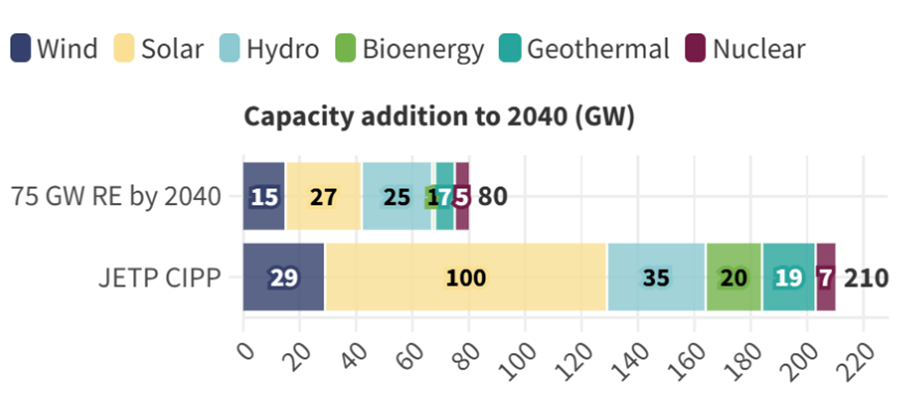
Hashim Djojohadikusumo, Special Envoy to the Indonesian President on Energy and Environment to COP29, appointed by and brother of President Prabowo Subianto had announced that in the next 15 years, Indonesia's renewable energy generation capacity is targeted to grow by 75% from total electricity capacity additions of 100 gigawatts (GW), comprising solar (27GW), hydro (25GW), Wind (15GW), geothermal ( 7GW) and bioenergy (1 GW) and 5% from nuclear energy, with projections that at least, by 2040, of 5 gigawatts (GW) of nuclear power plants will be built. ( Fig10 and Fig11)
(Source: https://energyandcleanair.org/president-prabowos-fossil-power-phase-out-vision-requires-more-robust-clean-energy-targets-and-investment/) and https://www.argusmedia.com/ja/news-and-insights/latest-market-news/2627675-cop-indonesian-energy-firms-reaffirm-net-zero-efforts
Fig10: Hashim Djojohadikusumo, Special Envoy to the Indonesian President on Energy and Environment to COP29 reiterated Indonesia’s commitment to accelerating energy transition.
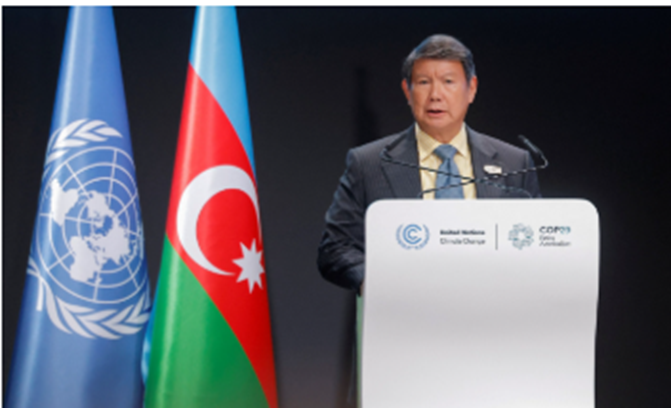
This announcement, followed by the President’s announcement on Indonesia's Nuclear Power Plans in Rio de Janeiro, Brazil during G-20 Summit marks ASEAN's second Member Country to announce its Nuclear Power Ambition at a Key Global event, after Philippines which had unveiled its Nuclear Energy Roadmap at the 68th International Atomic Energy Agency General Conference held from 16-20 September 2024 in Vienna, Austria
Philippines Department of Energy (DOE) Undersecretary Sharon Garin had announced "We aim to have commercially operational nuclear power plants by 2032 with at least 1,200 MW initially entering the country's power mix, gradually increasing to 4,800 MW by 2050.
.
Fig11 Indonesia’s Capacity Addition to 2040 (GW)
Sheriffah Dato Syed is a content creator under the Newswav Creator programme, where you get to express yourself, be a citizen journalist, and at the same time monetize your content & reach millions of users on Newswav. Log in to creator.newswav.com and become a Newswav Creator now!
The User Content (as defined on Newswav Terms of Use) above including the views expressed and media (pictures, videos, citations etc) were submitted & posted by the author. Newswav is solely an aggregation platform that hosts the User Content. If you have any questions about the content, copyright or other issues of the work, please contact Newswav.
