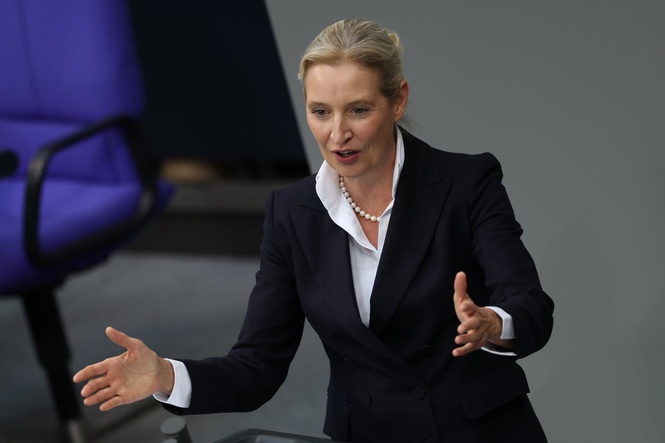
The head of Germany’s far-right party said that Berlin should end its support for Ukraine as the country is too small to defend itself against the invading Russian forces, in an interview that will set off alarm bells and Europe more widely.
Alice Weidel, co-leader of the Alternative for Germany party (AfD), told The Economist on Thursday that continuing the war is “not in our interest” and that it would be “wrong” to continue financing what she called “an already lost war”.
“Ukraine is too small. Ukraine cannot win against Russia. It is impossible,” she said, adding: “We are about to spend over 100 billion. No other country has spent that much, and we are highly indebted. I have the interest of my country first; it's Germany first and this war is not in our interest.”
Ms Weidel’s anti-immigration party inched closer to power last month after winning a regional election in the eastern state of Saxony Anhalt. Its officials have found resonance with voters in calls to restore ties with Russia while cutting military and financial assistance to Ukraine.
“If diplomacy sits at the table, there's always history sitting at the table as well,” Ms Weidel said in her interview this week, alluding to Russian talking points of Nato enlargement along Europe’s eastern frontier.
“This is not a justification of the attack on Ukraine. It is not a justification. What I'm trying to say is that there's history about the encroachment of Nato to the Russian border. Russia emphasized this problem several times.
“Why did nobody listen to the Russian concerns when rocket systems were being put at the borders, especially in Romania and then being able to carry nuclear devices?”
A US MK-41 missile defence system aimed at protecting European Nato Allies from ballistic missile threats was opened in Deveselu, Romania in 2016, two years after Russia illegally annexed Crimea from Ukraine.
Russia argued at the time that the MK-41 launchers could be used to fire ground-launched Tomahawk cruise missiles, which it alleged would be in violation of the Intermediate Nuclear Forces (INF) arms control treaty.
The Tomahawk is a sea-launched missile and the US said the land-based version in Romania was different and could only launch defensive SM-3 interceptors. The INF Treaty banned ground-launched cruise missiles up to a certain range, not sea-launched Tomahawks.
Nato said the move was purely defensive, not directed at Russia, and came in response to several countries seeking to develop or acquire missiles outside the Euro-Atlantic area. There is no public evidence that nuclear weapons were ever stationed at the Romanian site.
The United States has maintained nuclear weapons in several European Nato countries since the 1950s.
Ms Weidel said in her interview that the “prolongation” of the conflict with Ukraine and undefined measures taken by the German government “impose a huge risk on our country”.
“I think it is wrong to continue with the prolongation of financing of an already lost war. The Ukraine, unfortunately, you can say the Ukraine is too small,” she added.
Successive German governments on both sides of the political spectrum have offered Ukraine support packages worth a total sum of around €100 billion (£84.59bn) as of mid-2026.

“If we give up our support for Ukraine, this will have an enormous impact on the entire political order of this continent,” chancellor Friedrich Merz, of the centre-right Christian Democratic Union (CDU), told the FT on Wednesday.
Kyiv would not lose the war with Russia “if we are doing the right things”, he added, questioning US president Trump’s recent decision to lift sanctions on Russian diesel and to buy fuel from Moscow to bring down American energy prices ahead of the November midterm elections.
“The Americans have a problem with prices,” Merz acknowledged. “But this is of the outcomes of the terrible [US-Iranian] war in the Middle East.”
Ukraine meanwhile has stepped up pressure on Russia to end the war through devastating strikes on its oil refineries as gains on the battlefield grind to a halt. Russia has demanded Ukraine cede the 20 per cent of the eastern Donetsk region it still controls before it stops fighting, even as Ukrainian forces recover ground.
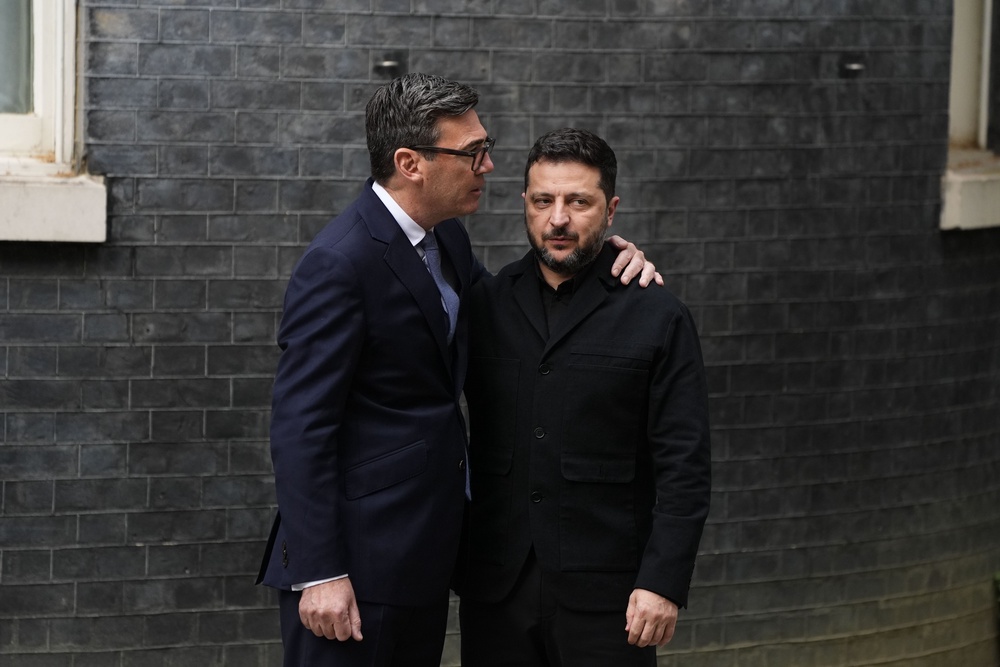
Ukrainian Brig. Gen. Andrii Biletskyi said on Wednesday that Ukraine has freed 16 villages from Russian forces in its latest counteroffensive, part of what he called a major frontline pushback amid increased Russian air attacks elsewhere.
“The Kremlin's plan to seize the Donetsk and Luhansk regions will not be implemented in the foreseeable future,” he said in a video address. Donetsk and Luhansk, which Russia almost entirely occupies, make up Ukraine's mineral-rich Donbas.
The highly publicised operation, dubbed "Vivaldi", comes as Ukrainian forces aim to seize the ground initiative from Russia in the fifth year of fighting, in part by embracing technology and new tactics.
Read MoreInternet trashes FBI Director Kash Patel for his ‘From Russia with Love’ post
UK lacked ‘moral courage’ to stand up to Russia before 2022, ex-MI5 chief says