Malaysia’s AI ambitions must be matched by sustainable management of electricity and water as data-centre demand continues to grow, says Fahmi Fadzil.
PETALING JAYA: Malaysia’s ambition to become an AI nation must be matched by careful management of the electricity and water resources needed to support its rapidly expanding data-centre industry, Communications Minister Fahmi Fadzil said.
He said Malaysia’s progress should be measured not simply by computing capacity, but by the economic value and opportunities generated from it.
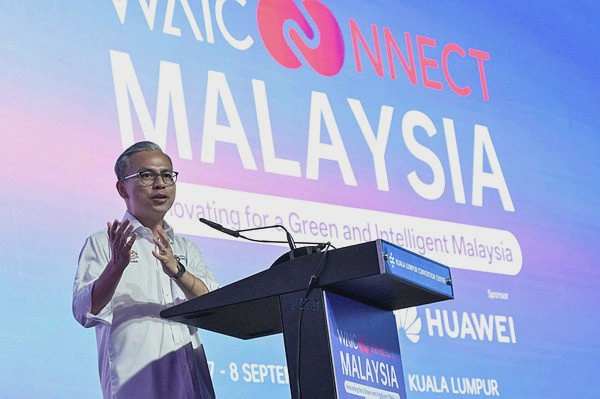
“AI requires computing power, which in turn requires energy and water,” he said in his speech at WAIC Connect Malaysia 2026 at the Kuala Lumpur Convention Centre today.
Fahmi said data centres were projected to account for around 7% of Malaysia’s electricity consumption this year, equivalent to approximately 10,544 gigawatt-hours (GWh), with their share potentially rising significantly over the next decade.
“Our digital infrastructure growth must therefore be aligned with our energy and water resources, environmental commitments and community well-being,” he said.
Separately, the Energy Transition and Water Transformation Ministry said in July that electricity consumption by data centres in Peninsular Malaysia was projected to rise from 7% of total demand, or 10,544 GWh in 2026, to 31%, or 73,274 GWh, by 2035.
Peak demand in Peninsular Malaysia is also projected to increase from 21.3 gigawatts (GW) in 2026 to 33.5 GW by 2035.
In February, Prime Minister Datuk Seri Anwar Ibrahim said the government had restricted the entry of new data centres unrelated to AI for nearly two years to reduce pressure on the national power grid and water supply.
He said applications involving high technology and AI development would be easier to approve.
Fahmi said Malaysia had already demonstrated its ability to attract investment, build digital infrastructure and develop the computing capacity needed to participate in the AI economy.
Between 2021 and mid-2025, the Malaysian Investment Development Authority approved RM144.4 billion in investments in data centres and cloud computing.
The country’s digital economy already contributes 25.5% to national GDP and is targeted to reach 30% by 2030, while national data-centre capacity is expected to more than double to 2,055 megawatts by the end of this year.
However, Fahmi said Malaysia now had to distinguish between having digital infrastructure and becoming a country where AI was actually developed, deployed and applied.
“This means using AI to raise productivity in semiconductors and electronics, strengthen advanced manufacturing and logistics, improve supply chains, transform healthcare, support agriculture and deliver better public services,” he said.
Under the government’s National AI Action Plan 2026–2030, or AI Nation 2030, Malaysia is targeting an additional 0.8 to 1.2 percentage points of annual GDP growth, equivalent to roughly RM13 billion to RM20 billion a year.
It also aims to create between 300,000 and 500,000 new AI-related jobs.
Fahmi said the targets were ultimately about enabling more Malaysian businesses to adopt and develop AI, allowing more Malaysians to participate in the AI economy and ensuring more AI-generated value remained within the domestic economy.
As of April, data centres were using about 1,102MW of electricity against approved demand of 2,050MW, while reported water consumption stood at 28.68 million litres a day, or 51.4% of approved demand, according to Energy Transition and Water Transformation Minister Datuk Seri Fadillah Yusof.
Fahmi said sustainability was also a matter of trust and governance, with a dedicated AI regulatory framework being developed to support innovation and investment while ensuring AI remained responsible, secure and trusted.
He also welcomed Huawei’s plan to nurture 30,000 Malaysian AI talents and develop 200 local AI partners over the next three years through engagement, knowledge transfer and cloud and AI collaborations.