FOR businesses in the Philippines, the question is no longer whether to use artificial intelligence (AI). The harder question now is how to make it work at scale.
A 2025 study on AI adoption in the Philippines found that 92 percent of organizations had used AI in some form over the past year, yet 65 percent remained at the proof-of-concept stage.
That gap says something important about where the country is in its AI journey. Businesses are ready to experiment with the technology, but the challenge is integrating it into everyday operations and scaling its use.
This brings another part of the AI equation into focus: the data infrastructure behind it.
AI can only work with the information it can access. As its use grows, so does the amount of data businesses need to manage.
When storage becomes bottleneck
For many businesses, that data has accumulated over years of digital transformation. It may sit on servers, cloud platforms, databases and various business applications. Managing information across all these systems inevitably becomes more difficult as the business grows.
AI also introduces new demands on storage compared with conventional business applications. Data may need to be accessed repeatedly for analytics, model training and AI applications. If that information is difficult to find or slow to retrieve, the computing power running those applications may not be used efficiently.
This makes data fragmentation more than a data management problem. When information is spread across systems that do not work well together, businesses may have more difficulty getting the right data to the right application at the right time.
The problem, then, is not necessarily a lack of data. It is having the right information available when AI needs it.
There is also the question of scale. As data volumes grow, businesses need to store, back up, protect and retain more information. Costs can rise, particularly when relying heavily on subscription-based cloud storage.
A 2026 study conducted across Asia, including 62 Philippine organizations, found that 71 percent of respondents cited insufficient computing power, storage or network capacity as a barrier to advancing their AI initiatives. The same share said delays in accessing or moving data were already affecting performance.
Storage, then, is not simply about having enough space. It can affect how quickly data is accessed, how reliably it remains available and how much it costs to manage as AI use grows.
Building infrastructure to scale
As AI moves into everyday operations, businesses need to consider where data is stored, how quickly it can be accessed, how it is protected and how costs will change as data volumes grow.
This does not mean every business needs to move away from the cloud. Different workloads have different needs, but businesses should consider where cloud services make sense and where owning infrastructure may provide greater control over frequently accessed or business-critical data.
As AI workloads become more integrated into everyday operations, the infrastructure supporting them needs to keep pace. Businesses need to consider not only how quickly data can be accessed, but also whether systems can remain available as workloads grow and how easily infrastructure can scale with increasing data demands.
This is where the underlying storage architecture becomes increasingly important. Technologies such as NVMe storage can help improve access to large datasets, while active-active configurations can support service availability in the event of component failure. Scalable capacity and centralized management can also help businesses manage growing data volumes without adding unnecessary complexity.
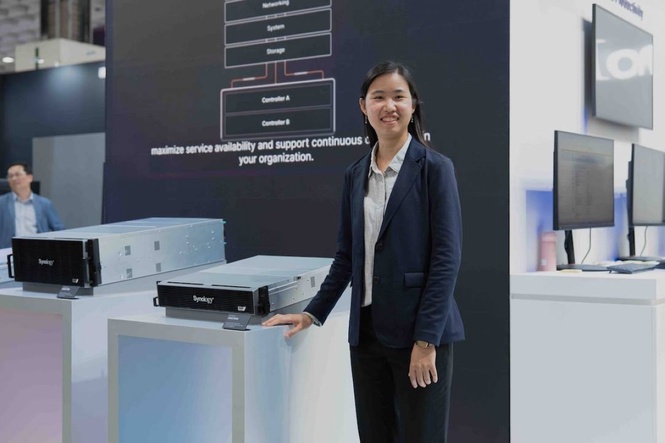
Synology’s PAS Series is designed around these requirements, combining an active-active NVMe architecture with scalable capacity and centralized data management to support performance, availability and protection for business-critical data.
AI readiness does not begin with the AI tool.
As businesses move from experimentation to real-world applications, establishing a solid data foundation will be critical to turning promising AI pilots into reliable, scalable business applications.
Claire Huang is the Philippines country manager at Synology, a Taiwan-based technology company that specializes in data storage, backup, file management and data protection solutions for businesses and individuals.