
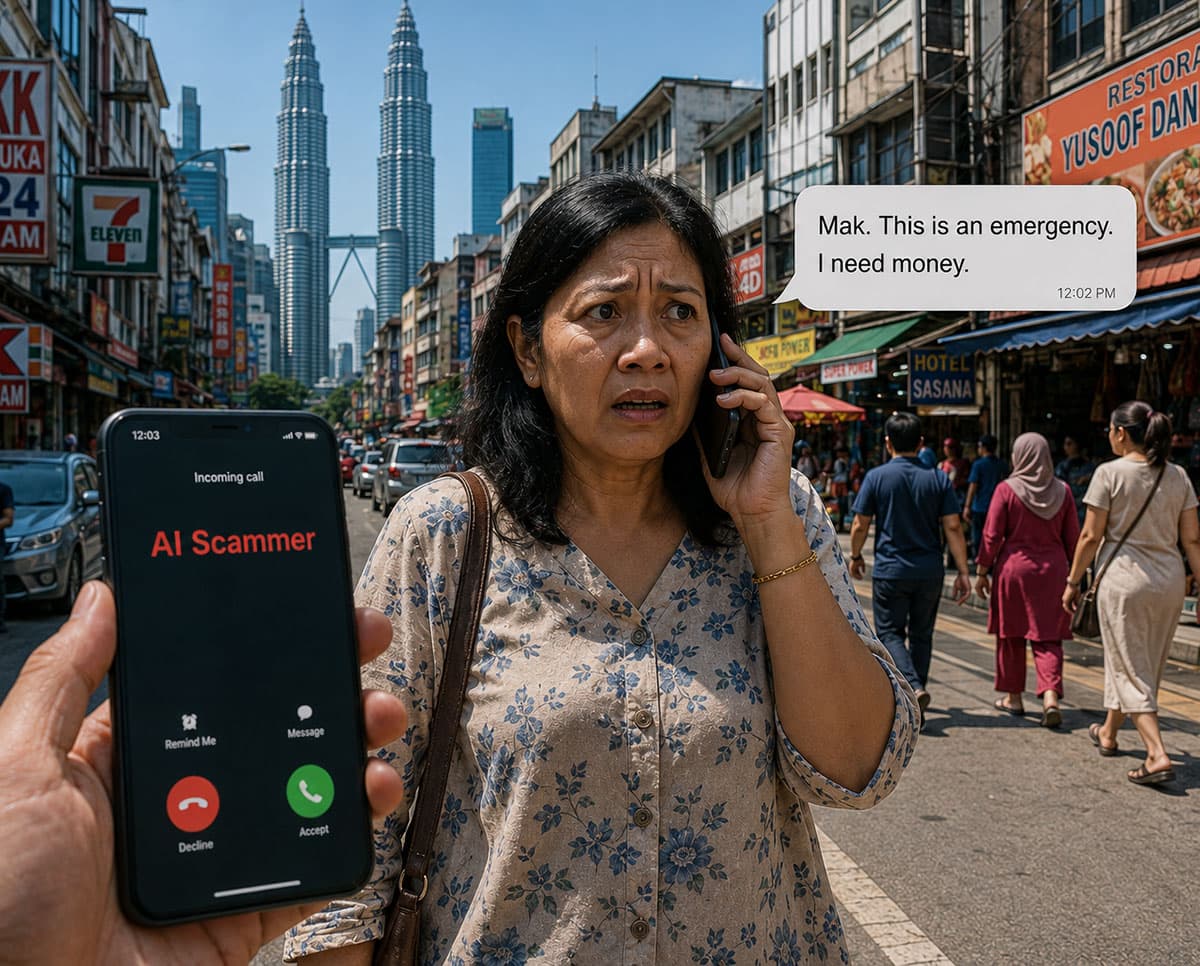
Scammers no longer need a script. They just need three seconds of your voice and a free AI app.
Somewhere out there, a scammer is recording your voice from a TikTok video. And they are about to call your mother.
Welcome to 2026, where online scams have graduated from badly written emails asking you to help a Nigerian prince to fully AI-generated phone calls that sound exactly like your boss, your spouse, or your child in distress. The technology has levelled up. Most of us have not.
The Old Scams Were Easier to Spot
Remember the classic hallmarks of a scam call? The suspiciously formal Bahasa Melayu. The strange background noise. The "officer" who could not quite pronounce your name correctly. The number that showed up as +1-800-something that no Malaysian government agency has ever used.
Those were the training wheels era of scamming. Annoying, yes. Convincing, not really.
Online scams in Malaysia doubled in a single year, jumping from 35,470 cases in 2024 to 74,744 cases in 2025, with losses exceeding RM2.9 billion. That is not a rounding error. That is a very profitable industry that has been quietly upgrading its tools while most of us were busy scrolling TikTok. Which, as it turns out, is part of the problem.
I Received One of These Calls. Here's What Happened.
Let me tell you about the day I almost got played.
My phone rang. A woman introduced herself as a bank officer, polite and professional. She told me I had an outstanding loan I had never applied for. When I said as much, she barely flinched. She said my identity had probably been stolen and that she would transfer me to their in-house police officer to help me sort it out.
That is when my antenna went up.
The "officer" came on the line. Authoritative tone, measured pace, very convincing. He told me to verify his legitimacy by looking up the official phone number of a police station in Ipoh and that he would call me back from that exact number. A few minutes later, my phone rang. The number matched the Ipoh police station perfectly.
But something was off.
There was a noticeable delay in the call. A lag. Anyone who has ever made a VoIP call over the internet, where your voice travels through a data connection rather than a traditional phone line, knows exactly what that lag sounds like. He was not calling from any police station. He was spoofing the number through a Voice over Internet Protocol system, using the real station number as a disguise while calling from somewhere else entirely.
I hung up. I called the actual Ipoh police station directly. A real officer answered. I told her everything. She confirmed it was a scam call, took down the original number, and thanked me for reporting it.
The whole thing was impressively orchestrated. And that was before AI entered the picture.
Now Add Artificial Intelligence to That Recipe
What I experienced was essentially the manual version of phone scamming. Skilled human actors following a well-rehearsed script. Effective but limited by human effort and human error.
AI voice cloning has since crossed what researchers call the indistinguishable threshold, meaning human listeners can no longer reliably tell the difference between a cloned voice and the real person. All a scammer needs is a short audio clip, sometimes just a few seconds, pulled from your Instagram story, your YouTube video, or even your voicemail greeting. Feed it into an AI tool. Get a voice replica that sounds exactly like you.
Then call your mother.
The scenario writes itself. "Mak, I am in trouble. I had an accident. I need you to transfer some money urgently. Please do not tell anyone." In your exact voice. With your exact intonation. Spoken with the breathless panic of someone genuinely in distress.
If your mother picks up, what are the chances she hangs up without sending anything?
The Numbers Are Not Comforting
Deepfake-enabled voice phishing attacks surged by over 1,600% in a single quarter in 2025. Not year-on-year. In a single quarter.
And it is not just phone calls. In one of the most jaw-dropping corporate scam cases in recent memory, a finance employee at the engineering firm Arup joined what he thought was a routine video call with his company's CFO and several colleagues. Every single person on that call was an AI-generated deepfake. Faces, voices, everything. He transferred USD 25.6 million across 15 transactions before anyone realised what had happened.
That was not a elderly person with no tech experience. That was a professional at a sophisticated global company, fooled by a live deepfake video call.
Malaysians now face an average of 140 scam attempts per person every year, according to the Global Anti-Scam Alliance. That works out to roughly one scam attempt every two and a half days. Some of us are batting them away without even noticing. Others are not so lucky.
Who Is Most at Risk
Here is the uncomfortable truth. AI-powered scams are no longer just a threat to the elderly or the less tech-savvy.
Yes, older Malaysians remain disproportionately vulnerable. The moment the phone rings and a calm, official-sounding voice tells them their bank account has been compromised or their child is in trouble, the emotional response kicks in before the rational one has a chance to catch up. That window, between hearing the news and thinking it through, is exactly where scammers operate.
But the AI upgrade means even digitally literate Malaysians are no longer automatically safe. The AI tools used to power these scams are free, require no technical expertise, and can be used completely anonymously. A scammer does not need to be a programmer. They just need to know which app to download. The barriers to running a sophisticated, AI-enhanced scam operation have collapsed almost entirely.
If you have ever posted a video online where your face and voice are visible, you have already provided the raw material. Congratulations, you are in the dataset.
How to Not Get Played
The good news is that awareness is still your best defence. The moment you know what to look for, the scam loses most of its power over you.
Here are the habits that actually work, tested by someone who has been on the receiving end:
- Listen for the lag. AI-generated voice calls and VoIP spoofing often carry a subtle delay in the conversation, a beat too long before responses come. It is not always obvious, but once you know what you are listening for, you will catch it. Real phone calls from real people flow naturally.
- Always call back directly. If someone claims to be from your bank, LHDN, or any government agency, hang up and call the official number yourself. Do not call back the number that called you. Look up the official number independently and dial it fresh. This one habit alone would neutralise the majority of phone scams.
- Verify before you transfer. If you receive a voice note or call that sounds like your wife, your child, or your colleague asking you to urgently send money, stop. Call that person back on their usual number before doing anything. A real emergency can wait 30 seconds for a verification call. If someone is pressuring you not to verify, that is your answer right there.
- Pause on urgency. Every scam, AI-powered or otherwise, relies on manufactured urgency. The loan is overdue right now. The arrest warrant is being issued today. Your child needs help immediately. Real emergencies rarely come with a countdown clock attached. When someone is pushing you to act before you can think, slow down deliberately.
- Talk about it. Share this article with your parents. Your aunties. Your group chat. The people most at risk are often the ones with the least access to this kind of information. One conversation could save someone a life's worth of savings.
My Take
When I think back to that call and that perfectly spoofed Ipoh police number, I realise how close it could have come for someone less familiar with how VoIP works. The mechanics were genuinely impressive. If I had not spent years in tech and digital marketing, that lag might not have registered as anything unusual.
And that is exactly the problem. The scammers are getting better faster than public awareness is keeping up. Malaysia has launched nationwide internet safety campaigns in response to the surge in losses, which is the right move. But government campaigns reach people through official channels. Scammers reach people through their phone, their WhatsApp, their TikTok feed, and sometimes through a voice that sounds exactly like someone they love.
The best antivirus for an AI scam is a well-informed, slightly paranoid Malaysian who pauses before doing anything, calls back to verify, and has already had the conversation with their family about how these things work.
Be that Malaysian. Then make sure your mother is one too.
Kamarul Azwan (k.azwan@gmail.com) is a content creator under the Newswav Creator programme, where you get to express yourself, be a citizen journalist, and at the same time monetize your content & reach millions of users on Newswav. Log in to creator.newswav.com and become a Newswav Creator now!
The User Content (as defined on Newswav Terms of Use) above including the views expressed and media (pictures, videos, citations etc) were submitted & posted by the author. Newswav is solely an aggregation platform that hosts the User Content. If you have any questions about the content, copyright or other issues of the work, please contact creator@newswav.com.

