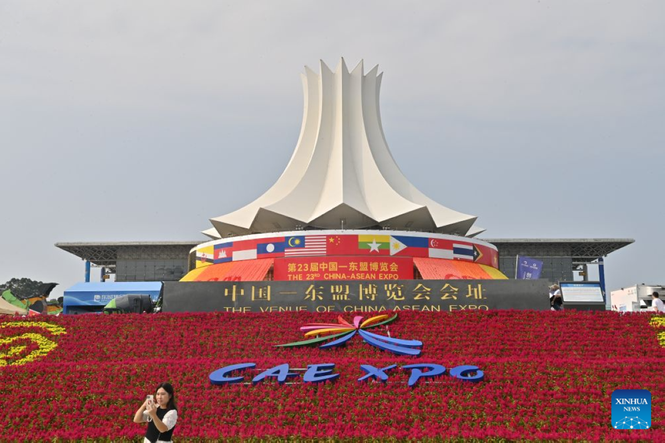
ARTIFICIAL intelligence (AI)-related products – including smart glasses that can provide real-time translation in over 40 languages – have taken center stage at the 23rd China-Association of Southeast Asian Nations (Asean) Expo in Nanning, south China’s Guangxi Zhuang Autonomous Region, that ran on Sept. 17 to 21, 2026.
The expo attracted more than 3,400 companies from China, the Asean region and beyond.
Vietnamese visitor Doan Minh Thao, who got interested in an AI-powered eyewear that can provide real-time translation in over 40 languages, including Vietnamese, which was developed by a Chinese company, managed to have unimpeded verbal communication with exhibitors at the venue.
From concept to real business
“Last year, AI was mostly for show. This year, it is driving sales,” said Wang Jicai, secretary-general of the China-Asean Expo Secretariat.
In exhibition halls situated in the downtown area of this southern Chinese city, embodied AI robots, exoskeleton medical equipment and AI-enabled wearables attracted crowds of curious visitors, while unattended coffee booths and ice cream stands served customers with nimble robotic arms.
As some companies displayed fancy hardware at the expo, others showcased AI-driven systems for sectors ranging from finance, healthcare, transportation and agriculture to production management and water treatment.
China and Asean, trading partners that saw bilateral trade volume top $1 trillion in 2025, have been organizing this major trade and investment event for more than two decades.
For this year’s edition, special emphasis was placed on the AI sector.
According to organizers, the cxpo’s “AI marketplace” featured about 500 products from more than 70 companies, allowing visitors to test and buy products on-site.
Meanwhile a China-Asean AI application cooperation center has cataloged more than 1,000 potential AI scenarios, set up offices in Vietnam, Laos and Malaysia, and backed over 30 cross-border projects.
AI enables broader cooperation
“What inspires me most is seeing that AI is not limited to the technology sector. It can also serve as an enabler for education, healthcare, tourism, industry, public services, agriculture and the development of economic zones,” said Dyah Wahyu Ermawati, director of investment and integrated license services office of Indonesia’s East Java province.
China and Asean, already each other’s biggest trading partner, are seeking to strengthen and upgrade cooperation in a wide range of sectors.
The progress in digital technologies including AI has facilitated cooperation and enhanced efficiency.
In Laos and Cambodia, for example, a platform developed by local partners together with an enterprise from China’s Guangxi Zhuang Autonomous Region has started to use satellite imagery, drones and ground sensors to optimize tropical crop cultivation.
Apart from precision agriculture, cooperation in AI applications can also include fields like smart logistics, manufacturing automation, financial technology, urban management and cross-border e-commerce, according to exhibitors and seminar speakers at the Expo.
AI brings great opportunities
As China and Asean advance high-quality economic cooperation under the framework of the China-Asen Free Trade Area 3.0 Upgrade Protocol, signed in October 2025, AI has emerged as a new frontier for win-win cooperation.
During a China-Asean business and investment summit held on Sept. 17, a collection of case studies on China-Asean AI cooperation was released, showcasing a range of practical achievements.
The cases included 31 practical AI cooperation projects between China and Asean, covering all 11 Asean member states and sectors such as infrastructure, intelligent manufacturing and smart logistics.
“I think there’s a lot of optimism that we will be benefiting from this collaboration with AI,” Secretary-General of Asean Kao Kim Hourn said to reporters Thursday on the sidelines of the expo.
It is not only for the economic sector; it cuts across all sectors of the society, he said.
The secretary-general said there are great opportunities to capitalize on the potential of AI and the digital sector.
Regarding AI cooperation, he called for adequate rules and regulations and advised against stifling innovation and creativity.
Country of Honor
In Manila, on Sept. 17, a Filipino expert said the China-Asean Expo contributes to economic integration, innovation cooperation and shared prosperity between Asean countries and China
“The China-Asean Expo and the China-Asean Free Trade Area Version 3.0 present promising platforms for the Philippines to deepen economic ties with China,” Rowena Mendoza, manager of the Consumer Business Department at the Center for International Trade Expositions and Missions (Citem) of the Philippines, told Xinhua in an exclusive interview.
Designated as this year’s Country of Honor, the Philippines sent a delegation of 313 people, comprising 73 enterprises in sectors such as agrifood, home and fashion, personal care and tourism, to the expo, according to Citem.
The Philippines – with the theme “The Philippines is Programmed for Business and Growth” – showcased its tropical food such as durian, coconut and ube, among others, to the vast Chinese market, looking forward to increasing trade opportunities and economic activities with China.
“Hitting just several buyers and distributors would generate promising returns,” Mendoza said.
“The Philippines recognizes the transformative potential of AI, and we are eager to deepen cooperation with China, which is cutting-edge in the field,” she said, adding that China’s experience can contribute to industrial upgrade and human capacity building in the Philippines.
Cebu Province represented the country as the official Province of Charm.