ACCORDING to the World Health Organization, air pollution is the “single biggest environmental threat to human health.” Particle pollution exposure, says the United States Environmental Protection Agency (Usepa), can lead to premature death in people with heart and lung diseases; it can aggravate asthma and cause decreased lung function and non-fatal heart attacks. Particles “less than 2.5 micrometers in diameter, also known as fine particles or PM2.5, pose the greatest risk to health.”
Monitoring air pollution is therefore an important tool in protecting human health from exposure. Timely and accurate information helps citizens and decision-makers make decisions toward reducing exposure and protecting our own health and the health of vulnerable individuals.
In the Philippines, the Department of Environment and Natural Resources’ Environmental Management Bureau (EMB) is charged with monitoring outdoor or ambient air quality. Monitoring stations exist across the country and data is published on the web and social media. “The Air Quality Index (AQI)” — used by EMB to measure air quality — “is a tool used by (regulatory bodies) to relate air pollutant concentrations to health-based ambient air quality standards and communicating the information through color coding,” as explained by War on Waste Negros Oriental and GAIA in their report on air quality monitoring in Dumaguete City (2025).
There are six levels of air quality — from green, meaning good, to yellow, fair, to different levels of horror: orange, red, purple and brown. Brown means that the AQI value has crossed the 301 micrograms per cubic meter (μg/m3) of air threshold. This level of air pollution, according to the EMB, constitutes an emergency.
Metro Cebu was close to an emergency. At 1 a.m. of Sunday, Sept. 20, the AQI value for PM2.5 reached 296 μg/m3, a handful of micrograms from the emergency level threshold. It remained in the purple zone — acutely unhealthy — until 9 in the morning of Sept. 21, or more than 50 hours after the PM2.5 concentration first breached the acutely unhealthy threshold (201 μg/m3).
Breaking with its usual practice of only posting on its Facebook page air quality updates in connection with the AQI values recorded at 7 a.m., 11a.m. and 4 p.m., EMB-7 posted updates at 9:23 p.m. and 5:18 a.m. on Sept. 19 and 20, respectively. (Updates are usually posted about one hour and 20 minutes after the time of measurement.)
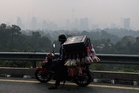
We were so close to reaching the emergency level of air pollution. Most of us were fast asleep at the time. Even when we woke up and saw the haze, many of us failed to understand the danger of exposure. The sight of the sun behind the haze curtain had an eerie beauty to it.
The public Emergency Alert and Warning Messages system sends out alerts in connection with natural disasters such as earthquakes, tsunamis, storm surges, heavy rainfall, tropical cyclones and volcanic eruptions, but not life-threatening air pollution. Would a 301+ AQI value in the early hours of Sept. 20 have triggered any kind of public warning?
EMB Central Visayas uses a Facebook account to reach the general public, but AQI updates are few and generally only made public in connection with the regular posting of 7 a.m., 11 a.m. and 4 p.m. levels. Hourly values can be found on a website — but usually they become available only when an official public (FB) update has been made. The recent deterioration of Metro Cebu’s air quality did not prompt EMB Central Visayas to increase the frequency of public updates.
EMB cannot do much about the pollution associated with the fires in Indonesia. But what is the purpose of monitoring air quality and then not making sure that the information reaches the public in general, vulnerable sectors and decision-makers in particular? Why is the data not released with dispatch and automatically, rather than a few times a day only? There are no public updates — despite the availability of the data as monitoring is continuous — through the EMB-7’s Facebook page between 4 p.m. the previous day and past 8 in the morning. By then, most people have left home for work and kids for school. For something as critical as air quality, time is of the essence. Is monitoring for compliance and reporting purposes only?
Knowledge is power. Making critical information available when it matters empowers the public. This should be the default setting for the government. Yes, there may be little that our government can do when air pollution is caused by fires in another country except warn us when the smoke is blowing our way. As for “local factors” — emissions from vehicles, factories, wear and tear of tires and roads, burning of garbage etc. — which have caused Metro Cebu’s latest unhealthy air, both LGUs and EMB could be more pro-active. And if they can’t do anything else, then at least give the public fair warning — continuous, round-the-clock updates communicated expeditiously and in a clear, concise manner, on the severity of the pollution, to give us a fighting chance against the menace of air pollution.