
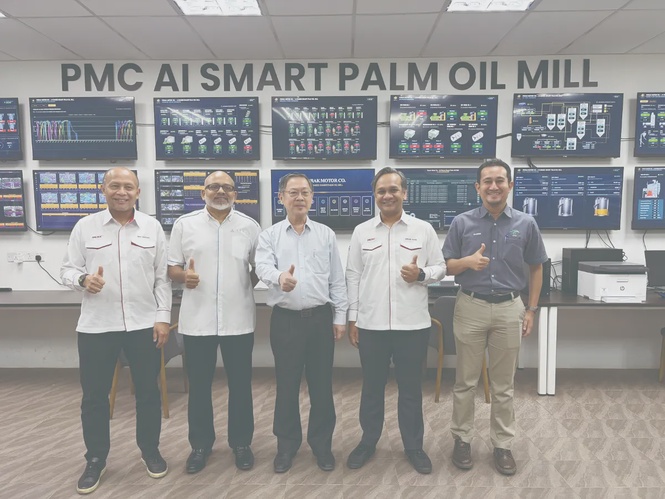
TELUK INTAN: AIREI Sdn Bhd has launched its second AI-based smart palm oil mill, extending the use of artificial intelligence (AI) in an industry where small gains in extraction and efficiency can have a large impact on returns.
The new deployment at Perak Motor Co (PMC Oil Mill) in Teluk Intan has a processing capacity of 60 tonnes of fresh fruit bunches an hour, up from the 45-tonne capacity of AIREI’s first AI-enabled mill.
The project also marks a new partnership with the Malaysia Digital Economy Corporation (MDEC), giving the initiative wider national significance.
Less than two years after AIREI introduced what it described as the world’s first AI-based smart palm oil mill, the company is now seeking to show that the technology can work at a larger scale and within existing mill operations.
For operators, the appeal is practical as the AI system monitors performance, detects production anomalies and helps keep processes within agreed operating parameters.
It is designed to reduce the inconsistency that can arise when decisions depend heavily on individual operator experience.
PMC Oil Mill said the system has improved the oil extraction rate (OER) by between 0.1% and 0.2%.
It also reported a 13% reduction in mesocarp oil losses on a wet basis at the press station.
Perak Motor palm oil mill division managing director Steven Yow Thin Chin said the results had shown that AI could contribute directly to the numbers that matter most to millers.
“At the end of the day, a mill is measured by its oil extraction rate, and this system has made a real, measurable difference on that front.
“It has eliminated human error and removed much of the guesswork that used to shape how we plan our operations,” he said.
AIREI said the technology has also helped the mill reduce its dependency on foreign operators.
Within the first month of implementation, reliance on foreign workers fell by 20%, with a reduction of up to 40% projected as operations become more established.
The system gives managers a centralised view of mill performance, helping them identify recurring operational issues faster.
Rather than requiring a mill to be rebuilt, AIREI said its technology can be integrated with existing equipment and workflows, a factor likely to matter to operators considering the cost and disruption of digital upgrades.
AIREI founder and CEO Surendran Kuranadan said the company’s first project was intended to test whether AI could function reliably under real mill conditions.
“When we first deployed this system, the goal was to prove that AI could work on a palm oil mill floor.
“We are now proving that it can scale. The system identifies anomalies, analyses their root causes and helps keep production within milling parameters, driving oil losses down,” he said.
MDEC CEO Anuar Fariz Fadzil said the project demonstrated the potential for locally developed technology to improve a strategic Malaysian industry.
“Palm oil is a strategic national commodity, and greater adoption of digital technology and AI can improve operational efficiency, optimise resources and deliver better production outcomes,” he said.
He said the deployment supported Malaysia Digital 2030, which aims to encourage home-grown innovation, create higher-value jobs and strengthen Malaysia’s ambition to become an AI-focused nation by 2030.
AIREI said interest in its model has emerged from palm oil markets beyond Malaysia, including Indonesia, Thailand, Mexico and Colombia.
The company estimates that mills can recover their investment within 18 to 20 months, depending on mill capacity and deployment scope.
Representatives from MDEC, the Malaysian Palm Oil Board, industry partners, and Universiti Tunku Abdul Rahman attended the launch.
Discussions included possible research collaboration and internship opportunities for students to gain exposure to artificial intelligence-driven mill operations.
For Malaysia’s palm oil industry, the Teluk Intan project may be an early indication of how artificial intelligence can move from experimental use into normal operations – not as a replacement for mill expertise, but as a tool to help operators make faster, more consistent and more profitable decisions.