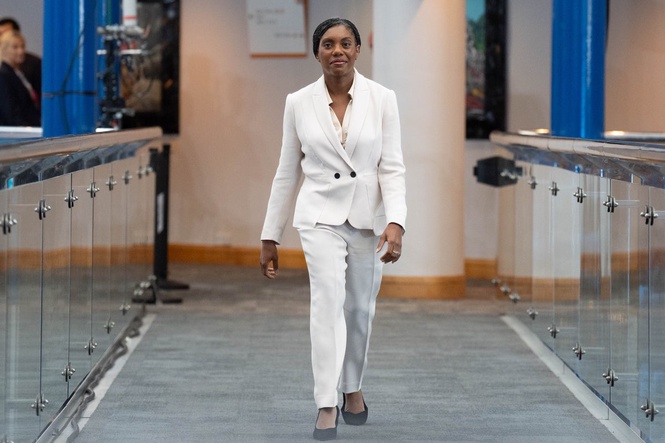
Kemi Badenoch’s ambition to build a missile defence system to protect the skies over the British Isles has sown some confusion.
A party press release excitedly likened it to Israel’s world-famous anti-missile defences used to shoot down hostile rockets and drones over its larger cities, describing it as “in essence, a British ‘iron dome’”.
An hour later, Ms Badenoch moved to clarify things. “We are not building the iron dome,” she said when interviewed about the new policy. She drew a distinction, sensibly enough, between the different threats faced by the United Kingdom and by Israel, and said: “We are designing something specific for the kind of threat that we face here.”
She – and her party’s spin doctors – want to give the impression that they plan to build something that will provide equivalent protection to that provided by the Israeli early-warning and anti-missile missile system. As Ronald Reagan discovered when he proposed a “Star Wars” system of missile defence to cover America in 1983, the idea of an impregnable defensive shield is popular with the citizens notionally protected. That technology remained science fiction, however, and the plan fizzled out.
It was only when the Israelis, under intermittent attack from relatively low-tech missiles from Gaza, Lebanon and more recently Iran, made the idea work – defending a territory one-quarter of one per cent of the area of the United States – that the idea recaptured the public imagination.
No wonder Donald Trump has revived the “Star Wars” idea for America, rebranding it the “Golden Dome”. And no wonder Ms Badenoch has tried to grab a slice of the headline-friendly action.
Unfortunately for her, the gimmickry fell apart almost instantly, as it emerged that what she was proposing was not £10bn a year but £10bn in total – £1bn a year for 10 years – against a rough estimate for a working “entry-level” system of £80bn. Her plan is more like a minor upgrade of existing radar and missile defence systems.
However, her attempt to provide clap lines for the Conservative Party conference in Birmingham does perform one valuable public service, in that it turns attention to the evasiveness of the new prime minister and his chancellor on the subject of defence spending.
Because the Conservatives have advocated spending 3 per cent of national income on defence by the end of the decade – a substantial real-terms increase on the current 2.6 per cent – Ms Badenoch is not under such pressure to say how she will pay for her “Britannia Shield”.
The funding for the 3 per cent pledge is not entirely convincing – it is to be paid for by savings from the welfare budget, including reinstating the two-child benefit cap, and by cuts to net-zero research – but if the pledge is funded, the “shield” can come out of that.
Andy Burnham, however, does not have the luxury of making sweeping promises in opposition. He has to decide. On the 3 per cent target, he decided to be undecided, and now it seems that he has decided to continue the indecision still further. He and John Healey were going to set out the “path to 3 per cent” in the spending review in the spring. It seems that this has now been deferred until later next year. At this rate, they will still be making up their minds in 2030.
Neither the government nor the official opposition, then, seems to be facing up to the challenge of paying for national security with the honesty, courage and leadership required. Ms Badenoch’s claim to fiscal responsibility has been seriously undermined by her refusal to back the prime minister’s change to the triple lock for uprating the state pension, which is essential to long-term credibility. Meanwhile, she seems intent on announcing yet more tax cuts without any plausible means of paying for them.
But at least her claim to provide an alternative to Mr Burnham’s government is more believable than that presented by Nigel Farage. He, too, has ducked the difficult choices on defence spending. So much so that he has not even appointed a defence spokesperson, while pretending that he thinks Mr Burnham might call an election at any moment.
The defence of the realm is too important to be left to such evasive, back-of-the-envelope politicking. All the party leaders need to step up to their responsibilities.
The UK’s growth and opportunity problems are two sides of the same failure
Why Kemi Badenoch is so wrong about Margaret Thatcher’s water company ‘success’
The Tories have found a blueprint they can sell to Britain
What made Trump pull his bombers out of Britain?
Time for Conservatives to say what it thinks on the economy and Brexit
It’s now time for the Tory party to say what it thinks on the economy and Brexit