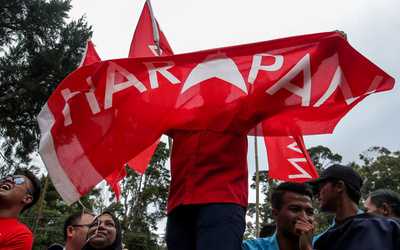
NOV 9 — As reported, a new chapter was indeed written in the country’s history books when 945 candidates from various parties submitted their nomination papers, it was the highest in election history to contest the 222 parliamentary seats in the 15th General Election (GE15). Based on the data displayed at the Media Centre of the Election Commission (EC) headquarters, a total of 441 candidates will also contest for 117 state seats in the GE15.
Under the Elections (Conduct of Elections) Regulation 1981, each constituency can nominate more than one candidate. The battle, as seen in Batu parliamentary seat, is the most crowded one with ten (10) candidates competing to become the people’s choice.
After the nomination day, as set by Election Commissioner, all parties will kick start their campaign process, which lasts for 14 days until the day of the election.
This is where the nominated candidates will meet and greet the people in their constituencies, to have more insights into the place they have been nominated for. Besides, this is the time when the parties and independent candidates will openly make promises. This is known as a manifesto.
A manifesto is a public declaration of policy and aims that is issued before an election by a political party or candidate.
However, there are certain rules that the candidates need to abide by, and any contravention of such rules is an offence under the Election Offences Act 1954, the Malaysian Anti-Corruption Commission Act 2009, and the Penal Code.
Under Section 4A of EOA 1954. it is an offence to promote feelings of ill or hostility. This was explained by Hafiz Hassan in his article . As such, any person who commits such an offence, is incapable of being registered or listed as an elector or voting at an election, or being elected at an election (S4A(2) of EOA 1954).
Moving on, there are limitations set to election campaigns, which falls under Section 24B. The candidate during his campaign period, (a) hold, and organize an open public meeting, open public rally or entertainment, or (b) give an open public address or open public lecture in the constituency in which the candidate seeks election, but he has to give notice to the police officers in charge of the district for him to hold such a campaign (S24B(3) EOA 1954)
Part III of the Act has a list of corrupt practices that are categorised as corrupt acts.
Section 8, of the EOA 1954,” treating“ states that offering any food, drink, or refreshment to the voters/ any persons constitutes an act that corruptly influences the person to give or refrain from giving his vote during an election.
Under Section 9 of the EOA 1954, “undue influence,” states that people who are threatened by any force, violence, or restraint by any other person directly or indirectly or against any person in order to induce or compel such person to vote or refrain from voting, is deemed to have interfered his right to vote freely.
Furthermore, under EOA 1954, Section 10 caters to bribery. Bribing a person, especially during the election takes many forms, and anything that leads to promises, money, gifts, loan procurement agreements, and more, that induces any person, or the vote of any elector is an offence.
Malaysia is yet to table the Political Funding Bill. As such, there is an absence of proper law that monitors the cash flow into each party or how the parties would fund themselves in the coming election. The public knows so little about how these elections are funded, and it is a stage for open corruption.
Having said that, under the law, each candidate can spend a maximum of RM200,000.00 for a Parliamentary seat, and for a State Assembly seat is up to RM150,000.00.
However, all expenses incurred by the candidate during the election must submit an audit report to the Election Commissioner within 8 weeks from the publication of the election result (Section 19 (1A) EOA 1954).
In short, it is the duty of the candidates to make sure that these laws are followed to avoid any issues as the ‘rakyat’ would then finally exercise their lawful rights as citizens to vote for the candidates that we believe could bring changes to Malaysia.
With that said, All the best!!
* This is the personal opinion of the writer or organisation and does not necessarily represent the views of Malay Mail.