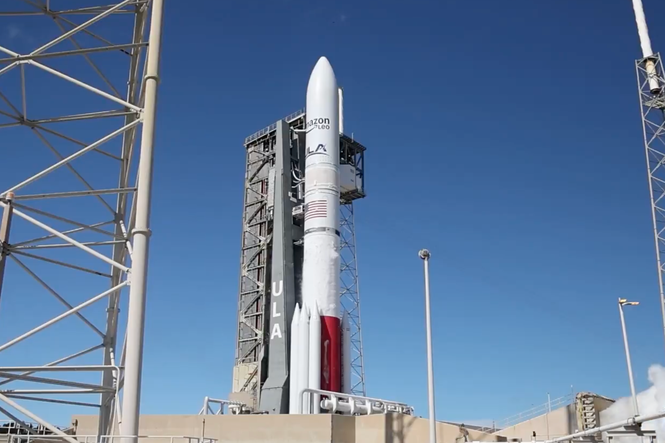
A Vulcan rocket owned by the Boeing-Lockheed firm United Launch Alliance failed shortly after lift-off on Sunday, destroying its payload of 40 satellites meant to form part of Amazon’s Leo internet network.
The rocket, LV-01, failed about 10 minutes into launch from the Cape Canaveral Space Force Station in Florida.
It is a setback to ULA, which is looking to regularly launch satellites for Amazon's internet constellation.
It was not immediately clear what caused the rocket’s failure, and a lengthy technical investigation was expected, which could keep the rocket off the market for months.
"Based on data received by our launch director, we confirm that the Vulcan vehicle launched from Space Launch Complex 41 suffered an anomaly 10 minutes into the flight and failed to deliver the Amazon mission to orbit," ULA said in a statement.
"Every flight generates data, and every flight teaches us something. Since the anomaly just occurred, we don't have any specific data yet to understand what occurred today.”
And LIFTOFF of the first Vulcan Amazon Leo mission, carrying 40 broadband satellites to low Earth orbit! pic.twitter.com/dv1MSjJUMF
The failure is also significant for Amazon, which wants to launch its satellites in a rocket specifically designed for the job.
Vulcan was slated to launch over 1,500 Amazon Leo satellites across 38 missions, more than any other rocket in the programme.
“Vulcan will launch close to half our first-generation constellation, making it our primary workhorse over the next several years, and we are looking forward to kicking off the sprint with our partners at ULA,” Amazon had said before the launch.
Amazon has been seeking third-party launch providers to deploy its satellites but many have had groundings and failures.
Earlier this year, Blue Origin’s New Glenn rocket exploded days before it was due to launch a batch of Leo satellites.
Such failures have held Amazon back while its rival SpaceX has over 11,000 satellites and millions of customers worldwide.
In comparison, Amazon runs only 396 operational satellites in low Earth orbit, which is about 12 per cent of the 3,236 satellites the tech giant needs for global service coverage.
"There is risk with any launch, and that's especially true for inaugural missions like LV-01,” Amazon said in a statement.
“ULA has been a trusted partner for Amazon, and we believe they'll learn from this mission and deliver on their long-term plans for Vulcan.”
Appreciate you quickly keeping the public and your partners informed. The team at @NASA is available to assist in all matters related to the investigation and remediation effort. Artemis, Moon Base, and the nation need ULA. We are in your corner and here to help. https://t.co/FzYcLudZs2
— NASA Administrator Jared Isaacman (@NASAAdmin) November 15, 2026
The incident poses a challenge to the overall US space launch industry amid the looming retirement of SpaceX’s Falcon 9, with Elon Musk’s company no longer accepting bookings for the rocket.
“We’ll work closely with our customer and other appropriate organisations to find the cause, determine the appropriate corrective action, and return to flight as quickly as possible,” ULA said.
SpaceX’s Starship returns to launch pad from orbit for first time
Starship launch today is ‘profound’ test for Nasa’s Moon mission
Elon Musk’s Starship may need 22 refuel missions to reach Moon
Rare star system is emitting radio signals at 8-minute intervals, scientists announce
Scientists want to send ‘swarms’ of robots to search for life on Mars
Single nuclear explosion in orbit enough to wipe out almost all satellites