
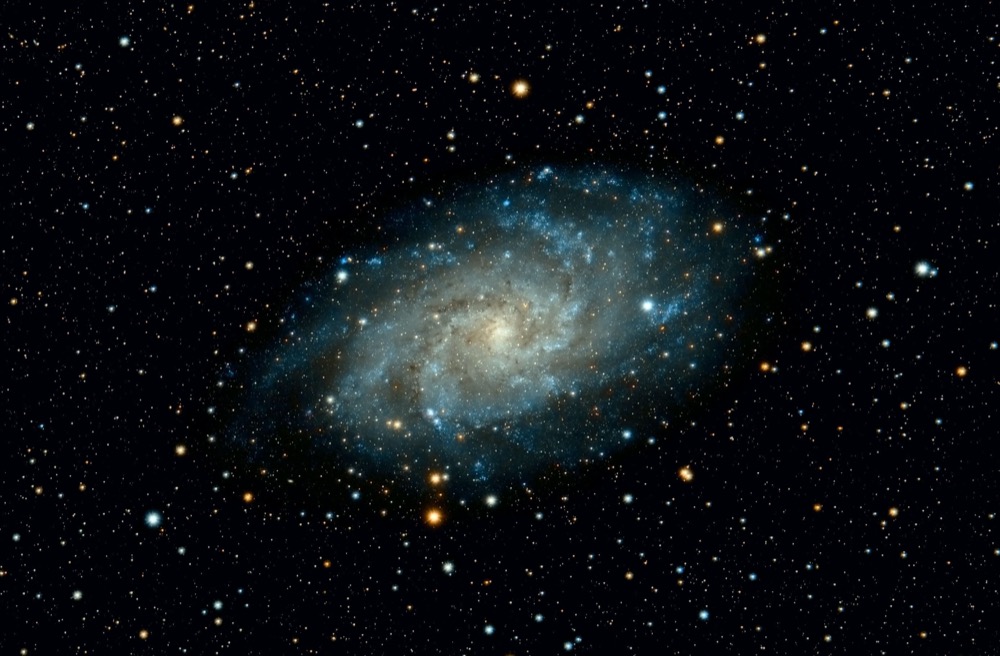
An amateur astronomer in Vermont has captured detailed images of theCroc’s Eye galaxy and the Whirlpool galaxy. The photographs are the result of dozens of hours of observations combined with careful image processing.
Astronomical imaging of galaxies requires patience, favorable weather, and specialized equipment. While professional observatories routinely study these objects, amateur astrophotographers continue to produce increasingly detailed views of deep-space targets through long-exposure imaging techniques.
That is precisely whatMichele Hernandez Bayliss achieved from her observatory in Weybridge, Vermont. A longtime visual astronomer who only recently turned to astrophotography, she spent the last two years building her observing facility before undertaking projects aimed at some of the night sky’s most recognizable galaxies.
20 Hours on the Croc’s Eye Galaxy
One of Michele Hernandez Bayliss‘s latest targets was Messier 94, often called the Croc’s Eye galaxy. Located in the constellation Canes Venatici, the spiral galaxy lies approximately 34 million light-years from the solar system. As explained by the NASA in a release:
“M94 was initially believed to be roughly 30,000 light-years in diameter, two faint spiral arms were recently discovered outside of its core region that extend far out into space. This discovery has effectively tripled the galaxy’s known diameter. M94 is also notable for its deficiency of dark matter relative to other galaxies.”
According to Space.com, the final image was assembled from around 20 hours of data collected through luminance, red, green, and blue filters. These observations were later combined into a single color image that reveals the cosmic structure’s bright nucleus and surrounding structure.
The project required more than simply gathering data. Bayliss explained that it appeared smaller than anticipated through her 990 mm telescope setup, creating additional challenges during image processing.
“The tricky part about galaxies is the processing — for the Croc eye, the challenge was that it was a lot smaller than I thought in my 990mm scope but I was able to crop in a bit,” she explained.
Capturing Every Layer of a Galaxy
Processing the Croc’s Eye galaxy involved overcoming significant contrast differences within the object itself. Its core is exceptionally bright compared with its outer regions, making it difficult to preserve details across the entire image. Bayliss explained that she used HDR compression techniques to better reveal the central area while maintaining the visibility of fainter structures. She also described taking particular care with the synthetic luminance channel created from the LRGB data.
Weather proved to be another challenge. Deep-sky imaging generally requires dark skies free from moonlight and cloud cover, conditions that are not always available in Vermont. As Bayliss said, obtaining two consecutive nights with clear skies, no moon, and no clouds was unusual.
“The other challenge is getting dark nights with no moon for galaxies and clear nights as we don’t get that many clear nights in Vermont — so it was awesome to get two nights in quick succession with no clouds, no moon and clear skies — a miracle!”
The Whirlpool Galaxy Through the Same Lens
Before photographing Messier 94, Bayliss focused her attention on another famous target: Messier 51, better known as the Whirlpool galaxy. The observations were carried out in February using RGB filters alongside hydrogen-alpha filters. As explained by the same source, the imaging campaign required a total of 16 hours of data collection before the final portrait could be assembled.
The completed image displays several defining characteristics of the Whirlpool galaxy, including a luminous central core, dark dust lanes, and bright regions where stars are forming. The structure visible in the photograph reflects why M51 is often classified as agrand-design spiral galaxy.
The image also includesNGC 5195, the smaller companion galaxy located near one of M51’s spiral arms. NASA noted that some astronomers believe that the Whirlpool galaxy’s prominent spiral pattern may be linked to a close encounter with NGC 5195 in the past.