
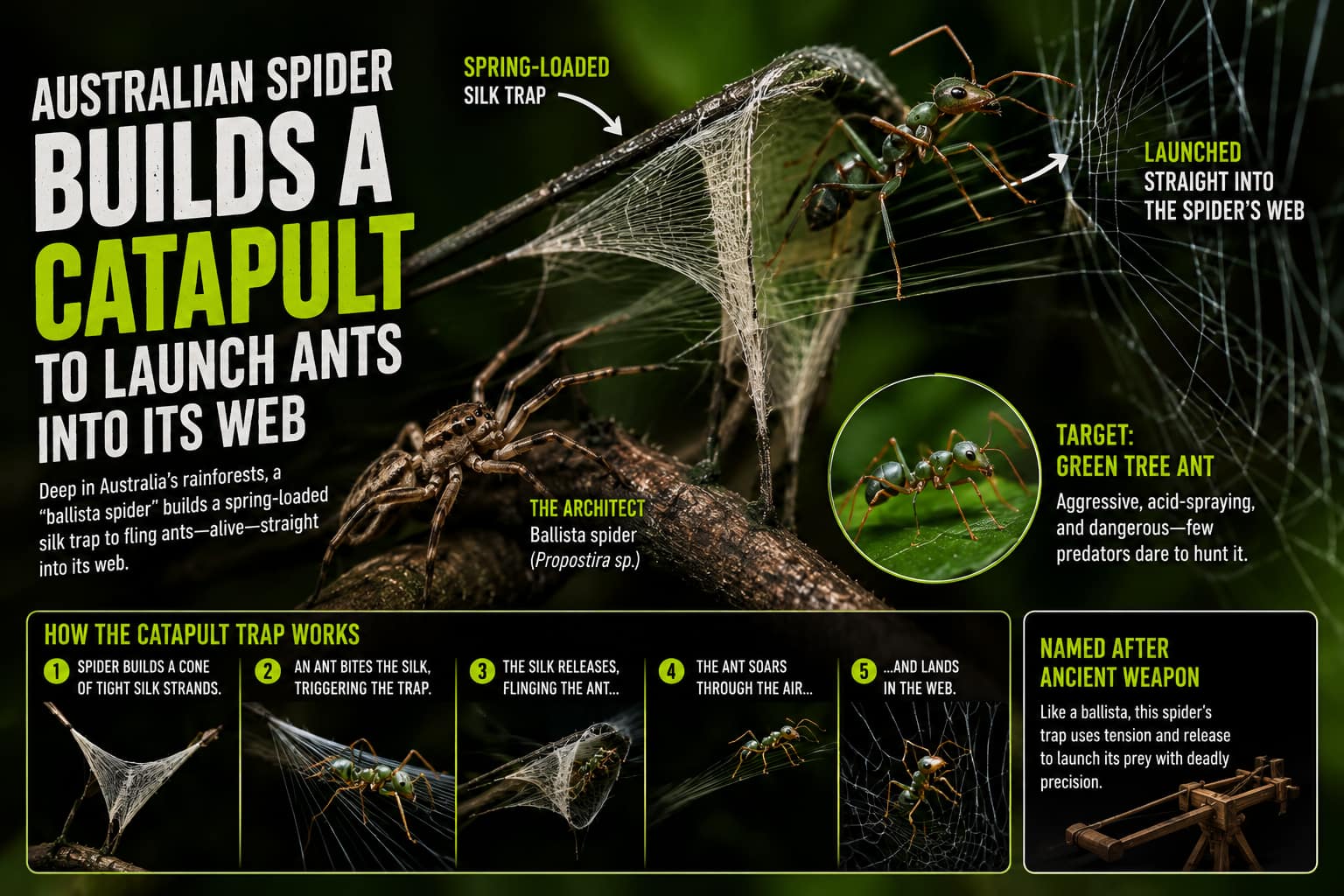
Deep in the rainforests of northern Queensland, a small nocturnal spider has developed what might be the most sophisticated hunting strategy ever documented in the animal kingdom. It builds a spring-loaded silk trap, waits for an ant to bite it, and then lets the trap launch the ant through the air and straight into its web.
The spider, nicknamed the "ballista spider" after the ancient Roman siege weapon, was first observed by spider taxonomist Greg Anderson in 2023. He returned with a research team, and their findings were published in Current Biology in June 2026. The spider belongs to the genus Propostira but has not yet been formally named as a species.
To hunt, the spider constructs a cone-shaped web out of dozens of tightly woven silk strands, then waits nearby. Its target is specifically the green tree ant, one of the most aggressive ant species in Australia. These ants have a painful bite, can spray acid into wounds, and call in reinforcements when threatened. Very few predators bother with them.
When a green tree ant bites the trap, the strands snap loose and fling the ant upward into the spider's main web. The researchers measured the snare's instantaneous power density at up to 11.73 megawatts per kilogram, which is three to four orders of magnitude higher than what muscles alone can produce. In some cases, the ants were launched at speeds exceeding 3,000 miles per hour.
The spider may also coat the trap with a chemical that specifically provokes the ant into attacking the silk, essentially tricking the prey into triggering its own capture. That theory has not been confirmed yet, but the researchers noted that the trap seems designed to catch only one species and is triggered entirely by the prey rather than the predator.
"This seems to be the only case where a spider's web is designed to catch a single prey species, and where the mechanism is triggered by the prey rather than by the predator," said Professor Ajay Narendra of Macquarie University, the lead researcher.
The trap is also remarkably durable. It can be reused multiple times without losing its structural integrity. And the spider builds it fresh every night.
What makes this even more impressive is the engineering itself. The silk trap is not a standard web. It is a purpose-built mechanism with a specific release point. The spider constructs the cone from dozens of individual strands, each contributing to the stored tension. When the ant bites, the energy releases all at once, converting the ant's own aggression into the force that launches it into captivity. It is a trap that punishes the thing it catches for trying to fight back.
What's the coolest animal hunting technique you've ever heard of? This one's going to be hard to beat.
Ronny M (ronny76netstuff@gmail.com) is a content creator under the Newswav Creator programme, where you get to express yourself, be a citizen journalist, and at the same time monetize your content & reach millions of users on Newswav. Log in to creator.newswav.com and become a Newswav Creator now!
The User Content (as defined on Newswav Terms of Use) above including the views expressed and media (pictures, videos, citations etc) were submitted & posted by the author. Newswav is solely an aggregation platform that hosts the User Content. If you have any questions about the content, copyright or other issues of the work, please contact creator@newswav.com.