
In previous posts, I have written many times about Rafizi, Khairy, and Nurul Izzah.
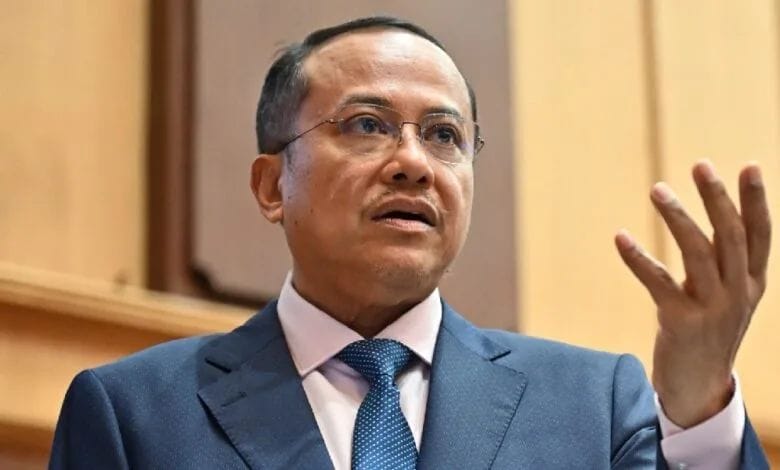
But about the fourth person in the quartet of politicians whom I believe will define the next generation of leadership in the post-Anwar era — Dr Ahmad Samsuri of PAS — I have not said anything until today.
That I have remained silent about Dr Sam until now is partly because he belongs to PAS, and non-Malays tend to be as averse to PAS as Malays are to DAP.
In reality, PAS’s challenge in reaching Putrajaya mirrors DAP’s challenge in becoming a ruling party: both parties command strong loyalty from segments of the population who feel their racial or religious identity is under threat, yet neither is broadly accepted as a party capable of governing the entire nation.
One of the ironies of Malaysia is that both Malays and non-Malays currently feel that their respective identities are under threat by the other, although neither believes that they are the ones that are threatening the other's identity.
That both the Malays and the non-Malays feel that their identity is being threatened is why PAS and DAP have become two of the largest political parties in the country — with PAS holding 43 parliamentary seats as the single largest party, and DAP close behind with 40 seats.
Yet despite the strong support PAS and DAP receive from their respective bases, both parties are also aware that they are not broadly seen as national governing parties. This is why neither has positioned itself as the ruling party of their respective coalitions, even when they are the strongest components within those coalitions.
That, however, may begin to change — at least for PAS — with the rise of Dr Ahmad Samsuri as a leading figure within Perikatan Nasional.
With Dr Sam at the helm of Perikatan Nasional, PAS could potentially evolve from being a party that Malay Muslims rely on primarily to defend identity, into a party that Malays can also view as a credible governing alternative for the country.
As for non-Malays, while it is unlikely that we would ever support PAS into power, under Dr Sam’s leadership of PN, we may become less resistant to the idea of PAS governing the country.
Let there be no doubt: non-Malays will never fully support PAS.
The aversion non-Malays have toward PAS is similar to the aversion Malays have toward DAP — it is identity-based, and therefore not entirely rational in political terms.
In other words, even if PAS were to field highly competent and exemplary candidates in future elections, a significant portion of non-Malays may still refuse to vote for them, because doing so would feel like you are insulting yourself.
However, PAS does not necessarily need substantial non-Malay support in order to take Putrajaya.
What it needs is sufficient Malay support, combined with a reduced level of non-Malay resistance, to form a viable path to victory.
In this sense, I see a parallel between Dr Ahmad Samsuri’s leadership of PAS and Narendra Modi’s leadership of the BJP in India.
The BJP is to Hinduism in India what PAS is to Islam in Malaysia.
Just as PAS seeks to turn Malaysia into an Islamic state, the BJP also seeks to turn India into a Hindu state.
Although India is approximately 80 percent Hindu, BJP has never enjoyed unanimous Hindu support, just as PAS does not command unanimous Muslim support in Malaysia, despite Malaysia having a 65 percent Muslim majority.
A significant reason for this is that ultra-conservative parties such as the BJP and PAS are often perceived not as vehicles of broad national progress, but as guardians of identity. They tend to gain support only when communal identity feels threatened and lose appeal when voters prioritise governance, development, and economic progress.
Historically, voters tend to favour more moderate parties when their identity feels secure, because moderates are often perceived as more effective in delivering development, progress, and prosperity.
This changed in India in 2014, when Narendra Modi was elevated as the leader of the BJP.
Modi, like Dr Sam, began his political rise as a chief minister of a state. And like Dr Sam during his tenure in Terengganu, Modi built a reputation in Gujarat for administrative efficiency and a strong emphasis on development and governance.
In the 2014 Indian general election, Muslim voters — the largest minority group in India and the traditional opponents of the BJP — had grown so disillusioned with the Congress Party, the BJP’s main rival and the ruling party at the time, due to its failure to govern, inability to stem communal tensions, and corruption scandals, that many either abstained from voting or shifted support toward smaller regional parties.
We can see parallels between what happened in India in 2014 and what is happening in Malaysia today.
In Malaysia today, non-Malays — traditionally opposed to PAS and Perikatan Nasional — have similarly become disillusioned with the ruling Pakatan Harapan due to perceived failures in governance, corruption scandals, and its inability to address issues surrounding race relations. This has led to growing openness toward smaller parties and regional blocs, including Sarawak and Sabah-based parties, as well as emerging political movements such as Rafizi’s Bersama.
In India, with increased support from Hindu voters who saw Modi as a figure capable of delivering development and progress, and reduced opposition from Muslim voters who were no longer unified behind Congress, the BJP secured victory in 2014, bringing Modi to power as Prime Minister.
In a similar way, if Malay-Muslim voters increasingly see Dr Sam as a leader capable of delivering governance, progress, and development, and if non-Malay opposition to PAS becomes more fragmented rather than unified behind a single alternative, then PAS — or Perikatan Nasional under PAS leadership — could plausibly win GE16.
As things stand, among Rafizi, Nurul Izzah, Khairy, and Dr Ahmad Samsuri, I believe Dr Sam currently has the strongest chance of becoming Malaysia’s first next generation next prime minister in the post-Anwar era.
Even if he does not become prime minister in GE16, I still think he remains the most strategically positioned among the next generation of political figures to eventually reach that office.
I am not saying this is something I personally support. I do not think there is any non-Malay who would naturally prefer a PAS-led federal government.
I am simply saying this because this is how I see the future unfold, regardless of personal preference, if current political trends continue.
TheRealNehruism (nehru.sathiamoorthy@gmail.com) is a content creator under the Newswav Creator programme, where you get to express yourself, be a citizen journalist, and at the same time monetize your content & reach millions of users on Newswav. Log in to creator.newswav.com and become a Newswav Creator now!
The User Content (as defined on Newswav Terms of Use) above including the views expressed and media (pictures, videos, citations etc) were submitted & posted by the author. Newswav is solely an aggregation platform that hosts the User Content. If you have any questions about the content, copyright or other issues of the work, please contact creator@newswav.com.