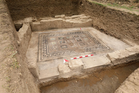
Archaeologists have unearthed a marble slab at Emperor Hadrian’s Villa in Tivoli, Italy, bearing engravings revering the Roman god of lightning.
The discovery sheds more light on ancient Roman rituals.
The slab was found still in the original position in which it was buried, in an area near the villa’s amphitheatre.
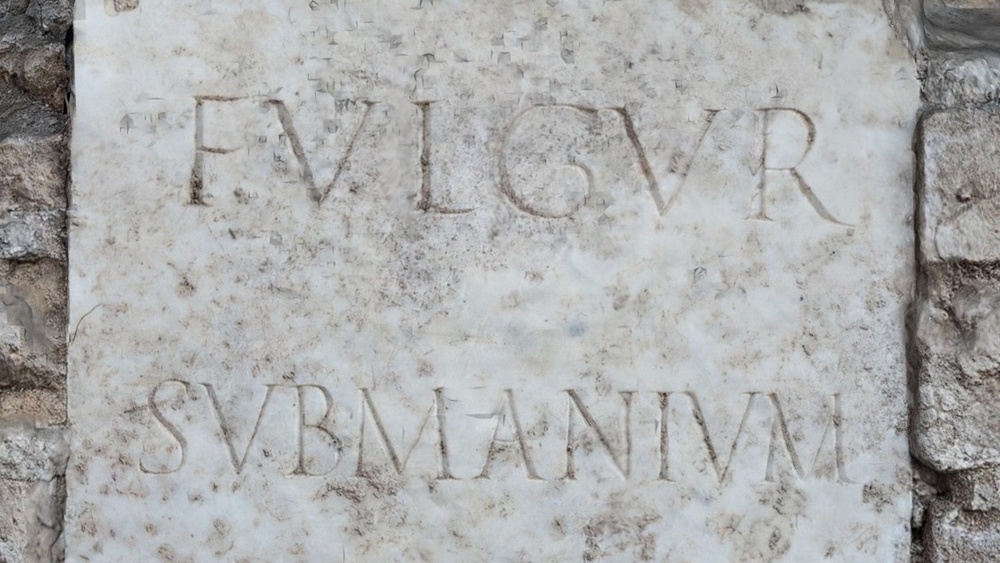
It bore the inscription “FVLGVR SVBMANIVM”, meaning Summano, the Roman deity of nocturnal lightning.
"The finding of the FVLGVR SVBMANIVM inscription, still preserved in its original position, is a data of exceptional importance,” said Fabio Giorgio Cavallero, director of the excavation.
“The discovery opens up new perspectives on the history of this sector of Villa Adriana and on the role of the fulgur conditum ritual in the reorganisation of spaces,” he said.
The slab could clarify the sequence that led to the transformations of the “entire monumental area”, Dr Cavallero added.
Researchers suspect the slab’s burial is connected to the Roman ritual sacralisation of the place struck by lightning.
In Roman times, places struck by lightning were considered religious, consecrated by the intervention of the divinity.
Materials struck by lightning were collected and buried underground as part of rituals.
"This discovery gives us a rare testimony of the extraordinary evocative force of Roman religiosity: the sign left by lightning and the rite through which the affected place was recognised as belonging to the divine sphere,” said Italian minister of culture, Alessandro Giuli.
“It is the ability of archaeology to give us back, through material traces, thoughts, rites and forms of the relationship with the divine. I thank the archaeologists of the University of Urbino and the Villa Adriana and Villa d'Este Institute for a discovery that expands the knowledge of one of the most extraordinary places of Italian heritage," he said.
The marble slab inscription also specifically identified the lightning as one that struck at night.
Ancient Roman sources routinely distinguished diurnal lightning, attributed to Jupiter, from nocturnal ones, traced back to Summano, god of the sky and night lightning.
The inscription's careful specificity and its burial suggest the lightning strike marked the divine entering human space, making the place religious and removing it from its ordinary condition.
“This discovery shifts attention from the great architecture to the most intimate sphere of Roman religiosity,” said Alberto Samonà, the director of Villa Adriana under the Italian ministry of culture.
“Finding the material sign of the sanctification of a place struck by lightning allows us to touch the meticulous ritual procedures of time,” Dr Samonà said.
Read MoreJudge accused of enabling immigrant to escape ICE gets a rare public reprimand
For these Midwest farmers, regenerative agriculture is about more than soil health. It's spiritual