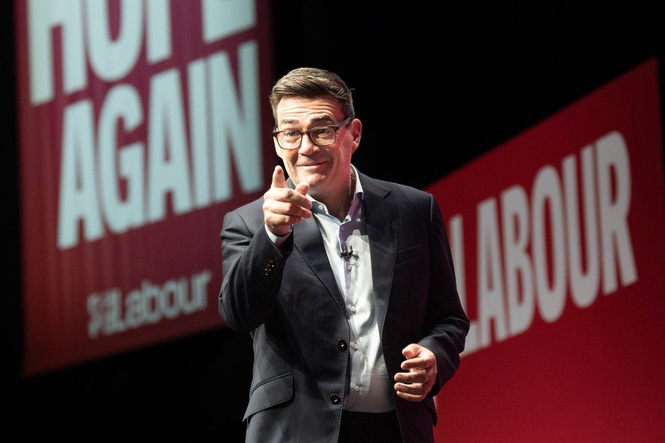
It’s been just 10 weeks since he became prime minister, but in his first set-piece conference speech as Labour leader, Andy Burnham wanted the party and the country to know its origins went back much further.
To his working-class background, right there, in Liverpool. To securing the education his parents were denied, to his disillusion with Westminster, to the transformation under his watch of Manchester, to the recent death of his father. The landmarks of his life were all there, and more.
He deployed them skilfully and, at times, emotionally, to issue an intensely personal tour de force, pleading to the nation to combine – “All together now” – to rewire the country and make far-reaching reforms, to produce a better future in every postcode, for everybody.
He stopped short of proclaiming a national emergency, but in laying out several of the deep-rooted problems that Britain faces and in pledging his determination to wrest change, Mr Burnham seized on the pivotal landmarks in British and Labour post-war history – in 1945, 1964, 1997 and now.
In terms of practical vision, he promised a National Care Service, an “NCS” following Labour’s delivery of the NHS; the end of right-to-buy for new council houses; public ownership of water companies that fail; a new Great Britain Grid to invest in electricity; removal of VAT from electricity bills, starting this week; a more pragmatic approach to the North Sea (code for recommencing drilling for fossil fuels); technical school qualifications; boosted apprenticeship scheme; better mental health care for the young; closer ties to the EU; electoral reform…
On it went, a veritable manifesto of one politician’s ideology and vision, introducing and planting himself as a relative outsider, as he said, a newcomer. Parts had been rehearsed before but, contained in one single blast, it made for a powerful and substantial whole.
That, in a sense, is what it was, the setting out of Labour’s manifesto for the next election, not due until 2029. It had the flavour of an electoral wishlist, appealing to voters to get behind him and Labour, and to return them to power. In that, too, he said he was aware not all he was pledging would appeal, just like a ballot where what determines the placing of the “X” is some policies, not every single one.
He wished it to be seen as a historical turning point, and it was. For that, he deserves huge praise. Gone was the pussy-footing, uncertain approach of his predecessor. This was big and bold, an authentic orator (“Honest” was his word) applying broad messages, with which it is difficult to disagree.
Britain is broke, let’s face it. “This country is not where we want it to be”. The arguing and pettiness must stop, as it is getting us nowhere. Nothing short of a new, national consensus is required.
Whether his opponents say so, of course, is an entirely different matter. Mr Burnham did invite them to join him in a spirit of renewal. They are unlikely to do so.
Predictably, already, they are sniping at his planned abolition of the pensions triple-lock to pay for the new NCS, ignoring his well-made argument that, while pensioners could be worse off from the abandonment of the formula, they will benefit from free care.
If there was a weakness with his address, it was this, which, as the setting out of his credo, very little of it can be delivered quickly. He was asking for belief, and for time, seeking trust to make these changes and others in the long term. That was brave, and for that, he does deserve credit.
But it is also dangerous. An awful lot can happen between now and the next election. As he himself pointed out, to laughter, he has been in No 10 longer than a recent predecessor, and he is acutely conscious of being the seventh premier in a decade.
To reach where he wishes to be, he must negotiate the present and the next two-plus years – unless he does go back on his word and calls an early election, perhaps out of frustration.
Should he do so, the Labour “prospectus”, as he termed it, is already half-written. There is the not inconsiderable matter of a weak economy and lack of public funding to deal with, and here, not unexpectedly, he offered no detail. How exactly he would achieve economic growth – a word not uttered once – to drive revenues, to pay for the beginning of his reshaping of a new-look Britain, was notably absent.
That, though, is for those politicos who indulge in point-scoring, not problem-solving, to use one of his repeated barbs. It is where he would like us to receive what he said and to see him, on a higher level, earnestly and creatively, installing a new belief in Britain. “Hope again”, as the party slogan puts it.
This was not, as Mr Burnham put it, the “usual tub-thumping speech” – nor was it about the “politics-as-usual that have taken the country backwards”. In that respect as well, it was refreshing.
He stuck to his no point-scoring theme, and did not single out Kemi Badenoch and Nigel Farage by name. But he put down a marker for each of them. The next election begins here – and they have a hard act to follow.
Read MoreThat was a big, brave speech from Andy Burnham – but he made one mistake